 Photo Wikimedia Commons
Contents
History & cultureBY TELLBY7 sections · numbered as on the map01 Orientation
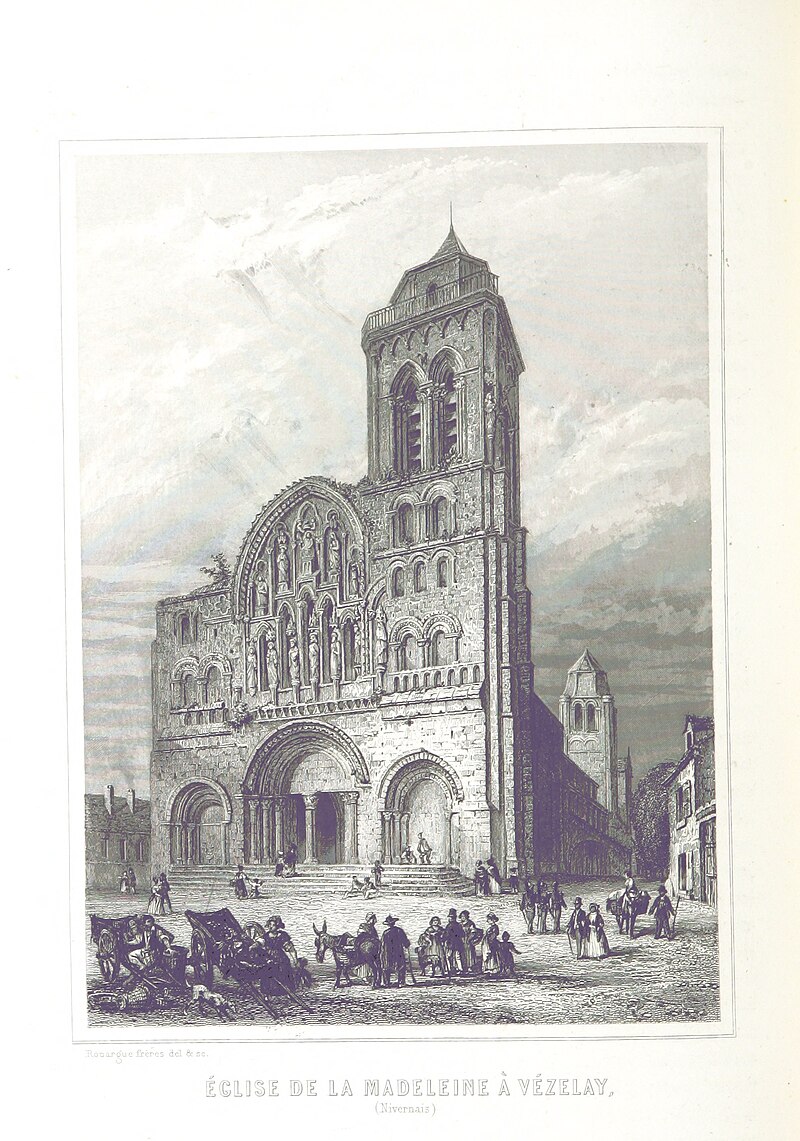
Welcome to Vézelay Abbey, a magnificent sanctuary standing atop a prominent hill in Burgundy. This revered monument is recognized as a UNESCO World Heritage site for its extraordinary role in medieval Christian pilgrimage and its monumental Romanesque architectural brilliance. The historical origins of this holy location extend back to around eight hundred fifty eight, when Count Gerard of Roussillon and his wife Bertha established a monastery for women at the foot of the hill along the Cure River. After being completely destroyed by raiding Normans in eight hundred seventy three, the community refounded itself in eight hundred seventy eight as a monastery for men at the very apex of the hill. Before the year ten hundred fifty, the monks proclaimed that they held the sacred relics of Saint Mary Magdalene, brought directly from the Holy Land. This announcement transformed Vézelay into one of the most vital pilgrimage centers in medieval Europe and a major starting point for pilgrims embarking on the long journey along the route to Santiago de Compostela in Spain. The influx of devoted pilgrims brought immense wealth, but it also triggered fierce conflicts regarding monastic authority between the abbey, local nobles, and the townspeople. In eleven hundred twenty, on the eve of the Feast of Mary Magdalene, a devastating fire swept through the abbey church, tragically claiming the lives of more than one thousand pilgrims gathered inside. The dramatic portal and solemn architecture you behold today emerged directly from the passionate rebuilding campaign that followed that disaster. In eleven hundred thirty two, Pope Innocent the Second inaugurated the vast western narthex, an enclosed entrance porch designed specifically to accommodate the surging crowds and to serve as a sacred threshold separating the secular world from the holy interior. It was also from this hilltop in eleven hundred forty six that Bernard of Clairvaux preached the Second Crusade before King Louis the Seventh and an immense assembly of noble knights and common believers. As you stand before the entrance of the narthex, prepare to cross this historic threshold and enter a sanctuary where human craftsmanship meets cosmic order.
02 Central Narthex Tympanum: Christ, Rays, and the Magdalene
Step closer to the central doorway inside the narthex and pause directly before the main portal. An astonishing historical fact regarding this Romanesque relief is that it originally featured a rare, three dimensional kneeling figure of Saint Mary Magdalene sculpted almost entirely in the round directly at the feet of Christ. …
03 The Four Quadrants: Neoplatonic Macrocosm and Elements
Examine the finely sculpted forms immediately surrounding Christ. A truly surprising aspect of this portal is that it incorporates a complex pagan Neoplatonic diagram of the physical cosmos, seamlessly weaving natural science into a Christian narrative of spiritual salvation. Monastic scholars at Vézelay utilized classical natural philosophy to demonstrate that physical creation itself participates in the divine plan of redemption. …
04 The Portal Lintel: Cornelius the Centurion and Monstrous Peoples
As you examine the long horizontal stone beam beneath Christ's feet, notice the crowded procession of diverse human figures. A truly remarkable numerical fact embedded in this scene is that the lintel and surrounding compartments contain exactly seventy two sculpted figures. This precise figure corresponds to the medieval calculation derived from the Table of Nations in Genesis chapter ten, which enumerated the seventy two distinct nations that populated the earth through the three sons of Noah…
05 The Archivolt: The Zodiac Cycle and Solstice Zenith
Look up at the sweeping semicircular stone arch framing the central relief portal. Vézelay Abbey represents a landmark milestone in Western European art history, as it contains the very first cyclical arrangement of the signs of the zodiac integrated with the labors of the months ever carved onto a monumental church portal. …
06 The Basilica Nave: Summer Solstice Light Alignment
As you pass through the narthex doorway, step into the expansive nave and stop at the head of the central aisle. An extraordinary astronomical alignment was discovered inside this nave in nineteen seventy six by Father Hugues Delautre. He revealed that every year at local noon during the summer solstice in late June, sunlight streaming through the southern clerestory windows projects a series of glowing circular spots aligned precisely down the exact longitudinal center line of the nave floor. …
07 Closing
As you conclude your audio guide journey through Vézelay Abbey, pause to quietly reflect upon the profound synthesis of sacred art, cosmic order, and human faith embodied within this extraordinary monument. Through its masterfully orchestrated program of relief sculptures, the narthex portal transformed complex theological doctrines into an accessible visual map of spiritual salvation for medieval pilgrims. …