Contents
History & cultureBY TELLBY7 sections · numbered as on the map01 Orientation
Welcome to Golestan Palace, the extraordinary former royal complex of the Qajar dynasty located in the historic heart of Tehran. Standing as one of the oldest monument ensembles in the Iranian capital, Golestan Palace exemplifies a remarkable architectural synthesis, seamlessly blending traditional Persian artistic craftsmanship with nineteenth century European design influences. In recognition of its outstanding universal cultural value, the complex was officially inscribed as a UNESCO World Heritage Site in two thousand thirteen during the thirty seventh session of the World Heritage Committee. The designated world heritage site encompasses a core protected area of five point three hectares surrounded by an extensive buffer zone of twenty six point two hectares. The historical origin of this royal citadel traces back to July six, fourteen zero four, when Ruy Gonzalez de Clavijo, the Spanish envoy of King Henry the Third of Castile, journeyed to Samarkand to meet Timur and stayed at the residence of Baba Sheikh within the citadel area. The defensive citadel itself was substantially fortified during the reign of Shah Tahmasp the First of the Safavid dynasty, while Shah Abbas the Great subsequently constructed a vast walled garden featuring a grand royal residence. During the later Safavid period under Suleiman the First and Soltan Hoseyn, palatial structures expanded in the Chenaristan area, where Soltan Hoseyn received the Ottoman ambassador Ahmad Dari Effendi in his final regnal year. Following restorative enhancements under Karim Khan of the Zand dynasty, Agha Mohammad Khan of the Qajar dynasty designated Tehran as his imperial capital in seventeen eighty five, establishing Golestan Palace as the official seat of Qajar power and government administration. In eighteen sixty five, the complex was extensively reconstructed into its present monumental form under the supervision of the master architect Haji Ab ol Hasan Mimar Navai. During the Pahlavi era from nineteen twenty five to nineteen seventy nine, the palace served as the premier setting for solemn state ceremonies and royal receptions, hosting the grand coronation of Reza Shah in nineteen twenty six, as well as the coronation of Mohammad Reza Shah and Shahbanu Farah in nineteen sixty seven. Although certain historic fortifications and structures were removed during twentieth century urban expansion, the complex endures as an opulent ensemble comprising eight major palatial buildings, seventeen historic museum halls, and three invaluable archives housing rare manuscripts, administrative documents, and an early photographic collection initiated by Naser al-Din Shah, where courtiers and palace servants playfully posed for early cameras. Visitors can also explore the white neo-baroque facade of Abyaz Palace, built to display magnificent gifts from Ottoman sultans. As you stroll along shaded pathways lined with serene water channels, prepare to embark on an unforgettable journey. Please proceed along the courtyard path toward our first stop, the Marble Throne Terrace known as Takht-e Marmar Iwan.
02 The Marble Throne Terrace
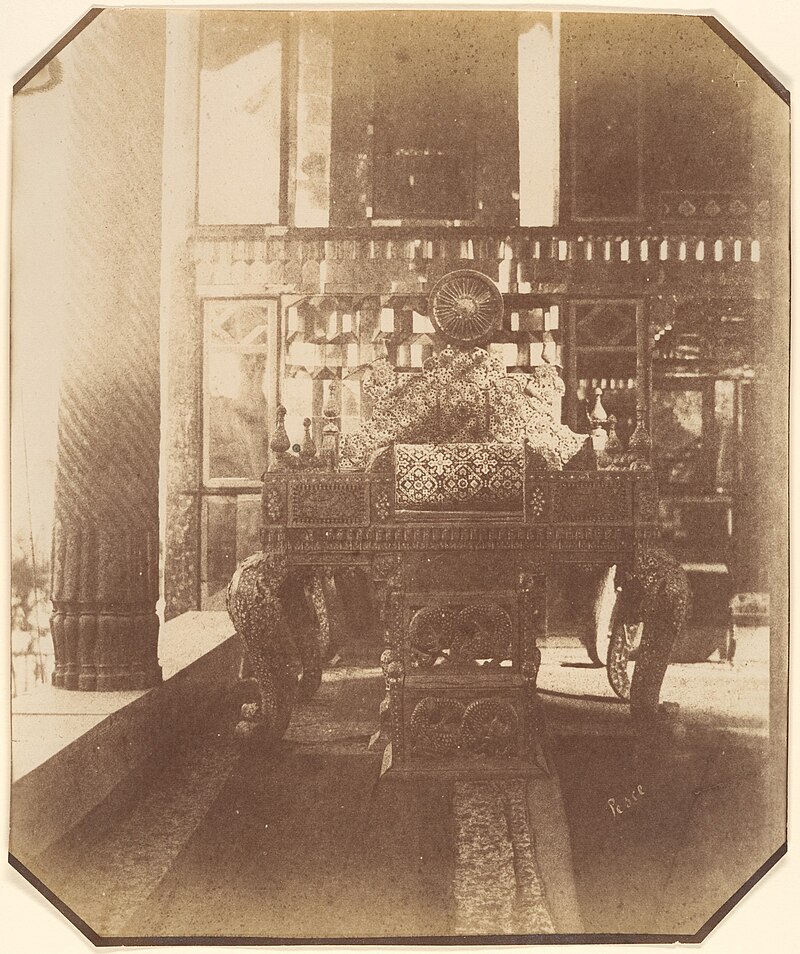
Standing majestically at the edge of the courtyard garden is the open air reception structure known as Takht-e Marmar Iwan, or the Marble Throne Terrace, representing one of the oldest and most historically significant architectural treasures within the Golestan Palace complex. Constructed between seventeen forty seven and seventeen fifty one during the mid eighteenth century, this grand elevated veranda was crafted using yellow marble elements quarried from the region of Yazd in central Iran. …
03 Karim Khani Nook
Nestled in a peaceful and shaded recess of the palace garden is Khalvat-e Karim Khani, or the Karim Khani Nook, an intimate open air pavilion whose name translates as the private retreat of Karim Khan. Constructing this secluded structure in seventeen fifty nine during the Zand dynasty, Karim Khan Zand intended it to serve as a quiet sanctuary within his residential quarters. …
04 The Mirror Hall
Stepping into the main palace building, you are immediately enveloped in a breathtaking spectacle of refracted light known as Talar-e Aineh, or the Mirror Hall. Designed by the distinguished royal architect Haj Abd ol Hossein Memar Bashi, also known as Sanie ol Molk, this hall is surprisingly intimate in scale compared to larger ceremonial reception rooms. …
05 The Windcatcher Mansion
Moving into the southern wing of the Golestan Palace complex, situated adjacent to the Diamond Hall known as Talar-e Almas, you are greeted by an extraordinary building crowned with four prominent towers known as Emarat-e Badgir, or the Windcatcher Mansion. Originally constructed during the reign of Fath-Ali Shah Qajar, this remarkable palace was engineered to overcome Tehran's blistering summer heat through an ingenious natural air conditioning system. …
06 Edifice of the Sun
Standing majestically at the eastern edge of the royal garden courtyard is the most iconic landmark of the Golestan Palace complex, the magnificent five-story tower known as Shams-ol-Emareh, or the Edifice of the Sun. Commissioned in eighteen sixty five by Naser al-Din Shah Qajar and designed by the distinguished royal architect Moayer ol Mamalek, this monumental structure was completed in eighteen sixty seven after two years of intensive construction. …
07 Closing
Thank you for joining us on this immersive audio guide exploration through the historic halls, quiet retreats, and shaded gardens of Golestan Palace. Beginning with the medieval citadel origins of Tehran and journeying through the majestic Marble Throne Terrace at Takht-e Marmar Iwan, the tranquil waters of Karim Khani Nook, the shimmering glass mosaics of the Mirror Hall, the natural cooling towers at Emarat-e Badgir, and the soaring clock tower of Shams-ol-Emareh, our tour has traced the…