 Photo Wikimedia Commons
Contents
History & cultureBY TELLBY7 sections · numbered as on the map01 Orientation
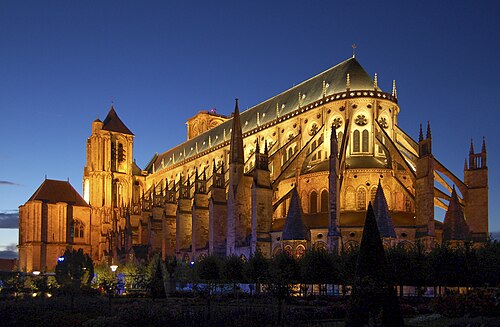
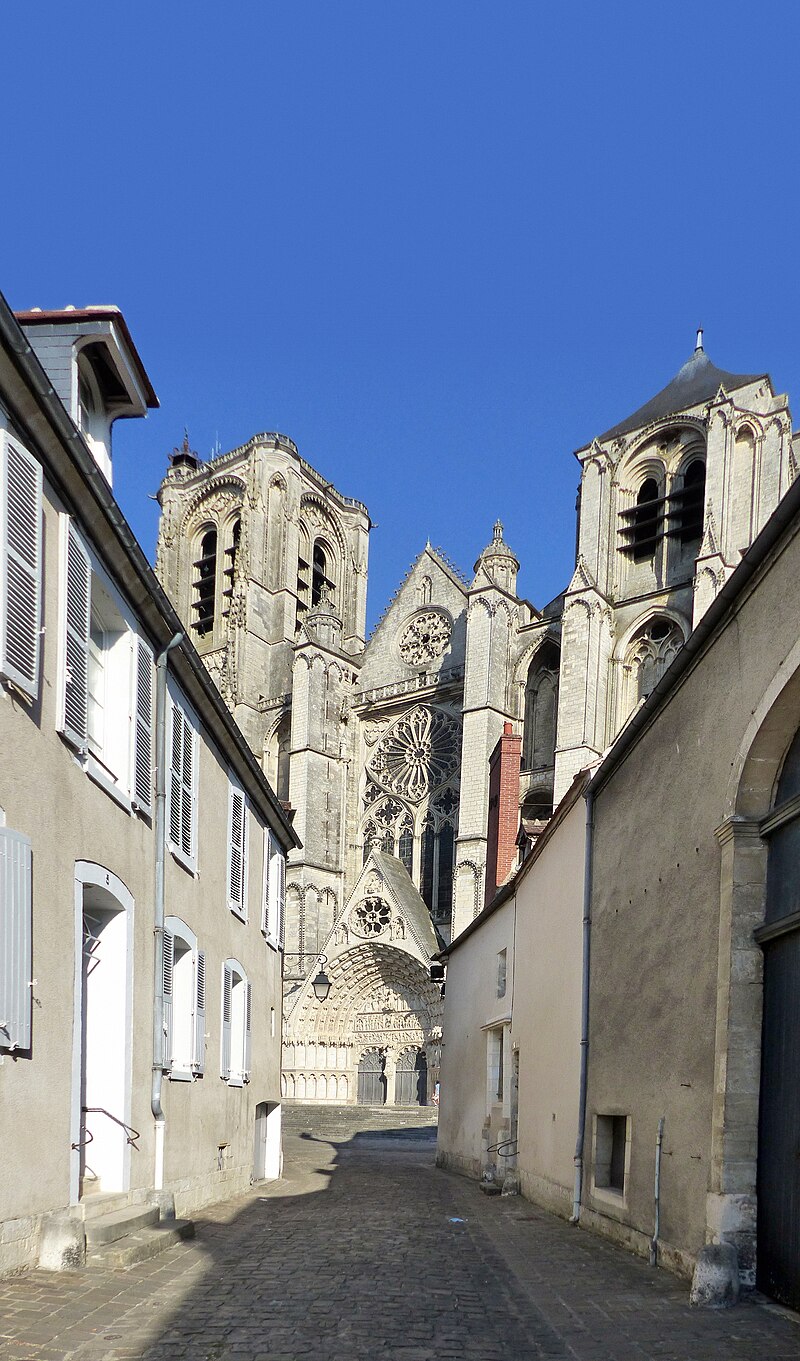
Welcome to Bourges, a historic city in the heart of the Berry region with a heritage stretching back over two millennia. This ancient settlement was originally known as Avaricum, the proud capital of the Gallic Bituriges tribe, which was dramatically besieged and conquered by Julius Caesar in fifty-four BC. Following the arrival of Saint Ursinus around three hundred AD, who introduced Christianity to the region, Bourges developed into a vital spiritual center. Standing before you today is the Cathedral of Saint Stephen of Bourges, a supreme masterpiece of High Gothic architecture dedicated to the first Christian martyr. In recognition of its structural daring, artistic harmony, and grand scale, this sanctuary was inscribed as a UNESCO World Heritage Site. It also serves as a historic waypoint along the medieval pilgrimage routes of Santiago de Compostela across France. The foundation of this monumental cathedral began around eleven ninety-five under Archbishop Henri de Sully, who envisioned a majestic shrine to replace an earlier Romanesque cathedral that was no longer adequate for the growing crowds of pilgrims. Building on this specific site presented extraordinary engineering difficulties, as the chosen ground extended over the formidable Gallo-Roman defensive city walls, where the terrain plummeted downward by six meters toward the east. Undeterred by this steep gradient, medieval master masons devised a brilliant solution by erecting a massive lower church structure directly over the ramparts to serve as a solid terrace for the high chevet above. Beyond its religious purpose, this ambitious construction was a resounding statement of Capetian royal authority at the southern frontier of the French royal domain, projecting the supreme prestige of both the monarchy and the archdiocese. Our carefully curated walking tour today offers an immersive journey through stone, light, and medieval ingenuity. We begin here on the western exterior approach, marveling at the expansive facade with its five distinct portal entrances. Next, we will step through the central portal to experience the breathtaking interior nave, defined by its continuous one hundred eighteen meter axis uninterrupted by a transept. Walking along the side aisles, we will discover the intricate astronomical clock installed in fourteen twenty-four, an extraordinary monument of medieval mathematics. We will then proceed around the northern ambulatory to explore private family chapels, including the lavish chapel commissioned by the wealthy merchant Jacques Coeur with its exquisite fifteenth-century stained glass. Finally, we will descend into the lower church beneath the choir to inspect the grand white marble tomb effigy of Duke Jean de Berry and the remarkable geometric plans etched directly into the stone floor by thirteenth-century builders. Prepare to step back into the golden age of High Gothic creation.
02 The West Façade and Portals
As you stand before the towering west front of Bourges Cathedral, take a moment to absorb the astonishing horizontal breadth of this majestic stone facade. The first surprising historical fact that strikes every visitor is that this western facade spans an impressive fifty-five meters in width, featuring five distinct double-door portal entrances side by side. …
03 The Nave and Double Ambulatory
As you step through the main western portal into the central nave, you are immediately enveloped by an astonishing sense of uninterrupted space stretching far into the distance. The most surprising architectural fact defining Bourges Cathedral is its total lack of a transept, the transverse crossing arm found in virtually every other High Gothic cathedral of the medieval era. …
04 The Astronomical Clock
As you walk along the southern side aisle, you come face to face with a marvel of medieval science and craftsmanship: the Bourges Astronomical Clock. The most astonishing fact about this remarkable instrument is that it was originally installed in November fourteen twenty-four, making it one of the very oldest functioning precision astronomical clocks in all of France. …
05 Chapel of Jacques Cœur
Continuing along the outer northern ambulatory around the rear of the choir, we arrive at the exquisite Chapel of Jacques Coeur. The most surprising historical irony surrounding this chapel is that it was commissioned in fourteen forty-eight by Jacques Coeur, the wealthiest merchant in medieval Europe and official treasurer to King Charles Seventh. …
06 The Lower Church and Duke of Berry's Tomb
Descending the stone steps beneath the ambulatory, you enter the subterranean realm of the lower church, often referred to as the crypt. The most surprising engineering fact regarding this structure is that it was constructed around the year twelve hundred over a steep six-meter drop across the old Gallo-Roman city walls. …
07 Closing
As you step back out through the grand western portals and re-enter the charming streets of Bourges, take a final look up at the towering spires, sweeping flying buttresses, and expansive stone facade. Walking inside the Cathedral of Saint Stephen of Bourges has offered an unforgettable encounter with one of humanity greatest architectural triumphs. …