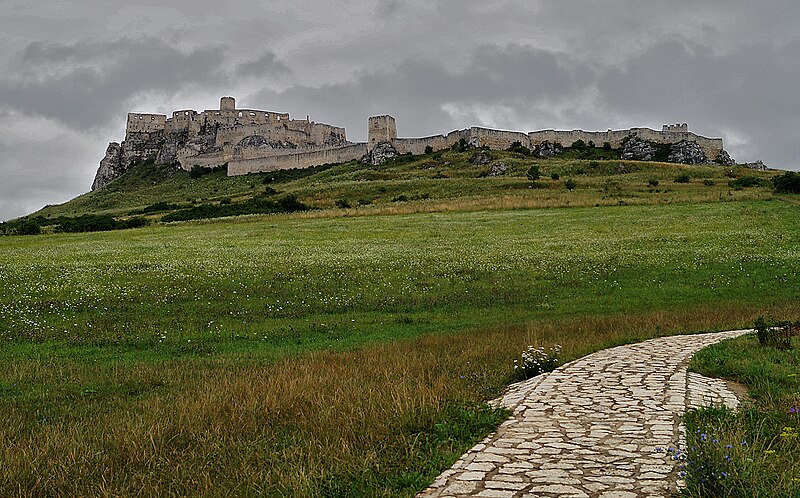
 Photo Wikimedia Commons
Contents
History & cultureBY TELLBY7 sections · numbered as on the map01 Orientation
Welcome to Spiš Castle, one of the most monumental and expansive medieval fortresses in all of Eastern Europe. Rising magnificently above the rolling hills and countryside of eastern Slovakia, the monumental stone complex before you encompasses an extraordinary area of nearly four hectares. Established in the early twelfth century as a strategic border outpost on the northern frontier of the Kingdom of Hungary, this formidable stronghold served for centuries as the primary political, administrative, military, and cultural center of the entire region. Perched atop a sheer travertine limestone cliff reaching six hundred and thirty-four meters above sea level, its natural position provided an impenetrable defensive vantage point that dominated the landscape.
This precipitous rock hill has offered a natural refuge for human settlement since antiquity, dating back over seven thousand years to the Neolithic period and the Bukk culture. During the first century before the Common Era, a Celtic tribe known as the Cotini established a thriving fortified center here, associated with the Púchov culture, where they minted silver coins and processed iron ore. Following the departure of early tribes, Slavic populations settled on the neighboring Dreveník plateau during the fifth and sixth centuries before eventually returning to reoccupy this imposing hilltop in the eleventh century, laying the physical foundations for the stone fortress you see today.
Spiš Castle was designated a UNESCO World Heritage site because it represents an exceptional and remarkably intact ensemble of medieval military, political, and religious architecture. Unlike many European strongholds that suffered total destruction or heavy modern alteration, this complex offers an undisturbed record of architectural evolution, seamlessly blending Romanesque solidity, Gothic elegance, and Renaissance sophistication. Together with the nearby historic town of Levoča, the ecclesiastical settlement of Spišská Kapitula, the village of Spišské Podhradie, and the surrounding cultural landscape, it forms an invaluable heritage treasure of international significance.
Our guided exploration today will lead you step by step through the vast lower courtyards, past intricate barbicans and defensive gates, and ultimate up to the ancient summit of the upper castle where the magnificent circular keep and noble palatial ruins reside. As you ascend along the ancient stone pathways, please remain mindful of the steep slopes and uneven footing. Let us now embark on this captivating journey into the distant past as we slowly move toward our first designated stopping point in the expansive lower courtyard.
02 Lower Courtyard and Jiskra's Fort
It is a truly astonishing historical fact that during the middle of the fifteenth century, an entirely independent and self-contained fortress within a fortress was constructed directly inside this massive lower courtyard. As you stand within this expansive open field, which constitutes the largest single enclosure of Spiš Castle, please direct your gaze toward the center of the courtyard. …
03 Middle Courtyard and the Barbican Gate
The middle courtyard and its sophisticated double-gate system, constructed during the fourteenth century, were ingeniously engineered to function as a lethal trap designed to funnel and annihilate invading forces. Look up at the massive stone walls and observe the curved defensive outer gate structure known as a barbican. …
04 Upper Castle and the Main Tower
It is an astonishing geological reality that the original twelfth-century circular tower built atop this limestone peak collapsed unexpectedly, not from enemy weaponry, but due to severe ground displacement caused by underlying tectonic shifts. Please look up at the towering circular stone keep that commands the highest pinnacle of the hill. …
05 Romanesque Palace and St. Elisabeth Chapel
In the late fifteenth century, this austere medieval fortress was transformed into a sophisticated noble palace where a future King of Hungary was born. Please direct your eyes toward the beautifully carved Gothic arched window frames and the consecrated altar space along the right wall. These impressive architectural remains belong to the two-story Romanesque palace and the Chapel of Saint Elisabeth, which was completed in the 1470s under the patronage of high nobility. …
06 Renaissance Arcade and the Great Fire
It is a striking historical paradox that this invincible fortress, which survived centuries of fierce military assaults, was reduced to a tragic ruin in a single day by a mysterious fire in the year 1780. Please look through the open arches of the arcaded hallway toward the breathtaking panorama of the surrounding countryside. …
07 Closing
Thank you for joining this comprehensive audio guide tour of Spiš Castle. We sincerely hope this journey through time—spanning prehistoric origins, Celtic settlements, formidable medieval keeps, and noble Renaissance palaces—has enriched your appreciation of this monumental heritage site. Inscribed on the UNESCO World Heritage list in 1993, this extraordinary stone complex stands as a glowing testament to the architectural brilliance, political drama, and enduring resilience of Eastern European…