 Photo Wikimedia Commons
Contents
History & cultureBY TELLBY8 sections · numbered as on the map01 Orientation
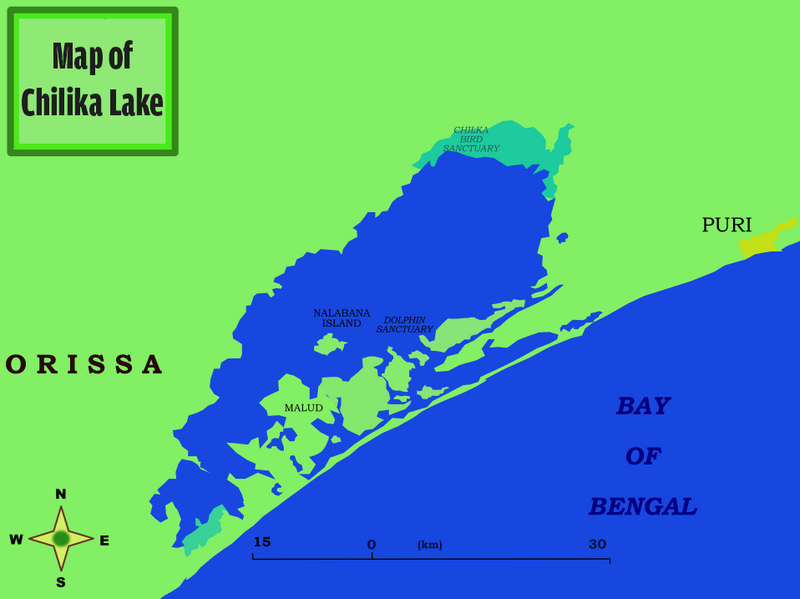
Welcome to Chilika Lake, the largest brackish water lagoon in Asia and the second largest coastal lagoon on Earth, stretched majestically across the coastal districts of Puri, Khordha, and Ganjam in the state of Odisha, India. This vast expanse of water is far more than a simple lake. Formed several thousand years ago through the dynamic meeting of ocean currents from the Bay of Bengal and freshwater rivers flowing down from the mainland, Chilika represents a living ecosystem of global importance. The overall scale of the lagoon shifts dramatically with the changing seasons. During the heavy rainfall of the monsoon season, the surface area expands to an astonishing one thousand one hundred sixty five square kilometers, creating a horizon that feels as boundless as the sea itself. In contrast, during the dry summer months, the water recedes to around nine hundred six square kilometers, exposing extensive mudflats and shallow wetlands that become a safe haven for wildlife. A long outer channel extending thirty two kilometers connects the main body of the lagoon to the Bay of Bengal near the village of Arakhukuda. The surrounding region experiences a tropical climate, with annual temperatures ranging from fourteen to thirty nine degrees Celsius and an average annual rainfall exceeding twelve hundred millimeters brought by the southwest and northeast monsoons. This ever changing environment is nourished by fifty two incoming rivers and streams, including the Daya and Bhargavi rivers, which deliver nutrient rich freshwater into the saline waters of the ocean. This continuous mixing creates a rich gradient of fresh, brackish, and marine habitats. However, this ecological paradise faced severe degradation during the nineteen nineties. Silt and sediment brought down by inland rivers accumulated at the outer channel, clogging the narrow mouth connecting the lagoon to the Bay of Bengal. As tidal exchange was disrupted, salinity levels within the lagoon dropped drastically, altering the natural environment. Aquatic weeds proliferated rapidly, biodiversity declined, and fish catches plummeted, devastating the livelihoods of more than two hundred thousand local fisherfolk. Recognized as a wetland under threat, Chilika was placed on the Montreux Record in nineteen ninety three. In response, the Chilika Development Authority executed a monumental restoration project. Based on extensive scientific modeling and consultations with local communities, a new mouth was artificially opened through the coastal sandbar in September two thousand, reconnecting Chilika directly with the ocean. The results were instantaneous and transformative. Saltwater flushed back into the lagoon, natural salinity gradients were restored, and invasive freshwater weeds receded. Fish, prawn, and crab populations surged to record levels. In recognition of this remarkable restoration, Chilika was awarded the prestigious Ramsar Wetland Conservation Award in two thousand two and became the very first site in Asia to be successfully removed from the Montreux Record. As you begin your journey today, listen closely to the soothing sound of the water and prepare to explore the timeless history and natural wonders of Chilika Lake.
02 Satapada and the Irrawaddy Dolphin Sanctuary
Welcome to Satapada, the vibrant coastal gateway situated along the outer channel where the brackish waters of Chilika Lake merge with the vast expanse of the Bay of Bengal. The name Satapada literally translates to a group of seven villages in the local Odia language, referencing the historic settlements that have long stood watch over these tranquil shores. …
03 Nalabana Bird Sanctuary Island
You are now observing Nalabana Island, an extraordinary avian sanctuary nestled in the very heart of Chilika Lake. In the regional Odia language, the name Nalabana translates directly to an island covered with weeds, a simple description that belies its immense ecological significance. Spanning an area of approximately fifteen point five three square kilometers, Nalabana undergoes a dramatic physical transformation driven by the rhythm of the seasonal monsoons. …
04 Kalijai Temple Island
Welcome to Kalijai Temple Island, a deeply revered spiritual sanctuary perched atop a rugged rocky island in the middle of Chilika Lake. Surrounded by shimmering blue waters and framed by the dramatic, rolling contours of the Eastern Ghats hill range and Ghantasila Hill in the distance, this sacred island is considered the cultural and spiritual heart of the entire lagoon. …
05 Manikapatna Historic Port Settlement
Welcome to the historic port settlement of Manikapatna, located along the narrow outer channel connecting Chilika Lake with the Bay of Bengal. This remarkably rich archaeological area stands as enduring testament to the glorious maritime heritage of the ancient Kalinga Empire and reflects a unique blending of diverse religious traditions. Local folklore often attributes the very origin of Chilika Lake to a dramatic fourth century legend involving a pirate king named Raktabahu. …
06 Rambha Bay and Scenic Southern Islands
Welcome to Rambha Bay and the scenic southern islands, situated at the serene southernmost extremity of Chilika Lake. Where the rugged, green foothills of the Eastern Ghats mountain range slope dramatically into the calm water, Rambha Bay presents what is indisputably the most picturesque and tranquil landscape across the entire lagoon. …
07 Balugaon Shore and Wetland Research Center
Welcome to the Balugaon Shore and Wetland Research Center, located along the bustling western perimeter of Chilika Lake. Serving as a crucial transport hub skirted by the South Eastern Railway line and National Highway connecting Kolkata and Chennai, Balugaon is the principal commercial landing port where the aquatic wealth of the lagoon is gathered and distributed. …
08 Closing
Thank you for joining us on this audio guide tour of Chilika Lake, Asia's largest brackish lagoon and one of the world's most inspirational ecological restoration success stories. The journey we have shared today reveals far more than stunning aquatic landscapes. It tells the moving story of how a delicate ecosystem, once severely degraded by environmental distress, was brought back to vibrant life through scientific ingenuity, political resolve, and the dedicated stewardship of local…