Contents
History & cultureBY TELLBY8 sections · numbered as on the map01 Orientation
Welcome to the historic Sidi Saiyyed Mosque, situated in the ancient heart of Ahmedabad near the iconic Bhadra Fort and Lal Darwaja. You are standing before one of the most distinguished and peaceful exemplars of Indo Islamic architecture, a sacred monument where extraordinary artistic mastery and profound spiritual devotion converge seamlessly. This revered mosque was constructed in the Islamic year 980 AH, corresponding to the years 1572 and 1573 of the Common Era, during the final reign of Sultan Shams ud din Muzaffar Shah III, the last ruler of the independent Gujarat Sultanate. Completed in the absolute twilight of the Sultanate just before Mughal imperial authority swept across the region, this structure stands as an irreplaceable testament to the artistic zenith of a vanishing era. Fixed upon the wall of the mosque is an authentic marble tablet that explicitly identifies the founder as Shaikh Sa id Al Habshi Sultani, widely and affectionately known throughout the city as Sidi Saiyyed. His biography is an inspiring historical journey of resilience, intellect, and nobility. Originally an Abyssinian Habshi youth brought to Gujarat from Yemen under the service of the Turkish general Rumi Khan, Sidi Saiyyed rose through the ranks of society through his exceptional capability and character. He subsequently served Sultan Mahmud III and later aligned with the Abyssinian military commander Jhujhar Khan, becoming a prominent nobleman in the royal court. In sixteenth century Gujarat, Abyssinian officers and soldiers frequently attained positions of high state authority, reflecting a unique culture of meritocratic mobility. Upon his retirement from military service, Jhujhar Khan granted Sidi Saiyyed a valuable landed estate known as a jagir, further cementing his wealth and social prominence. Over his remarkable career, Sidi Saiyyed built an extensive personal library to foster scholarship, managed over one hundred retainers, completed the holy Hajj pilgrimage to Mecca, and established a celebrated public kitchen known as a langar to feed the poor, weary travelers, and merchants passing through Ahmedabad. Prior to the present structure, a modest brick mosque occupied this site. Sidi Saiyyed personally financed and oversaw its transformation into a magnificent, permanent sanctuary carved from enduring yellow sandstone. When Sidi Saiyyed passed away in the year 1576, he was laid to rest immediately adjacent to the mosque he had nurtured with such profound devotion. His legendary ascent from an enslaved youth to a revered statesman, scholar, and philanthropist is carved into every stone of this sanctuary, offering timeless inspiration to every visitor.
02 Façade and Arcuated Sandstone Architecture
Please step backward slightly to a position where your gaze can fully encompass the main exterior façade of the mosque. As you observe this extraordinary elevation, you will notice that the entire structure is crafted from rich yellow sandstone, exhibiting a pure arcuated style of architecture that represents the absolute pinnacle of stone masonry in sixteenth century India. …
03 The Interior Prayer Hall
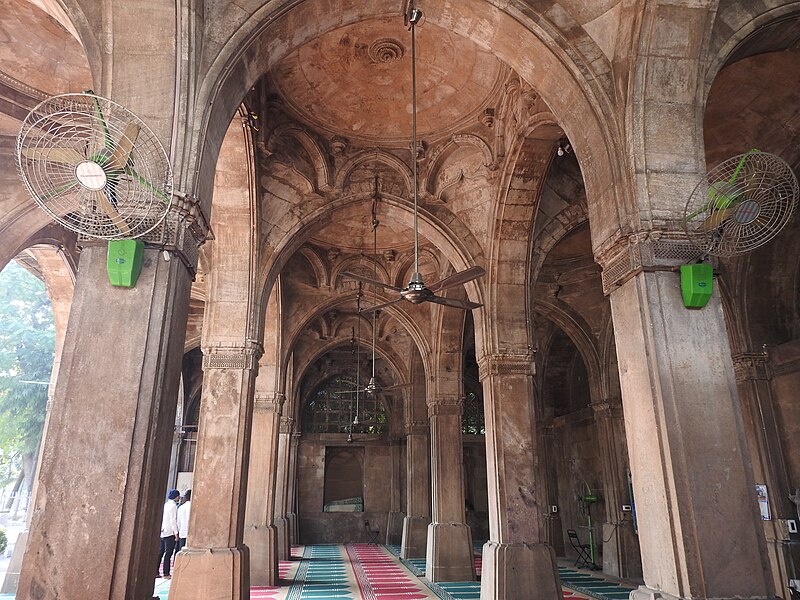
Now, please step inside the cool, sacred sanctuary of the interior prayer hall, leaving behind the heat and energetic activity of the surrounding city. As you cross the stone threshold into this quiet interior, pause near the central aisle leading toward the main prayer niche, or mihrab. You will immediately feel a profound shift in atmosphere, as if wrapped in a blanket of timeless tranquility and contemplative stillness. …
04 The Latticework Jalis and Geometric Patterns
Please walk toward the side and rear wall arches of the prayer hall to examine one of the true triumphs of global stonecraft. The Sidi Saiyyed Mosque owes its international renown primarily to its ten masterfully carved stone lattice windows, known in Gujarati as jalis. These jalis represent the ultimate refinement of pierced stone carving, a technique demanding unmatched patience, structural calculation, and artistic virtuosity. …
05 The Iconic Tree of Life Jali
Now, please guide your steps to stand directly in front of the crown jewel of the mosque and one of the world's most celebrated architectural masterpieces, the iconic Tree of Life jali. Located on the reticulated stone slab flanking the right side of the central aisle, this astonishing artwork spans an impressive width of sixteen feet, mesmerizing everyone who beholds its breathtaking detail. Take a moment to gaze in absolute wonder at this solid yellow sandstone carving. …
06 Mystery of the Blank Central Arch
Please direct your attention now to the central window arch situated along the primary wall of the interior prayer hall. As you observe this central bay, you will notice a striking visual anomaly. While the adjacent arches are filled with the world's most delicate stone jalis, this focal archway in the very center of the mosque is completely walled in with plain, unadorned sandstone blocks. …
07 Colonial History and Preservation
As you absorb the tranquil atmosphere of this sanctuary today, it is important to reflect upon the dramatic history of desecration and ultimate preservation that saved this monument for posterity. During the British colonial period in the nineteenth century, the sacred mosque was stripped of its religious role and repurposed for mundane administrative bureaucracy. …
08 Closing
This concludes our audio guide script tour of the historic Sidi Saiyyed Mosque. We extend our warmest gratitude to you for joining us on this exploration of architectural brilliance, historical syncretism, and spiritual devotion. Before leaving this sacred sanctuary, we invite you to linger for a quiet moment in the peaceful courtyard. …