 Photo Wikimedia Commons
Contents
History & cultureBY TELLBY7 sections · numbered as on the map01 Orientation
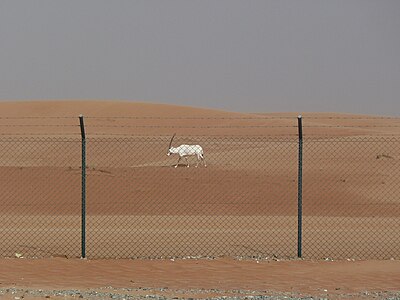
Welcome to the threshold of the Arabian Oryx Sanctuary, an extraordinary landscape situated between the central desert and coastal hills of the Sultanate of Oman. In nineteen ninety-four, this sacred ground was inscribed as a UNESCO World Heritage site in recognition of its monumental ecological significance as the first location in human history where the Arabian oryx, having been driven to total extinction in the wild, was successfully restored to its ancestral habitat. As you stand at this historic entrance, take a moment to pause and gaze directly ahead toward the vast, unbroken horizon. Feel the fine, windblown sand beneath your feet and listen closely to the deep, silent breeze sweeping across the arid Omani wilderness. Though this sun-drenched expanse may initially appear desolate and unforgiving, it harbors one of the most remarkable conservation triumphs ever achieved by mankind. The origin of this conservation miracle traces back to nineteen seventy-four, when Sultan Qaboos bin Said issued a historic royal decree to rescue the species from permanent disappearance. By nineteen seventy-two, relentless hunting had wiped out every single wild oryx across the Arabian Peninsula. Refusing to accept the permanent loss of this iconic white antelope, Sultan Qaboos bin Said established a specialized environmental authority under the royal court and launched an ambitious national restoration initiative. By gathering the few remaining individuals from international collections and fostering a rigorous captive breeding program, Oman laid the groundwork for an unprecedented ecological resurrection. Look closely at the dusty ground right beside the entrance marker board. There, clinging steadfastly to the parched earth, grows a single, delicate native desert plant. Even in an environment devoid of rain, this small plant draws life from invisible traces of moisture, offering a quiet yet powerful testament to the resilient spirit that defines all life in this sanctuary. Please prepare to step forward onto the sweeping Jiddat al-Harasis plain, where the legendary white herd now roams free.
02 Jiddat al-Harasis Plain
Welcome to the spectacular expanse of the Jiddat al-Harasis Plain, the iconic stage where a species once declared entirely extinct in the wild made a miraculous return to its ancient homeland. Position yourself facing the open plain and sweep your eyes slowly toward the far left horizon. There, gleaming like bright pearls against the sun-scorched gravel, you may observe a herd of Arabian oryx walking peacefully across the wilderness. …
03 Huqf Escarpment Lookout
Look up toward the sheer, rust-red rock walls rising dramatically to your right to discover a secret sanctuary where secretive carnivores and specialized desert reptiles thrive within narrow fissures. You are standing at the Huqf Escarpment Lookout, an imposing geological formation framing the eastern boundary of the central desert plains. Direct your eyes toward the deep shadows cast by the steep cliffs and rugged ravines. …
04 Oryx Reintroduction Center
Stand before the Oryx Reintroduction Center and reflect upon a sobering chapter in global conservation history, where a thriving population of four hundred and fifty Arabian oryx collapsed to just sixty-five individuals, leaving a mere four breeding pairs in the wild due to aggressive poaching and severe habitat destruction. Look directly at the heavy-duty metal enclosure fencing and the research facility situated behind the perimeter. …
05 Fog Oasis Flora Trail
Welcome to the Fog Oasis Flora Trail, where an astonishing network of one hundred and eighty-nine native plant species flourishes in an arid wilderness that receives virtually no annual rainfall. Lower your eyes to inspect the soil beneath your feet and observe the delicate foliage of the wide-canopied Ghaf trees casting broad shade across the path. Imagine standing here at dawn, as cool maritime winds carrying moisture from the Arabian Sea and Indian Ocean roll inland across the desert. …
06 Avian Observation Point
Welcome to the Avian Observation Point, where you will discover one of the most extraordinary parental survival adaptations in the natural world: a desert bird that flies up to seventy kilometers to soak its belly feathers in water so its chicks can drink back at the nest. Look outward through the observation screen toward the low bushes and open ground nesting sites swaying gently in the wind. …
07 Closing
Welcome to the final stop of our journey through the Arabian Oryx Sanctuary. Though this reserve experienced the painful loss of its UNESCO World Heritage status following boundary reductions and poaching crises, today the site continues a vital struggle for ecological recovery under Omani environmental authorities. …