 Photo Wikimedia Commons
Contents
History & cultureBY TELLBY7 sections · numbered as on the map01 Orientation
Welcome to the audio guide tour of Fort Saint Anthony, located in the historic coastal town of Axim along the western shores of Ghana. The site where you are standing today is a remarkably significant heritage landmark that overlooks the vast blue expanse of the Atlantic Ocean. In nineteen seventy-nine, UNESCO officially inscribed this fortification onto the World Heritage List as part of the collective entry titled Forts and Castles, Volta, Greater Accra, Central and Western Regions. This designation recognized the historic coastal structures scattered across Ghana as essential monuments of shared human memory and cultural heritage that must be preserved for future generations. Rather than navigating complex UNESCO criteria or formal academic classification numbers, we can simply understand this site as an extraordinary historical crossroad where the distinct destinies of Africa and Europe intertwined over several transformative centuries. The geography of this location is uniquely defined by its elevated position on a coastal hill, seamlessly enclosed by the rhythmic ocean waves, rolling green terrain, and the vibrant local architecture of Axim.
Our guided walking route will take you through a comprehensive exploration of the fort. We will begin at the main gate and outer wall, which offer commanding views of the coastline. From there, we will step into the central courtyard, a multi-functional space that has served as a center for both colonial administration and local community life. We will then proceed into the dedicated fort museum exhibition room, where historic trade artifacts and documents are preserved. After exploring the museum, we will ascend to the upper coastal artillery bastion to examine the historic defensive cannons facing the sea, before concluding at the southern outlook featuring the official UNESCO World Heritage marker. Fort Saint Anthony is far more than a static monument of stone and mortar. Throughout its long existence, it witnessed shifting commercial ambitions, colonial rivalry, and tragic maritime trade networks, while later adapting into a functional civic space for local governance and post office services after Ghana gained independence.
As you move along the stone pathways, take time to appreciate the weathered texture of the walls and the soothing ocean breeze that sweeps across the headland. The acoustic rhythm of the crashing Atlantic surf against the cliff face combined with the tactile warmth of the sunlit masonry creates an immersive setting for reflection. Every architectural contour and stone block carries the quiet echo of past generations who lived, worked, and passed through these massive gates. We invite you to explore this remarkable site with a thoughtful, receptive mind as we uncover the layered stories carved into the coastline of Axim. Let us now move forward to our first stop at the main entrance gate and outer wall.
02 Outer Walls Enduring Centuries
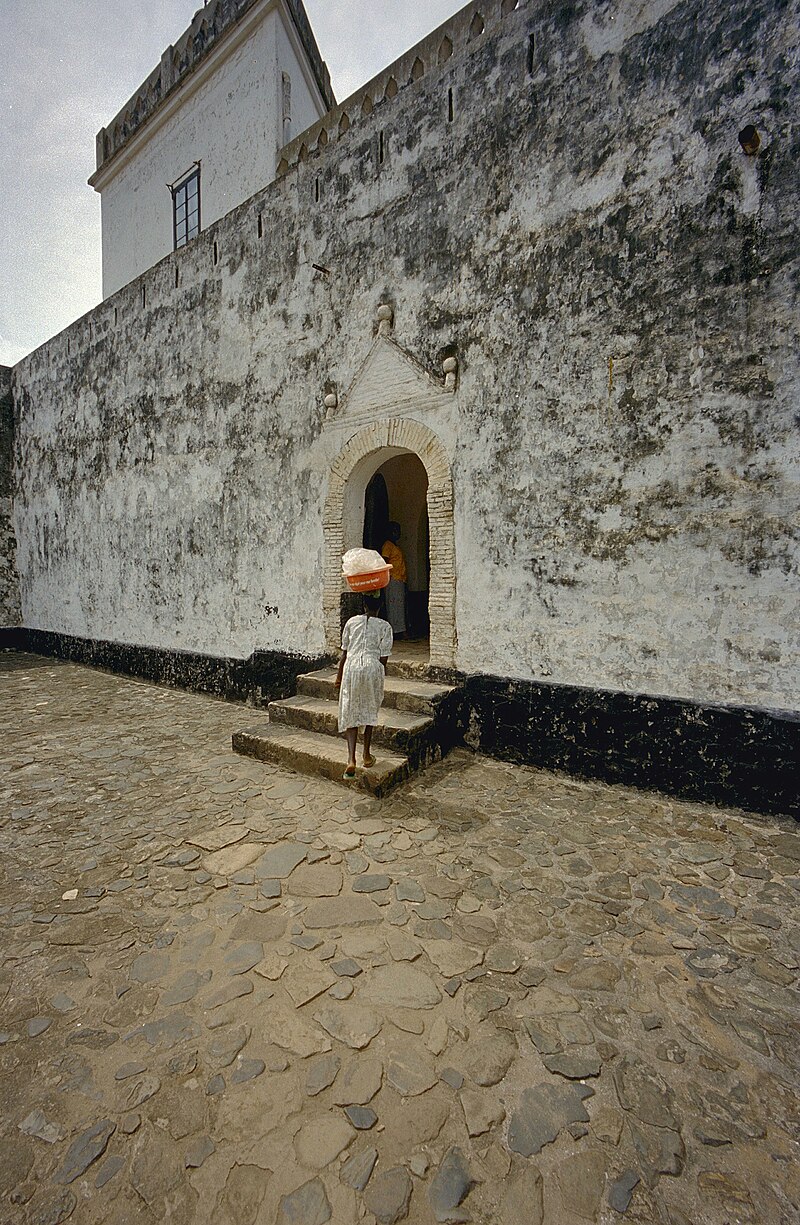
Welcome to the main gate and outer wall of Fort Saint Anthony. To begin our detailed examination of this remarkable site, consider a truly extraordinary historical reality regarding its heritage status. Fort Saint Anthony holds the distinguished position of being the second oldest European settlement and fortification in the entire nation of Ghana, preceded only by the famous Elmina Castle. …
03 Courtyard of Local Governance and Life
Welcome as we step into the open space of the central courtyard inside Fort Saint Anthony. Standing in this central area, we encounter a fascinating historical contrast that reshapes our understanding of this monument. For centuries, this structure functioned as a stern, heavily defended maritime trade fortress designed for commercial exploitation and military control. …
04 Museum Exhibition Room
Welcome as we enter the fort museum exhibition room located just off the central courtyard. As we begin our walkthrough of this dedicated display space, consider an extraordinary comparative fact regarding Ghana's coastal monuments. According to extensive academic field surveys evaluating twenty-four prominent colonial forts and castles along the Ghanaian coastline, only six of these historic sites possess a formal, fully organized internal museum exhibition room, and Fort Saint Anthony is…
05 Defense Line Facing the Atlantic
Ascending the stone steps brings us to the upper coastal artillery bastion, offering an unfiltered vantage point over the Atlantic Ocean. Standing upon this elevated platform, we appreciate a fundamental structural characteristic of Fort Saint Anthony. This site boasts a classic coastal hill-fort architectural design perched strategically above the shoreline to effectively block maritime approaches. …
06 World Heritage Marker and View point
Welcome to the southern coastal outlook featuring the official UNESCO World Heritage marker. Standing at this memorable viewpoint, we discover an important operational fact regarding the heritage presentation of Fort Saint Anthony. Field research across Ghanaian fortification sites reveals that Fort Saint Anthony is one of the rare historical monuments that actually maintains an official, fully installed UNESCO World Heritage informational plaque and marker directly on site. …
07 Closing
As we gather near the shaded shelter by the exit, our audio guide tour of Fort Saint Anthony comes to a thoughtful conclusion. Throughout our walk today, we have explored the layered architectural spaces of this coastal stronghold, moving from the formidable outer walls and main gate into the central courtyard, through the museum exhibition room, up to the upper artillery bastion, and finally to the UNESCO World Heritage marker overlooking the Atlantic. …