 Photo Wikimedia Commons
Contents
History & cultureBY TELLBY7 sections · numbered as on the map01 Orientation
Welcome to St. George's Church, a celebrated masterpiece of Galician timber architecture and one of the most remarkable historical landmarks in Drohobych. Tucked away on a tranquil hill along Solomianska Street within a peaceful residential neighbourhood, this magnificent timber temple stands as a living testament to centuries of local faith and craftsmanship. In two thousand thirteen, UNESCO officially recognized its universal value by inscribing it onto the World Heritage list as part of the Wooden Tserkvas of the Carpathian Region in Poland and Ukraine, a collective listing comprising sixteen exceptional timber churches across the region. Without getting tangled in complex academic terminology or criteria numbers, the reason for its world heritage status is immediately clear to anyone who beholds it. The entire structure was erected using the iconic traditional Boyko building techniques without utilizing a single metal nail, relying instead on intricately jointed timber logs. Furthermore, its interior features a virtually complete ensemble of seventeenth-century wall paintings that cover every wooden surface from the floor to the soaring vaults, creating an artistic atmosphere of unparalleled preservation and spiritual depth.
Drohobych itself has a long and proud history tied intimately to salt extraction. Since the era of Kyivan Rus, the town flourished through the traditional boiling of natural brine, turning salt into its primary economic foundation. The church you are visiting today is carefully preserved as a key department of the Museum of Drohobych Region. Rooted in structural elements dating back to the late fifteenth and early sixteenth centuries, the building was later expanded and reassembled using timber transported from the nearby village of Nadiyiv, giving rise to the majestic three-story timber sanctuary that greets you today. Its three iconic wooden domes and the broad wraparound arcades encircling the lower structure provided both physical protection and spiritual comfort to generations of local residents.
Throughout this guided audio tour, we will explore the key spots of this sacred site, beginning with the protective external arcades, moving into the entrance narthex known as the babynets, walking beneath the vibrant hand-painted frescoes of the central nave, admiring the monumental five-tiered iconostasis with its carved grapevine motifs, and finishing at the standalone wooden bell tower standing proudly in the courtyard. The site functions as a dedicated museum, welcoming visitors from Tuesday through Sunday with seasonal opening hours. As you stand here today, take a moment to absorb the warm texture of the ancient timber that has weathered countless Carpatian winters. When you are ready, let us begin our journey by stepping toward our first stop, the outer wraparound arcades encircling the church structure.
02 Spot 1: The Protective Wraparound Arcades
The traditional Boyko architectural method, constructed without using a single metal nail and relying entirely on the precise interlocking of massive timber logs, stands as an absolute marvel of structural engineering that leaves every visitor awestruck. Look at the wide arcades with sturdy wooden pillars and sloped roofs that encircle the lower perimeter of the building. …
03 Spot 2: The Relocated Timber of Babynets
The astounding historical reality that essential structural components of this magnificent timber church were acquired in sixteen fifty-six using salt instead of metallic currency, then transported piece by piece on ox-drawn carts from a distant village, leaves modern visitors thoroughly spellbound. Look at the thick log walls of the babynets, the designated women's worship sanctuary directly connected to the entrance threshold. …
04 Spot 3: Wall Paintings and Floating Domes of the Nave
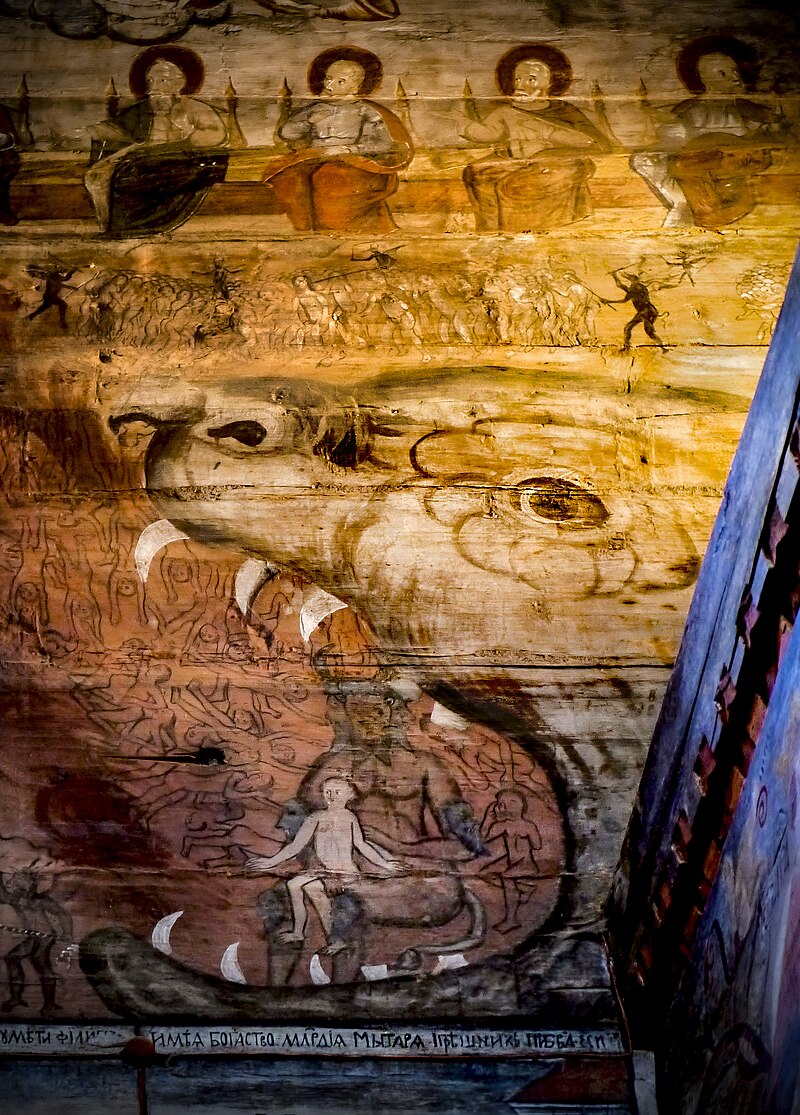
The breathtaking reality that every single inch of timber wall surface from the wooden floorboards to the highest octagonal dome vaults is continuously covered in brilliant seventeenth-century frescoes leaves every visitor completely spellbound. Raise your eyes high toward the soaring ceiling to observe the octagonal dome structures and the dramatic Last Judgment wall painting framing the nave space. …
05 Spot 4: The Masterpiece Five-Tiered Iconostasis
Rising majestically in five distinct tiers before the sanctuary altar, this monumental iconostasis represents the absolute pinnacle of handcrafted woodcarving art and sacred painting in the Galician region. Look closely at the grapevine vines carved three-dimensionally onto the wooden columns supporting the icon panels. …
06 Spot 5: The 1678 Wooden Bell Tower
Standing independently in the open courtyard adjacent to the main church, this imposing wooden bell tower built in sixteen seventy-eight has served for centuries as a historic sentinel, tolling its bells to signal community emergencies and joyful spiritual celebrations. Look at the courtyard square extending before the bell tower and the arched wooden windows on its upper story. …
07 Closing
Our audio guide tour of St. George's Church in Drohobych has now come to a gentle conclusion. Today, we have journeyed together through an exceptional architectural wonder erected without a single metal nail, retracing the moving history of sixteen fifty-six when townsfolk exchanged precious salt to bring this wooden sanctuary to Drohobych. …