Contents
History & cultureBY TELLBY7 sections · numbered as on the map01 Orientation
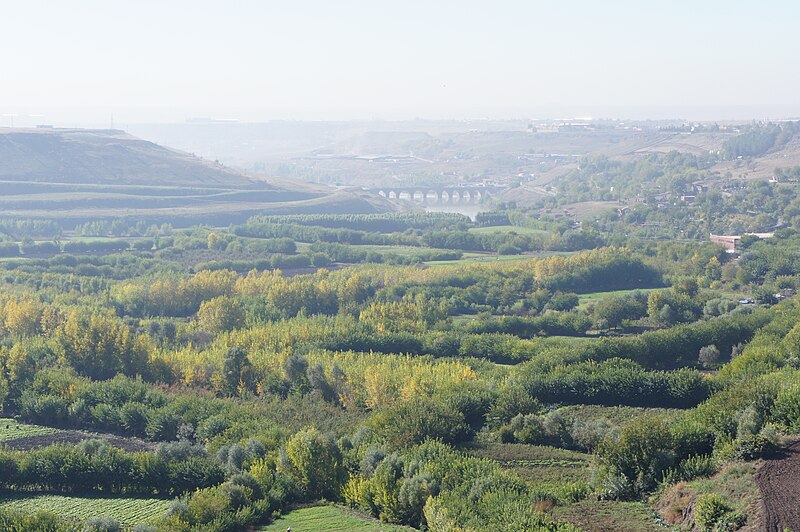
Standing high upon the dark basalt escarpment of Diyarbakir Fortress, a breathtaking vista unfolds before your eyes, stretching across the vast green floor of the Upper Tigris River Basin. Before you lie the historic Hevsel Gardens, a seven hundred hectare agricultural landscape nestled within the famed Fertile Crescent. For thousands of years, this lush expanse has served as a vital living link between the ancient fortified city above and the flowing waters of the Tigris River below, providing essential food and water to generations of inhabitants. Looking down from these ancient walls, you are beholding a living cultural landscape that demonstrates the profound and continuous relationship between human settlement and the natural environment. Diyarbakir and its surrounding lands have held immense strategic importance as a regional capital since the Hellenistic period, continuing through the Roman, Sassanid, Byzantine, Islamic, and Ottoman eras into the modern age. As the formidable basalt walls of the fortress protected the urban core on the elevated plateau, the natural springs emerging from the steep slopes beneath the rock layers fed the fertile fields along the riverbank. This seamless functional harmony between urban fortification, natural hydrology, and agricultural productivity led to the recognition of the site as a World Heritage property by UNESCO. Beyond its historic agricultural function, the gardens have long served as a crucial sanctuary for diverse wildlife, maintaining a rich ecological habitat along the river corridor. Over millennia, the river carved a broad valley, creating distinct stepped terraces that nurtured orchards, crops, and dense vegetation. The upper fortification safeguarded the population from external threats, while the lower gardens functioned as an indispensable food supply and ecological haven. Furthermore, city wastewater was ingeniously funneled down the slope to fertilize the fields and turn water wheels, reflecting an early mastery of resource management and urban planning. The enduring presence of these cultivated grounds right beside the grand stone ramparts highlights an unbroken tradition of sustainable land use that has sustained human life through countless historic transformations. As you take in this remarkable view, you are witnessing an extraordinary landscape where human history and natural vital force have intertwined for ages. Follow the path ahead as we explore this ancient sanctuary step by step, discovering how water, stone, and human ingenuity created an enduring legacy along the banks of the majestic Tigris River.
02 The Ancient Heart on the Basalt Mound
Standing here on the historic height of Amida Mound, you are touching the absolute oldest roots of this ancient city. Intriguingly, the very first written mentions of this sacred location appear in ancient Aramean chronicles dating all the way back to the ninth century BC. However, human occupation on this elevated ground extends even further back into the shadows of antiquity, as this high mound served as the original cradle and regional capital of ancient Amida. …
03 Basalt Ramparts and Lifegiving Waters
The massive stone rampart before us is far more than a simple defensive barrier, it represents one of the most astonishing engineering achievements of the ancient world. Encircling the high plateau, this extraordinary fortification system extends for a total length of five point eight kilometers, reinforced by numerous towers, gates, and buttresses, and adorned with sixty three historic inscriptions from various eras. …
04 Five Terraces of Eden
Stepping onto these green terraces, you feel as though you have walked into an ancient paradise of unceasing abundance. Throughout history, the fertile expanse of the Hevsel Gardens has been frequently compared to the mythical Garden of Eden, owing to its uninterrupted agricultural productivity across thousands of years. …
05 Sanctuary along the Tigris Wetlands
Reaching the lush riverbanks of the Tigris, you are greeted by the refreshing valley breeze and the vibrant sounds of untamed nature. This ecological corridor within the Hevsel Gardens serves as the largest bird sanctuary in Southeastern Anatolia, providing a sanctuary for biodiversity right beside an ancient city. …
06 The Ten-Eyed Bridge over the Tigris
Standing before this grand stone monument spanning the river, you are gazing upon one of the most remarkable historic trade conduits in the region. Known locally as On Gozlu Kopru, or the Ten-Eyed Bridge, this ancient basalt structure has anchored trade and transportation across the Tigris River for generations. …
07 Closing
As we stand at this elevated viewpoint below the fortress, looking out over the sweeping landscape where stone, water, and green fields converge, we reflect upon the enduring legacy of the Hevsel Gardens. For millennia, this landscape has embodied a continuous living relationship between the fortified city of Diyarbakir and the Tigris River, serving as an irreplaceable food basket, water source, and ecological sanctuary. …