 Photo Wikimedia Commons
Contents
History & cultureBY TELLBY7 sections · numbered as on the map01 Orientation
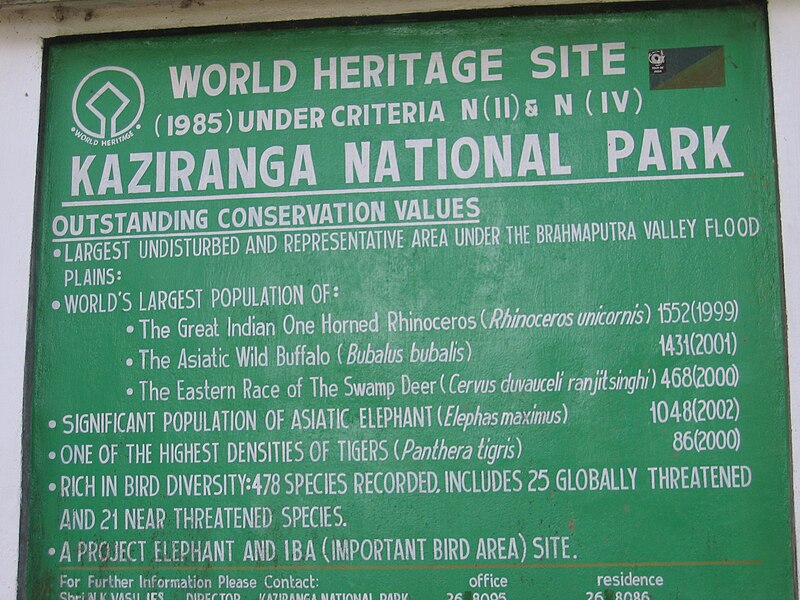
Welcome to Kaziranga National Park, a majestic natural sanctuary situated along the southern banks of the mighty Brahmaputra River in the northeastern state of Assam, India. Recognized as a UNESCO World Heritage Site in 1985, Kaziranga stands as an extraordinary testament to wildlife conservation, harboring over seventy percent of the world's remaining population of the Great One-Horned Rhinoceros. This unique ecosystem, continuously shaped by the annual flood cycles of the Brahmaputra River, features sprawling alluvial grasslands with elephant grass reaching over five meters in height, intricate riverine networks, and lush tropical moist forests. The nutrient-rich silt deposited by monsoon floods continuously rejuvenates the marshlands, sustaining an unmatched diversity of fauna including Bengal tigers, Asian elephants, wild water buffaloes, swamp deer, and hundreds of rare migratory bird species.
The historical trajectory of Kaziranga is a compelling saga of ecological resilience and dedicated human effort. At the dawn of the twentieth century, relentless hunting by colonial officials and tea planters had driven the regional rhinoceros population to the brink of utter extinction, leaving only a few dozen individuals surviving in the dense, impenetrable swamps. Designated as a reserved forest in 1908, Kaziranga began a long, painstaking journey of environmental recovery. Through decades of persistent conservation legislation, active field protection, and the gradual involvement of local communities, the rhino population miraculously rebounded to over two thousand six hundred individuals today. Spanning an area of approximately four hundred thirty square kilometers, the park represents one of the most successful wildlife recovery stories in modern conservation history.
As you embark on your journey through Kaziranga, you will experience far more than a typical wildlife safari. You are stepping into a dynamic landscape where ancient ecological rhythms intersect with the cultural heritage and livelihoods of the surrounding indigenous communities. From its designation as a wildlife sanctuary in 1950 to its establishment as a national park in 1974, Kaziranga's evolution reflects the delicate balance between environmental preservation and local human rights. The vast open floodplains and dense woodlands tell stories of struggle, adaptation, and harmonious coexistence between humanity and the wild. We invite you to listen closely to the subtle sounds of the wilderness and submerge yourself in the timeless spirit of Kaziranga.
02 Kohora Central Range Entrance Gate
You are currently standing at the Kohora Central Range Entrance Gate, the primary gateway into the heart of Kaziranga National Park. While most visitors travel here with the hope of catching a glimpse of the iconic Great One-Horned Rhinoceros, there is a fascinating and counter-intuitive truth about this realm: Kaziranga harbors one of the highest densities of Bengal tigers in the entire world. …
03 Kohora Grassland Observation Deck
Welcome to the Kohora Grassland Observation Deck. As you step onto this elevated viewpoint and gaze out over the vast expanse of greens, consider a truly surprising ecological reality: the ubiquitous elephant grass dominating this plain grows to astounding heights exceeding five meters. Consequently, adult Indian rhinoceroses weighing up to three tons, as well as entire herds of Asian elephants, can completely vanish into the dense foliage within seconds. …
04 Mora-Diphalu River Bank Lookout
Welcome to the Mora-Diphalu River Bank Lookout. This serene watercourse holds a remarkable and counter-intuitive ecological secret: despite its placid and modest appearance, these nutrient-rich river waters are home to the highly endangered Ganges River Dolphin. Furthermore, while the torrential monsoon floods that overflow from the Brahmaputra into the Mora-Diphalu might appear destructive at first glance, they actually serve as a vital ecological pulse. …
05 National Highway 37 Wildlife Corridor
You have arrived at the National Highway 37 Wildlife Corridor, which runs along the southern boundary of Kaziranga National Park. This paved arterial road presents a stark ecological dilemma: while serving as a vital transport link for human commerce and travel, it transforms into a dangerous barrier for wildlife during the annual monsoon season. …
06 Bagori Western Range Rhino Observation Post
Welcome to the Bagori Western Range Rhino Observation Post, widely regarded as the premier location in Kaziranga for close-range rhinoceros sightings. There is a dramatic historical transformation embedded in this site: once a vulnerable boundary sector heavily targeted by illegal poachers due to its open terrain, Bagori has been converted through rigorous patrol strategies and local community collaboration into the safest and most densely populated rhino habitat in the world. …
07 Closing
Thank you for joining us on this audio guide journey through Kaziranga National Park. The landscape you have explored today is far more than an isolated biological reserve set aside for wild animals. It is a living, dynamic testament to human dedication, ecological resilience, and the power of community-based conservation. …