Contents
History & cultureBY TELLBY8 sections · numbered as on the map01 Orientation
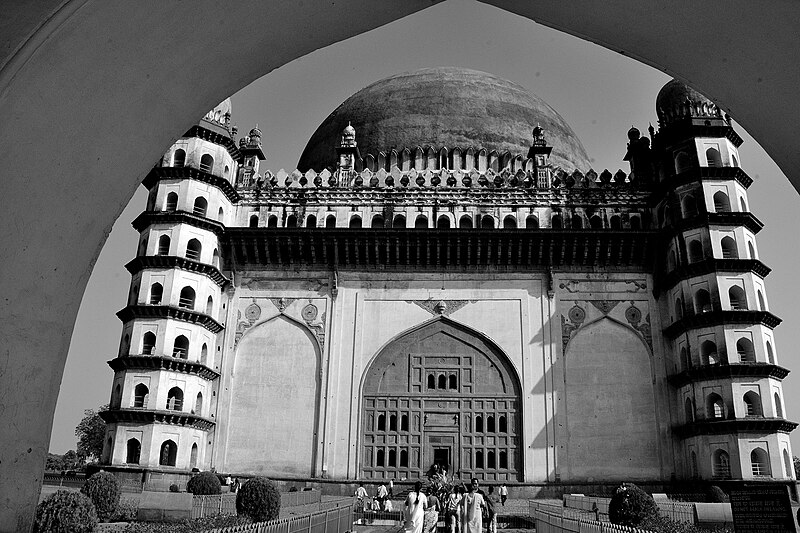
Welcome to the audio guide tour of Gol Gumbaz, the crowning architectural masterpiece of Bijapur and a monumental testament to the golden age of the Deccan Plateau. As you stand before the threshold of this magnificent heritage complex, you are stepping directly into the seventeenth century world of the Adil Shahi Dynasty. Upon ascending the throne in the year 1626, Sultan Mohammed Adil Shah, the seventh monarch of the dynasty, sought to carve his name permanently into the annals of world architecture. His father, Sultan Ibrahim Adil Shah II, had previously constructed the exquisite Ibrahim Rauza, a monument celebrated across India for its intricate decorative stone carvings and refined calligraphic ornamentation. However, Sultan Mohammed Adil Shah harbored a fierce creative ambition to surpass his father's architectural legacy, choosing to express his royal authority not through delicate detail, but through unprecedented spatial scale and structural grandeur. To realize this grand vision, the Sultan summoned elite master architects, engineers, and scholars from across the Indian subcontinent, Central Asia, and Persia to collaborate with local Deccan stone craftsmen. As you approach the massive main gateway, cast your eyes upward above the entryway. Suspended from a chain, you will notice an intriguing celestial relic: a genuine meteorite fragment recorded to have fallen from the heavens during the Sultan's reign. In seventeenth-century Deccani culture, this fallen sky stone was revered as a divine protective talisman believed to shield the colossal mausoleum from the destructive forces of natural lightning strikes. Looking directly south across the entryway, your eyes will meet an elegant two-story sandstone building known as the Naqqar Khana, or drum house. Commissioned in 1631 by Mohammed Adil Shah to serve as a ceremonial reception hall for royal dignitaries and court musicians, this building remained structurally incomplete at the time of his passing. The history of this site evolved further during the British colonial period when the municipal administration repurposed the building, transferring the regional museum from its original 1892 location at Anand Mahal to the Naqqar Khana in 1912, thereby establishing the modern Gol Gumbaz Archaeological Museum. Inside its eight specialized galleries rest over sixteen hundred invaluable historical artifacts spanning the sixth to the eighteenth centuries. Among these treasures are the seventh-century Mahakuta Pillar erected by the Chalukya King Mangalesha, a monumental sixteenth-century granite portrait sculpture of the Vijayanagara ruler Rama Raya, the historic battle sword of general Afzal Khan, exquisite hand-calligraphed manuscripts of the Quran, and rare imported Ming Dynasty celadon glassware. Passing through this ceremonial portal, prepare to embark on an unforgettable journey into the heart of Deccan engineering and royal grandeur.
02 Charbagh Garden and the Basalt Facade
As you step beyond the museum portal and follow the paved pathway into the complex, a breathtaking expanse of lush greenery unfolds before you. This is the classical Charbagh garden, laid out according to the revered Persian quadrilateral tradition designed to evoke the idyllic gardens of paradise. Precise axial walkways intersect at right angles, dividing the manicured lawns into balanced geometric quadrants that create a sense of harmony around the central monument. …
03 The Four Octagonal Corner Minarets
Please position yourself now near the base of one of the immense vertical towers anchored at the four corners of the mausoleum. Soaring dramatically toward the sky, these striking structures are the four octagonal minarets that define the heroic structural outline of Gol Gumbaz. Integrated directly into the four corners of the central cube, these towers extend continuously from the ground foundation platform all the way to the elevated roofline, providing essential lateral stiffness to the…
04 Main Interior Hall and the Royal Cenotaphs
Follow the pathway now through the grand western entrance portal into the main interior hall of the mausoleum. Crossing the stone threshold, you will immediately feel the cool indoor temperature and be overcome by a profound sense of awe as the vast interior void opens up above you. This colossal room represents one of the largest continuous single-chamber halls ever constructed in world architecture, completely devoid of any internal columns or supporting pillars. …
05 The Great Hemispherical Dome and Interlocking Arches
Standing in the exact center of the hall floor, raise your eyes high upward toward the soaring crown of the ceiling. Floating effortlessly above you is the breathtaking central hemispherical dome, celebrated as the largest unsupported masonry dome in India and among the most monumental vaulted achievements of the medieval Islamic world. The dome features an imposing outer diameter of 144 feet, or 44 meters, and an internal diameter measuring approximately 125 feet, or 38 meters across. …
06 The Acoustical Wonder, Whispering Gallery
Ascend the winding stone spiral staircase within one of the corner towers to reach the elevated gallery encircling the inner base of the giant dome. You are now standing inside the world-famous Whispering Gallery of Gol Gumbaz. Entered via eight arched doorways leading from the outer roof terrace into the interior dome void, this narrow circular gallery hangs suspended directly over the cavernous hall below. …
07 The Adjacent Mosque and Hashimpeer Dargah
As you descend back to ground level and wander toward the western grounds of the enclosed mausoleum complex, you will encounter two deeply significant religious structures that enrich the spiritual context of Gol Gumbaz. Standing directly adjacent to the western wall of the main tomb is the standalone Gol Gumbaz Mosque. …
08 Closing
You have now completed your audio guide tour of Gol Gumbaz, the undisputed crown jewel of Bijapur and one of the world's most astonishing architectural achievements. When Sultan Mohammed Adil Shah passed away in the year 1656, construction on this gargantuan mausoleum came to an abrupt halt, leaving several interior plaster finishes and fine ornamental details forever incomplete. …