 Photo Wikimedia Commons
Contents
History & cultureBY TELLBY7 sections · numbered as on the map01 Orientation
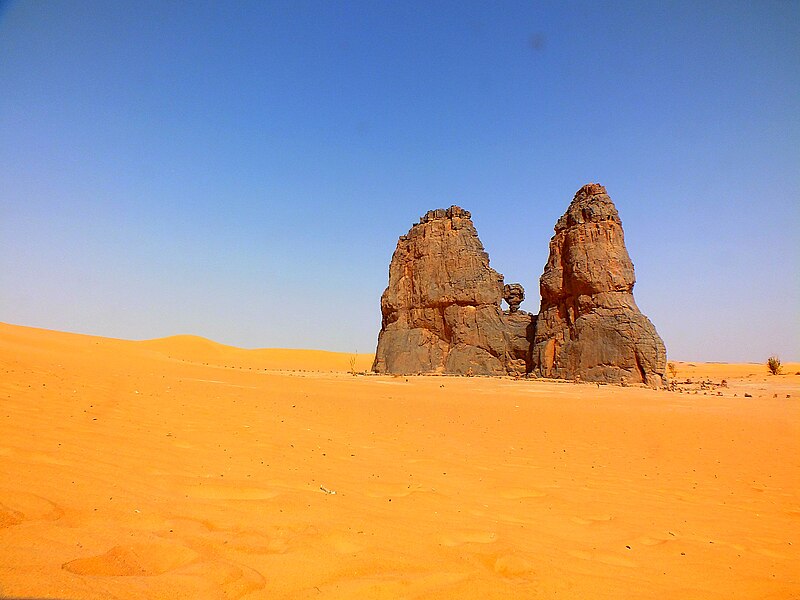
Welcome to Tassili n'Ajjer, an expansive and breathtaking sandstone plateau situated in the heart of the Algerian Sahara Desert near the borders of Niger and Libya. The site name in the native Tuareg language translates directly to the Plateau of Rivers, a title that offers a startling contrast to the arid, sun-baked stone wilderness stretching across the vast horizon today. However, this ancient elevated landscape was once a vibrant and flourishing green paradise. Millennia ago, during wetter climatic periods known as the Green Sahara, the region received generous rainfall, creating deep lakes, winding river channels, and lush vegetation that supported an incredible array of wildlife. Elephants, hippopotamuses, giraffes, antelopes, and giant crocodiles once roamed these fertile pastures alongside flourishing human communities of prehistoric hunter-gatherers and transhumant pastoralists. Formally recognized as a UNESCO World Heritage Site in nineteen eighty-two, Tassili n'Ajjer stands today as one of the most significant and extraordinary open-air groupings of prehistoric parietal art anywhere in the world. Encompassing an immense territory exceeding seventy-two thousand square kilometers, this national park and biosphere reserve preserves over fifteen thousand documented rock paintings and petroglyphs. These priceless ancient artworks provide an incomparable visual register of human cultural evolution, spiritual development, and environmental transformation spanning thousands of years. As you step onto this high plateau, you are walking into a vast natural sanctuary where ancient painters recorded their sacred rituals, hunting strategies, domestic lives, and economic transitions directly onto the sheltered sandstone walls. Beyond its unequaled artistic heritage, the plateau presents a stunning geological panorama filled with eroded sandstone rock forests, sheer canyon precipices, and hundreds of natural stone arches that evoke the illusion of an alien lunar landscape. Unique microclimatic conditions resulting from its higher altitude and sandstone water retention allow rare relict species, such as the ancient Saharan cypress and Saharan myrtle, to endure in hidden pockets. This audio guide will accompany you across time and stone, revealing the profound mysteries left behind by the ancient builders of the Green Sahara. Listen to the quiet whisper of the desert wind as we embark on this journey through sculptured monoliths and sacred rock sanctuaries.
02 The Sandstone Forest and Ancient Ice Canyons
It is a astonishing geological fact that this parched and waterless desert plateau was once carved open by roaring subglacial meltwater rivers flowing beneath immense ice sheets that enveloped Northern Africa. Look to your left at the monumental, labyrinthine stone pillars rising in silent formation against the clear desert sky. …
03 Shelter of the Mysterious Round Head Figures
It is a striking and mind-boggling fact that ancient painters depicted colossal human figures with featureless, perfectly round heads hovering silently without drawn eyes, noses, or mouths. Look directly ahead at the soaring wall inside this sheltered sandstone alcove. As you raise your eyes toward the central section of the rock panel, you will behold an imposing, enigmatic humanoid figure standing over three meters tall, gazing down upon the sanctuary. …
04 The Running Horned Woman at Aouanrhet
It is a profoundly captivating fact that this painting, hidden deep within a secluded Saharan rock shelter, represents one of the oldest known depictions of a horned female deity, marking the ancient origin of the African Sacred Feminine. Look carefully at the right wall of this sandstone rock shelter. …
05 Pastoral Rock Wall of the Domesticated Herds
As the Green Sahara gradually dried and water sources grew scarce, ancient human communities underwent a monumental economic transformation by shifting from hunting wild animals to domesticating cattle and establishing pastoral societies. Look closely at the expansive sandstone wall standing directly in front of you. As you scan across the vast panel, you will see it densely filled with detailed herds of speckled cattle and proud herders holding hunting bows. …
06 Fungoid Ritual Dancers of Tin-Tazarift
It is an astonishing and mind-bending fact that rock paintings depicting masked dancers holding mushroom-like objects with dual lines extending into their heads offer extraordinary visual evidence of ancient hallucinogenic mushroom rituals in the Green Sahara. Look carefully at the central panel of this secluded rock shelter. …
07 Closing
As our journey across the wind-swept plateau of Tassili n'Ajjer draws to a gentle close, we stand at the elevated vantage point of one of humanity's most magnificent prehistoric archives. Across thousands of years, as the Green Sahara shifted from a fertile landscape of flowing rivers and expanding lakes into a vast desert wilderness, generations of ancient artists transformed these sheltered sandstone walls into an immortal gallery of human survival and creative imagination. …