 Photo Wikimedia Commons
Contents
History & cultureBY TELLBY7 sections · numbered as on the map01 Orientation
Welcome to Cumalıkızık, a historic village where the living breath of the Ottoman era has been preserved intact across centuries. Nestled on the fertile plains of the Marmara region at the foot of the magnificent Uludağ Mountain, this village stands as an exceptionally precious heritage site that safeguards the early residential culture and everyday lifestyle of the Ottoman Empire. In the year two thousand fourteen, Cumalıkızık was inscribed as a UNESCO World Heritage site under the title Bursa and Cumalıkızık The Birth of the Ottoman Empire, earning global recognition for its remarkable historical continuity. Even without delving into complex historical records or technical jargon, the moment you step into the entrance of the village, the low stone walls and weathered timber posts will gently transport you into the authentic rhythm of an ancient way of life. The cool mountain breeze descending from the slopes of Uludağ and the serene cobblestone pathways create a timeless atmosphere that immediately captures the imagination of every visitor.
Geographically, Cumalıkızık is located approximately fifteen kilometres east of the industrial city center of Bursa. To the south, the lush green slopes of Uludağ Mountain rise up like a breathtaking natural fortress, while to the north lies the main highway connecting Bursa and Ankara. Looking at the surrounding neighboring settlements, the village of Hamamlıkızık lies to the east, and the district of Fidyekızık is situated to the west, clearly illustrating the regional cluster of agricultural settlements established during the early Ottoman period. The majority of the land extends smoothly toward the northern and southern woodlands, with narrow cobblestone lanes meandering along the natural contours of the mountain slopes to frame the entire settlement in a cohesive organic pattern. The dense green forests and rich soil provided a sustainable haven for generations of villagers, sustaining their agricultural livelihood while sheltering their homes from harsh northern winds.
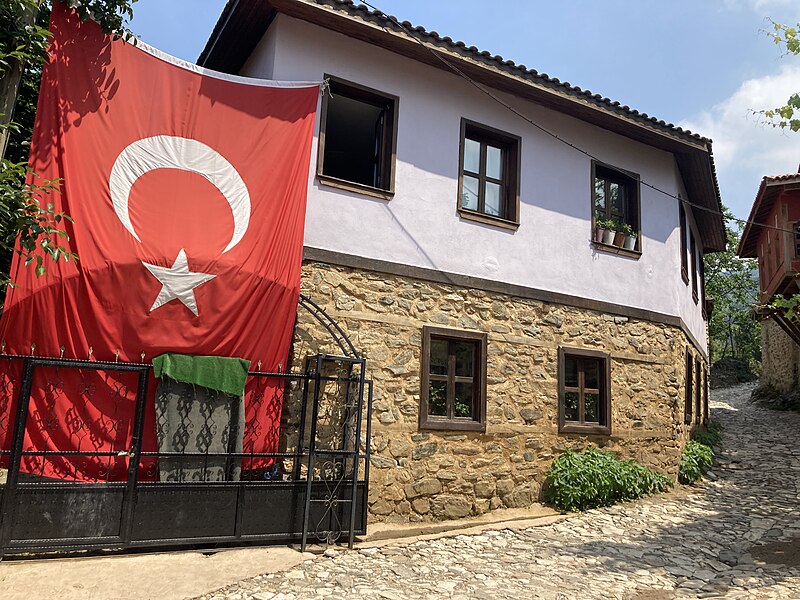
The traditional residences here exemplify Ottoman domestic architecture, featuring sturdy stone masonry ground floors topped with timber framed upper storeys filled with mudbrick. Designed specifically to adapt to the sloped terrain, the narrow cobblestone streets were intentionally constructed for pedestrian movement rather than vehicular traffic. Our walking tour today begins at Orta Mahalle Square, the social heart of the village. From there, we will wander through Hamam Alley with its historic public bath, pass through the mysteriously narrow Cin Aralığı lane where only one person can squeeze through at a time, explore the elegant residential structures of Eğrek Alley, and examine the sophisticated traditional window carpentry along Değirmen Alley before concluding our tour. As you walk along these tranquil stone paths and admire the weathered wooden gates, take your time to listen to the enduring stories embedded within the timber and stone of this extraordinary living heritage.
02 Orta Mahalle Square & Monumental Plane Trees
As you step into Orta Mahalle Square located at the very heart of the settlement, you are greeted by an extraordinary contrast: within this tranquil mountain village, there are sixty-one registered historical buildings concentrated together, yet only two of them are officially classified as monumental structures. These two monumental landmarks are the central congregational mosque where the community gathers for worship and the historical public bath that served their sanitation needs. …
03 Hamam Sokak Historic Bathhouse
Standing before the historic building along Hamam Sokak, you are confronted with a fascinating and surprising architectural reality regarding Ottoman sanitation culture: while this very bathhouse building on Hamam Sokak is the only preserved public bathhouse in the entire village, almost every private residential home in Cumalıkızık was equipped with its own secluded internal bathing space inside individual living rooms. …
04 Cin Aralığı Alley
Standing at the entrance of the extraordinarily narrow passage known as Cin Aralığı, visitors are invariably astonished by its breathtaking density and minimal width. This alley stands as one of the most remarkable urban features of Cumalıkızık, crafted so tightly that barely a single person can squeeze through at one time. Far from being a random byproduct of unorganized building, this extreme narrowness was a deliberate architectural strategy. …
05 Eğrek Sokak Traditional Residences
Standing before the majestic traditional houses along Eğrek Sokak, you are introduced to a remarkable structural secret of Ottoman residential engineering: a dual seismic design that combines a solid, unyielding stone masonry ground floor with highly flexible timber-framed upper storeys infilled with mudbrick, known as hımış. …
06 Değirmen Sokak & Traditional Window Techniques
Standing at the intersection of Değirmen Sokak and Keçecioğlu Sokak, you encounter a remarkable architectural truth governing the historic facades of Cumalıkızık: the windows of every single home were not crafted arbitrarily, but were meticulously built according to a rigorous proportional and typological system. …
07 Closing
Today, our audio journey has taken us from the timeless canopy of the monumental plane trees at Orta Mahalle Square through the ancient stone masonry of Hamam Sokak, the mysteriously narrow passage of Cin Aralığı, the resilient timber frameworks of Eğrek Sokak, and the refined window carpentry along Değirmen Sokak. …