 Photo Wikimedia Commons
Contents
History & cultureBY TELLBY7 sections · numbered as on the map01 Orientation
Welcome to the historic village of Wilhelminaoord, a living tribute to one of the most visionary social reform experiments of the nineteenth century. Established in 1821 by the Society of Benevolence, this carefully planned agricultural colony was created to address the devastating urban poverty that plagued the major cities of the Netherlands. During this era, thousands of impoverished families lived in precarious conditions with little hope for economic advancement. In response, social reformers sought to transform isolated peat and heath wastelands into productive agricultural settlements. By offering poor urban families a modest home, a parcel of land, and structured work, the colony aimed to empower individuals to become self-reliant citizens while simultaneously cultivating unused territory. Wilhelminaoord, along with neighboring Frederiksoord, stood out as a free colony where families lived and worked with personal independence under guided support. The village was named in honor of Wilhelmina of Prussia, the mother of King William First.
This groundbreaking project was recognized internationally and was inscribed on the UNESCO World Heritage List as part of the Colonies of Benevolence. The initiative represented a profound shift in human thought, demonstrating how systematic environmental design, compulsory education, and agricultural labor could uplift whole communities. Rather than viewing poverty as an inevitable individual failing, the founders believed that providing clean surroundings, discipline, and practical skills could systematically break the cycle of intergenerational hardship. Today, this peaceful setting retains the authentic character of its original utopian vision.
As you stand at the threshold of this heritage village, take a moment to observe the remarkable urban planning spread out before you. Notice the strikingly straight tree-lined avenues and the disciplined orthogonal grid layout that defines the entire settlement. Every road, plot of land, and residential structure was positioned according to a master plan designed to maximize efficiency, order, and visual clarity. The standardized cottages placed along linear roads reflected a belief that a well-structured physical environment would encourage moral order and industrious habits among the settlers.
During our audio tour today, we will wander through these historic tree-shaded lanes and explore the key landmarks that formed the backbone of daily life in the colony. You will discover the modest farmhouses built for incoming families, the beautiful colony church that once served as a place of mandatory gathering, the peaceful cemetery resting along an unpaved lane, and the vibrant community hall where generations of residents came together. Even today, many current inhabitants are direct descendants of the early colonists who arrived here two centuries ago. Step forward into this tranquil landscape and let us begin our journey through Wilhelminaoord.
02 Ribbon Settlement and Authentic Colony Farmhouses
It is truly astonishing to reflect on the fact that nineteenth-century municipal authorities actively transported their most impoverished city families into the heart of remote and uncultivated peatlands, with the firm expectation that standardized housing and rigorous agricultural discipline would transform them into ideal self-sufficient farmers. …
03 The Colony Church and Moral Reform
It is surprising to learn that attending religious services at this church was once strictly mandatory for every single resident living in the colony. For the leaders of the Society of Benevolence, economic relief and agricultural training were inseparable from moral re-education and social discipline. …
04 The Historic Cemetery on Oranjelaan
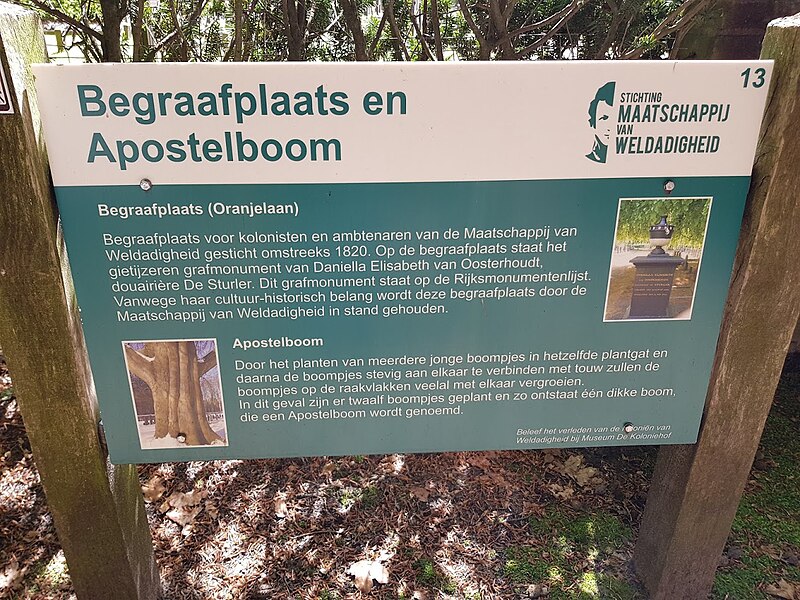
It is extraordinary to discover that hidden along this serene and unpaved dirt lane lies a historic cemetery established in 1821, which serves as the final resting place for the aristocratic mother-in-law of the founder of the Society of Benevolence himself. One might reasonably expect that high-ranking societal figures, titled nobility, and influential leadership families would choose burial in grand urban pantheons, family vaults, or prominent estate grounds. …
05 Ons Dorpshuis Community Hall
It is fascinating to learn that when this landmark building was constructed in 1915, it signaled a fundamental shift in the village identity, replacing strict institutional oversight with a community center built explicitly for social gathering, music, and democratic culture. In the nineteenth century, daily life in the colony was defined by panoptic surveillance, top-down administrative directives, and constant monitoring by appointed colony inspectors. …
06 The Original Colony School Building
It is remarkable to discover that the Society of Benevolence established mandatory primary education for all colonist children in 1821, long before the Dutch national government enacted compulsory schooling laws in 1901. During the early nineteenth century, children living in urban slums were routinely sent to work in hazardous factories or left to wander the streets without any access to formal schooling or literacy. …
07 Closing
The tour we have experienced today through Wilhelminaoord traces a remarkable journey from an ambitious nineteenth-century social engineering experiment into a peaceful, living heritage village surrounded by vast pine forests and rolling heathlands. Two centuries ago, this landscape was a barren wasteland transformed by human determination into a structured agricultural sanctuary designed to elevate impoverished urban families. …