 Photo Wikimedia Commons
Contents
History & cultureBY TELLBY7 sections · numbered as on the map01 Orientation
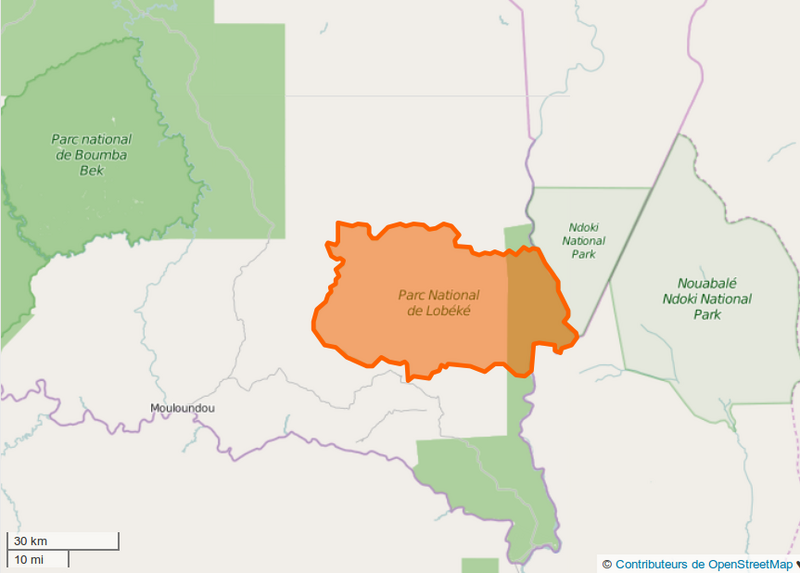
Welcome to the pristine green heart of the Congo Basin in southeastern Cameroon. You are standing in Lobéké National Park, located within the Moloundou Subdivision of the Boumba and Ngoko Division. Historically celebrated as a major center for natural rubber production during the German colonial period, the Moloundou region lies situated at an elevation ranging from three hundred to seven hundred and fifty meters above sea level. This majestic protected area receives an average annual rainfall of fourteen hundred millimeters, experiencing a short dry season from December through February that sustains one of the most vibrant and untouched rainforest ecosystems on Earth. First declared a protected area in October nineteen ninety nine and officially established with defined boundaries in two thousand and one, Lobéké National Park encompasses two hundred and seventeen thousand eight hundred and fifty four hectares of pristine primary rainforest. Lobéké is not an isolated sanctuary. It forms an integral component of the transboundary Sangha Trinational protected area complex, joining Dzanga Ndoki National Park in the Central African Republic and Nouabalé Ndoki National Park in the Republic of the Congo. Operated through the collaborative framework of the Central African Forest Commission with funding and oversight from international conservation organizations including the World Wildlife Fund, the Wildlife Conservation Society, and the German Cooperation of Technical Collaboration, the entire Sangha Trinational landscape was inscribed as a UNESCO World Heritage Site in twenty twelve. The peripheral zone of the park represents a carefully managed mosaic designed to balance biodiversity conservation with sustainable local livelihoods. To the west, the boundary is buffered by Community Managed Hunting Zones Number One, Number Two, and Number Three. To the north, Hunting Zones Number Twenty Eight and Number Thirty border the park, while Hunting Zone Number Thirty One protects the southern approach. Superimposed upon these hunting areas are multiple Forest Management Units, including Units Ten Zero Eleven and Ten Zero Twelve in the north, Ten Zero Sixty Three and Ten Zero Sixty Four in the south, and Ten Zero Thirteen in the west. Surrounding this expansive forest are twenty six indigenous villages, including Libongo, Béla, Momboué, Lokomo, Salapoumbé, Mambélé, Djembe, and Moloundou. Here, local residents belonging to the Baka, Bantu, and Bangando ethnic groups maintain traditional lifestyles centered around agriculture, fishing, hunting, and the gathering of non timber forest products. This wilderness harbors some of the highest population densities of African forest elephants and western lowland gorillas on the continent, alongside chimpanzees, De Brazza monkeys, leopards, bongos, sitatungas, red forest buffaloes, hippopotamuses, Nile crocodiles, and over two hundred and eighty three bird species. Today our audio guide journey begins at the green two story observation tower known as the Djangui Mirador. From there, we will descend into the mineral rich forest clearings or bais, where swirling flocks of thousands of African grey parrots, green pigeons, and forest mammals gather each morning. We will examine the tall perch trees along the canopy edge, trace fresh animal footprints beside natural mineral springs, and walk the shaded Bolo Bai stream trail. Prepare to immerse yourself in the sights, sounds, and ecological wonders of one of Africa's most extraordinary natural heritage sites.
02 Djangui Mirador Observation Tower
Welcome to the Djangui Mirador Observation Tower. We begin our tour at this location with a stark and alarming factual reality regarding the wildlife of this forest. According to long term ecological monitoring reports, over fifteen thousand African grey parrots are removed from the Djangui and Bolo clearings each year by illegal trapping operations. …
03 Djangui Bai Wetland & Geophagy Field
You are now standing at the center of the Djangui Bai wetland and geophagy field. Here, you are witness to a fascinating and essential biological phenomenon. African grey parrots intentionally seek out and consume the muddy soil of this wetland, a specialized intake known scientifically as geophagy. Soil research by Bently demonstrated that the clearing soil is exceptionally rich in fine sand and silt with a balanced clay fraction, providing essential mineral salts missing from the parrots…
04 Canopy Edge & Tall Perch Trees
We have reached the high canopy edge and tall perch trees standing along the forest margin. Here lies a strict ecological rule governing parrot survival. African grey parrots never nest inside open forest clearings. Instead, they rely on the highest branches of canopy trees reaching up to fifty meters in height to scout for hidden predators before making short, cautious flights down to the ground. …
05 Mineral Waterhole & Mammal Tracks
Welcome to the mineral waterhole and animal tracking field. Here, visitors witness an intriguing dynamic of interspecific competition and peaceful coexistence. Western lowland gorillas and mantled guereza monkeys frequently harass and chase away grey parrots near these waterholes. The primates perceive the vocal, fast moving parrot flocks as noisy competitors fighting for limited mineral drinking spots and space along the mud banks. …
06 Bolo Bai Trail & Stream Canopy
We are now walking along the Bolo Bai trail beside the stream canopy. Bolo Bai displays a distinctly different ecological structure compared to Djangui. Bolo Bai features a much denser, closed canopy layout. This dense overhead foliage restricts visibility, making it difficult for grey parrots to spot approaching raptors or escape quickly into flight during surprise attacks. …
07 Closing
Thank you for participating in this audio guide tour of Lobéké National Park. Today we have journeyed through the heart of the Congo Basin in southeastern Cameroon, exploring an extraordinary UNESCO World Heritage Site. From the elevated views of the green Djangui Mirador to the mineral rich geophagy fields, the high canopy perch trees, the animal traversed mineral waterholes, and the shaded stream trail of Bolo Bai, you have experienced one of the premier sanctuaries for the African grey…