Contents
History & cultureBY TELLBY7 sections · numbered as on the map01 Orientation
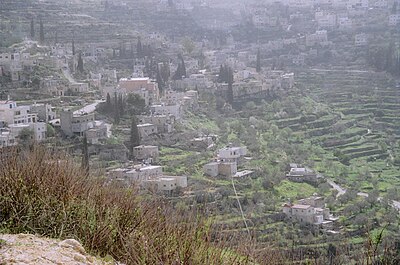
Welcome to the ancient cultural landscape of Battir, nestled peacefully in the Judean hills southwest of Jerusalem and six point four kilometers west of Bethlehem. The breathtaking panorama unfolding before your eyes represents an extraordinary living agricultural landscape forged through more than two thousand years of harmonious interaction between human enterprise and the natural environment. Situated at an elevation of approximately seven hundred and sixty meters above sea level, this UNESCO World Heritage Site showcases a remarkably preserved traditional agricultural system that has functioned continuously since antiquity. The landscape is defined by an intricate network of spring-fed irrigation channels feeding into steep, terraced hillsides supported by hand-crafted dry-stone retaining walls.
Spanning eleven square kilometers across the core and buffer zones, this extraordinary property encompasses the historic village of Battir alongside neighboring communities including Husan, Al-Walaja, Beit Jala, and el-Khader. For countless generations, local Palestinian farming families have meticulously shaped these sloping valleys, constructing dry-stone retaining structures known as habbai'l to collect fertile topsoil and retain precious rainwater. Across these terraced hillsides, villagers cultivate ancient olive groves, grapevines, vegetables, and fruit orchards. These traditional practices provide far more than agricultural sustenance; they form the very bedrock of local social cohesion, cultural identity, and communal governance. In recognition of these exceptional conservation efforts, UNESCO awarded Battir a prestigious fifteen thousand dollar prize for Safeguarding and Management of Cultural Landscapes in two thousand and eleven.
However, this priceless cultural heritage has faced grave existential challenges in recent history. When plans were introduced to construct a massive concrete separation barrier directly through the terraced agricultural valley and ancient hydraulic channels, the integrity and authenticity of Battir were threatened with permanent devastation. Responding to urgent calls from local communities and heritage experts, UNESCO inscribed the property onto the World Heritage List and the List of World Heritage in Danger in two thousand and fourteen under an emergency procedure. Building upon this international recognition, the Israeli High Court of Justice ruled in early two thousand and fifteen to halt the planned barrier construction through Battir, securing a vital victory for the local farmers and their ancestral land.
Today, local Palestinian communities, the Ministry of Tourism and Antiquities, the Municipality of Battir, and UNESCO continue to collaborate on active management and restoration initiatives to protect this vulnerable landscape. Ongoing projects focus on rehabilitating agricultural terraces, restoring traditional water channels, and fostering sustainable cultural tourism while resisting renewed settlement expansion. As you begin this audio tour, you will journey from the ancient Roman spring house at Ein al-Balad to the steep eggplant terraces, the historic Jaffa-Jerusalem railway bed, the threatened orchards of Wadi al-Makhrour, and the ancient stone watchtowers on Ain Bardamo Hill. Please step forward slowly, listen attentively, and immerse yourself in the enduring spirit of the Land of Olives and Vines.
02 Ein al-Balad Spring and the Roman Water System
In the historic village of Battir, local farmers often share a intriguing local proverb with visitors: In Battir, a week lasts eight days, not seven. This curious statement sounds like a mathematical puzzle, yet it describes a remarkably sophisticated traditional system of communal resource management that has governed daily life here for centuries. …
03 Ancient Stone Terraces and the Battiri Eggplant
The soaring hillside terraces stretching dramatically across this valley were constructed without using a single drop of mortar, cement, or modern industrial bonding material. Built entirely using the ancient dry-stone masonry technique, known locally in Arabic as habbai'l, these structures rely exclusively on gravity, physical friction, and the precise interlocking arrangement of natural limestone blocks. …
04 The Historic Jaffa-Jerusalem Railway and the Border Tale
During the turbulent Arab-Israeli war of nineteen forty-eight, when regional conflict forced the majority of residents in neighboring Palestinian villages to flee their homes, the village of Battir was saved from total abandonment and military destruction through the extraordinary courage and cunning of a single man named Mustafa Hassan. …
05 Wadi al-Makhrour Valley and the Kisiya Family Land
In the picturesque agricultural valley of Wadi al-Makhrour, a historic parcel of land with rock-solid legal title deeds—formally validated and reaffirmed by Israeli high court rulings—was brutally demolished in a single day and subsequently surrounded by illegal settler outposts. Located just west of the historic Christian town of Beit Jala, Wadi al-Makhrour is a fertile agricultural haven renowned for its lush terraced orchards, organic grapevines, and ancient stone field shelters. …
06 Ain Bardamo Hill and the Traditional Watchtowers
The ancient circular stone watchtowers crowning these high ridges—rustic structures where local farmers slept during the summer harvest season to guard their precious eggplants and grapes—are facing unprecedented destruction due to the aggressive expansion of unauthorized Israeli settlement outposts. Known locally in Arabic as muntar, these dome-roofed stone structures represent extraordinary examples of traditional dry-stone vernacular architecture that have dotted the Judean hillsides for…
07 Closing
As our audio walking tour comes to a heartfelt conclusion, take a deep breath and reflect upon the remarkable journey we have shared through the cultural landscape of Battir. We began our walk at the ancient Roman spring house of Ein al-Balad, where water has flowed continuously for two thousand years. …