 Photo Wikimedia Commons
Contents
History & cultureBY TELLBY8 sections · numbered as on the map01 Orientation
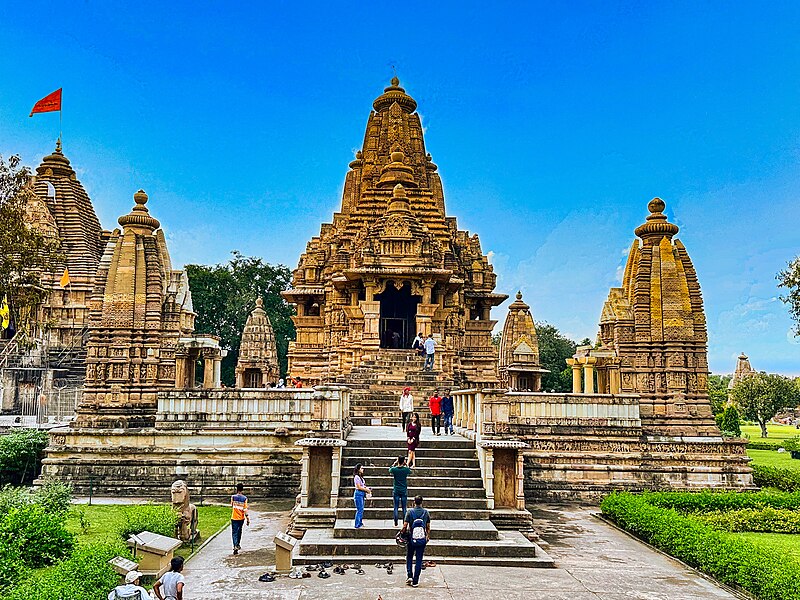
Welcome to the magnificent Lakshmana Temple, the crowning architectural masterpiece of the Western Temple Complex in Khajuraho, located in the Chhatarpur District of Madhya Pradesh, India. Dedicated to Vaikuntha Vishnu, a supreme composite aspect of the preserver deity Vishnu, this sacred tenth-century Hindu sanctuary stands as one of the most spiritually significant and artistically refined monuments in South Asia. Commissioned by King Yashovarman during the rise of the Chandella dynasty, major construction occurred between 930 and 950 CE, culminating in its formal consecration in 954 CE under the reign of his son, King Dhanga, as recorded on a commemorative inscription slab preserved within the temple halls. Historically, Khajuraho flourished as a serene rural religious and cultural sanctuary between 900 and 1150 CE, originally comprising eighty-five grand temples dedicated to divine worship, charitable endeavors, sacred music, dance, and philosophical recitations. Today, twenty-five surviving sanctuaries remain, with the Lakshmana Temple serving as the primary benchmark of this glorious legacy. As you stand before this monument, you are beholding a living model of the cosmic universe elevated above the mundane earthly realm. The entire temple complex rests upon a monumental raised stone platform known as the Jagati or Adhisthana, standing two and a half meters high. This elevated plinth serves both a physical and metaphysical function, separating the sacred precinct from temporal existence while drawing the eyes of approaching pilgrims upward toward the heavens. Spanning approximately one hundred feet in length, the structure rests upon a massive granite foundation supporting walls constructed from finely grained local sandstone in subtle shades of pale buff, pink, and yellow. Masons assembled these carved sandstone blocks without any mortar, relying entirely on gravity, inter-locking stonemasonry, and precise weight distribution. Architectural scholars celebrate the Lakshmana Temple as a pristine expression of the North Indian Nagara style, featuring a Panchayatana layout composed of a grand central temple anchored by four smaller subsidiary shrines at the corners of the platform. Furthermore, it belongs to the Sandhara design category, incorporating an enclosed ambulatory corridor that allows devotees to perform clockwise circumambulation around the inner sanctum. According to ancient Vastushastra canons, the architectural elevation mirrors the human body, comparing the base platform to the feet, the wall sections to the thighs, and the soaring central tower, or Shikhara, to the head. The roofline ascends rhythmically from the eastern entrance porch through successive halls, reaching its crescendo at the curvilinear Shikhara. Clustered around this main spire are minor secondary towers called Urushringas, echoing the contours of Mount Meru, the legendary cosmic mountain at the center of the universe. At the summit sits the Amalaka, a grooved stone disk symbolizing the radiant sun and cosmic lotus, crowned by a decorative finial known as the Kalasha. Please take a moment to absorb this vista before stepping up the eastern stairs onto the terrace.
02 The Varaha Shrine and Political Metaphors of Power
As you ascend the eastern staircase onto the elevated Jagati platform, the very first structure confronting you directly in front of the main temple is the standalone Varaha Shrine. Protected within this open pavilion rests a colossal monolithic sculpture of Varaha, the boar incarnation and third avatar of the supreme preserver deity Vishnu. …
03 The Grand Hall of Mahamandapa and Nagara Architecture
Passing through the outer entrance porch, you now step into the expansive interior of the Great Hall, known as the Maha-Mandapa. Architecturally, this central hall is distinguished by its transepts—projecting side bays running perpendicular to the main east-west axis of the temple structure. These side bays feature balconied windows fitted with ornate stone balustrades and protective stone awnings that filter natural daylight into the hall. …
04 Juncture Wall Sculptures and Allegorical Puns
Now let us focus our attention on the southern juncture wall, known in Sanskrit as the Sandhi-kshetra, which connects the Great Hall with the inner sanctum. On the architectural ground plan, this juncture wall marks the precise overlapping intersection of two equal squares formed by the hall and the sanctuary. …
05 The Clockwise Pradakshina Path and Divine Celestial Nymphs
Let us now step outside to perform the sacred circumambulation known as Pradakshina, walking around the exterior walls of the temple in a clockwise direction while keeping the sanctuary on your right. In Hindu spiritual tradition, circumambulating a sacred space clockwise aligns the devotee with the cosmic movement of the sun and celestial bodies, serving as an act of profound devotion. …
06 The Seven-Layered Doorway and Ten Avatars of Vishnu
Having completed the outer circumambulation, let us step back inside toward the vestibule known as the Antarala, which leads directly to the threshold of the inner sanctum. The Antarala represents a profound liminal boundary bridging the main gathering hall for devotees and the secluded chamber where the primary deity resides. …
07 The Inner Sanctum and the Tri-Headed Vaikuntha Vishnu
Stepping across the threshold of the Seven Sakhas, you now enter the innermost spiritual core of the temple, known as the Garbhagriha, or inner sanctum. The Sanskrit word Garbha translates directly to womb or embryo, connoting deep potentiality, hiddenness, and spiritual gestation. Dimly lit and completely removed from external noise and worldly sunlight, this hollow chamber resembles a quiet sacred cave where the devotee undergoes a profound spiritual rebirth. …
08 Closing
As we step out of the sanctuary and return to the spacious outer courtyard, take a moment to look back and appreciate the breathtaking full panorama of the Lakshmana Temple. Inscribed as a UNESCO World Heritage site in 1986 as part of the Khajuraho Group of Monuments, this tenth-century sanctuary stands as an extraordinary artistic and architectural pinnacle of the Chandella dynasty. …