Contents
History & cultureBY TELLBY7 sections · numbered as on the map01 Orientation
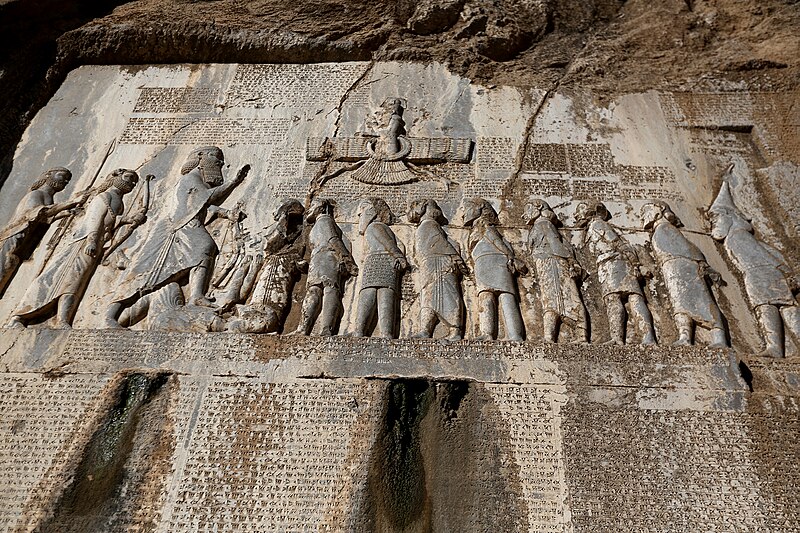
Welcome to the magnificent UNESCO World Heritage site of Behistun located in Kermanshah Province in western Iran. High above the ancient royal road that once connected the historic imperial capitals of Babylon and Ecbatana, the towering limestone cliff of Mount Behistun stands as an immortal monument to the power and endurance of the Achaemenid Persian Empire. Carved around five hundred twenty BC under the direction of King Darius the Great, this extraordinary rock relief and monumental cuneiform inscription tells the dramatic story of how Darius secured his throne against formidable odds. The Behistun Inscription serves as an indispensable key that unlocked the lost cuneiform languages of the ancient Near East, functioning as an irreplaceable historical volume carved directly onto living rock. Recognizing its profound historical and cultural significance for all humanity, UNESCO inscribed the entire Behistun complex as a World Heritage Site in two thousand six. As you stand along the designated viewing pathway below the vertical cliff face, gaze upward approximately one hundred meters above the ground. There, set into the sheer limestone rock, you will behold a vast bas relief measuring fifteen meters high by twenty five meters wide, flanked by extensive columns of cuneiform text written in Old Persian, Elamite, and Babylonian. Beyond this famous monument of Darius, the surrounding Behistun complex encompasses an extraordinary concentration of historical heritage spanning tens of thousands of years. Archaeological evidence indicates human habitation in this region dating back to prehistoric times at Hunters Cave. Within the complex grounds, dozens of registered historical monuments reside, including Median fortresses, a Parthian town and place of worship, a Hellenistic statue of Herakles sculpted in the second century BC, Sassanian carved stones, an Ilkhanid caravanserai, and a Safavid caravanserai. Throughout this guided audio tour, we will lead you along the observation path to examine each component of the grand creation of Darius in vivid detail. We will inspect the commanding figure of King Darius holding his bow of authority, the usurper Gaumata crushed under royal boots, the line of bound rebel leaders connected by a single continuous rope, and the sacred winged figure of Faravahar representing the supreme god Ahura Mazda floating above. We will also discover the perilous nineteenth century adventures of European scholars who scaled these treacherous heights to copy the trilingual script, and explore how this relief drew inspiration from much older Near Eastern art dating back four thousand years. Please take a comfortable step along the walking path, lift your vision up toward the center of the cliff face of Mount Behistun, and prepare to embark on a journey into ancient history.
02 Darius the Great and the Trampled Usurper Gaumata
Remarkably, after completing this monumental rock relief and cuneiform text high up on a sheer vertical limestone cliff one hundred meters above the ground, Darius the Great ordered the construction ledges used by the sculptors and masons to be completely hewn away. By permanently removing the footings, Darius ensured that no future human being could ever reach the cliff face to alter, deface, or destroy his sacred imperial declaration. …
03 The Line of Bound Prisoners and the Scythian King Skunkha
An astonishing secret lies hidden within the last figure standing at the far right end of this captive procession. The final man, distinguished by his remarkably tall pointed hat, was not part of the original composition created by the royal sculptors. Instead, his image was added long after the relief and the surrounding trilingual inscriptions had been fully finished. …
04 The Flying Faravahar and Divine Approval of Ahura Mazda
Throughout the lengthy narrative inscribed on the cliff, King Darius repeatedly asserts a profound theological claim: every single one of his nineteen victories over the rebel pretenders was accomplished not by human might alone, but solely by the divine grace of Ahura Mazda, the supreme deity of Persia. Facing lingering questions regarding the legitimacy of his ascension after assassinating Gaumata, Darius utilized divine authority to sanctify his reign. …
05 The Trilingual Cuneiform Text and Rawlinson's Daring Feat
The historical and philological significance of the Behistun Inscription to Near Eastern archaeology is directly comparable to that of the Rosetta Stone to Egyptology. Just as the Rosetta Stone unlocked Egyptian hieroglyphs, the trilingual inscription of Behistun served as the ultimate master key that enabled modern scholars to decipher the forgotten cuneiform scripts of three major ancient civilizations: Old Persian, Elamite, and Babylonian Akkadian. …
06 The Ancient Model: Inspiration from the Anubanini Relief
The grand visual composition of King Darius on Mount Behistun was not an entirely novel artistic invention created from scratch in the sixth century BC. Instead, archaeologists and art historians have demonstrated that the royal sculptors of Darius directly benchmarked and modeled their design upon a famous rock relief created eighteen hundred years earlier in the same geographic region: the Sarpol i Zohab Relief, also known as the Anubanini Rock Relief. …
07 Closing
As our journey at the foot of Mount Behistun comes to a close, we stand before this awe inspiring cliff reflecting upon the profound historical drama hewn permanently into the living rock. The monumental relief and trilingual cuneiform inscription commissioned by King Darius the Great represents far more than a personal victory song of a conqueror. …