Contents
History & cultureBY TELLBY7 sections · numbered as on the map01 Orientation
Welcome to the Historic Town of Grand-Bassam, the distinguished former first capital of Côte d'Ivoire and a magnificent living monument where coastal beauty meets profound history. Located along the Gulf of Guinea on a narrow sandy spit situated at the mouth of the Comoé River, this remarkable historical ensemble represents an outstanding example of a late nineteenth- and early twentieth-century planned colonial town. Grand-Bassam was inscribed as a UNESCO World Heritage site because it preserves an extraordinarily intact urban landscape that reflects rational colonial planning principles alongside the enduring cultural traditions and architectural continuity of the indigenous N'zima people. The spatial layout of Grand-Bassam was meticulously structured around specialized quarters dedicated to administrative functions, commercial activities, European residences, and African settlements. This distinct spatial segregation reveals the structured social hierarchy of the colonial era while simultaneously serving as an authentic witness to the intricate economic exchanges, cultural encounters, and social relations among European traders, diverse African populations from across the continent, and merchants arriving from the Mediterranean Levant. As the vibrant economic engine of the French trading posts in the Gulf of Guinea, Grand-Bassam played a pivotal role in shaping the modern nation. The town's colonial built environment features sober, functionalist architecture meticulously engineered to adapt to the challenging tropical climate. Buildings are characterized by elevated stone basements, spacious shaded verandas, open gallery arcades, and lush surrounding gardens designed according to the hygienic and ventilation standards of the period. In harmonious contrast, the neighboring N'zima fishing village demonstrates the incredible resilience, cultural permanence, and social organization of the native community over centuries. Furthermore, these historic streets hold memory not only as an administrative center but also as the sacred birthplace of popular movements that eventually fueled Côte d'Ivoire's march toward national independence. Our audio walking tour invites you on an immersive journey through these evocative quarters. You will stroll along the oceanfront avenues of the France quarter, examine historic landmarks such as the site of Fort Nemours, the Governor's Palace, the Old Post and Customs House, and the Old Courthouse, and conclude your exploration among the traditional dwellings of the N'zima village and the historic Victoire Bridge leading to Petit-Paris. As you listen to the rhythmic sound of the crashing Atlantic surf and feel the refreshing sea breeze, let this audio guide illuminate the rich narratives, subtle material details, and monumental legacy embedded within every corner of Grand-Bassam.
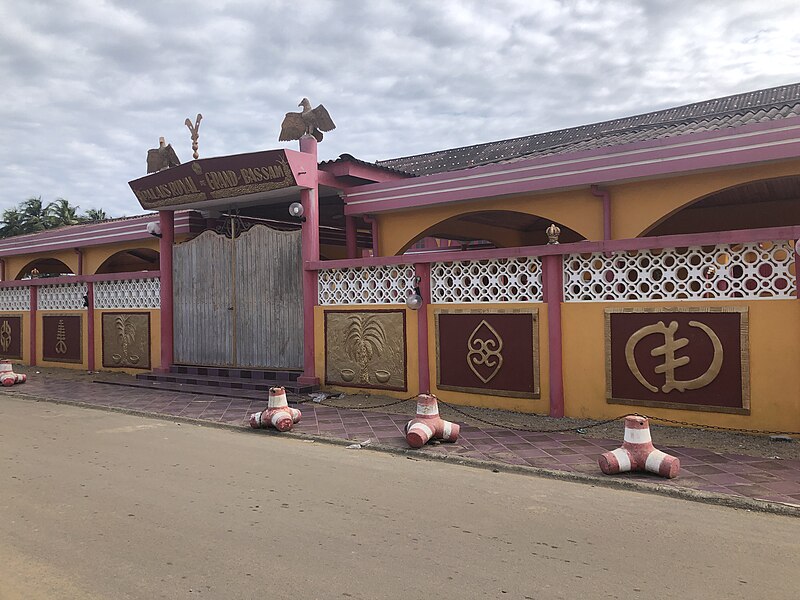
02 N'zima Village and the Roots of Bassam
Have you ever wondered about the true and fascinating origin of the name Grand-Bassam? Surprisingly, the name Bassam comes from an everyday exclamation used by the indigenous N'zima people who labored tirelessly along this treacherous coastline: "Bazouam," which in the N'zima language translates directly to "help me carry my load." Day after day, as native porters carried heavy trade crates through the crushing surf from ocean vessels to the sandy beach, their desperate and rhythmic calls of…
03 Governor's Palace and Tropical Architecture
As you stand before this grand historic structure, you are gazing at the Governor's Palace, an iconic centerpiece of colonial administration that currently houses the National Costume Museum of Grand-Bassam. Did you know that this magnificent palace was actually built using prefabricated iron components manufactured in France in 1893 and shipped across the ocean to be assembled directly on site? …
04 Old Post and Customs House
You have arrived before the Old Post and Customs Building, standing proudly facing the Atlantic oceanfront. Did you know that in the late nineteenth century, colonial authorities erected a dedicated customs station right upon this scorching beach in temperatures exceeding thirty-five degrees Celsius, purely to collect an export tax of five francs per ton on outgoing trade cargo? …
05 Old Courthouse of Grand-Bassam
Standing before you is the Old Courthouse, a building defined by its elegant proportion, balanced symmetry, and dignified architectural presence. Did you know that this refined structure once served as the supreme judicial authority handing down legal rulings for the entire territory of Côte d'Ivoire, yet within just a few decades, the courtroom was completely deserted due to devastating yellow fever epidemics and the shifting of major port infrastructure? …
06 Lighthouse and Victoire Bridge
You have reached the edge of the France quarter at the Victoire Bridge and the Grand-Bassam Lighthouse, which mark the gateway to the Petit-Paris district. Did you know that until this lighthouse was finally illuminated in 1915, incoming ships navigating the pitch-black ocean waters relied entirely on a tiny fixed lantern perched atop a fragile metal tower at the end of the wharf? …
07 Closing
As our journey through the Historic Town of Grand-Bassam comes to an end, we hope you have enjoyed exploring its remarkable architecture, coastal avenues, and the living heritage of the N'zima village. Following the devastating yellow fever epidemic of 1899, the colonial capital was officially transferred to Bingerville in 1900 and subsequently to Abidjan in 1934. Consequently, Grand-Bassam gradually slipped away from the political and economic spotlight. …