Contents
History & cultureBY TELLBY7 sections · numbered as on the map01 Orientation
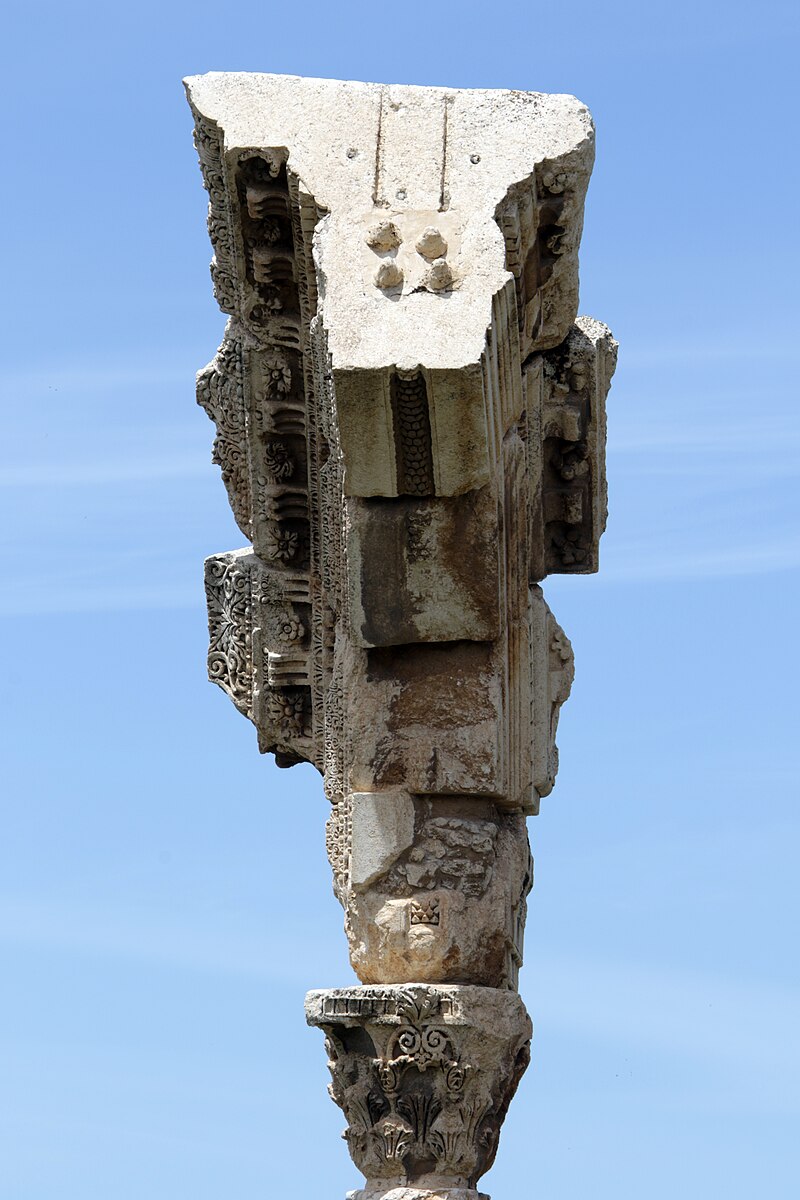
Baalbek, recognized as a monumental UNESCO World Heritage site, is a colossal sanctuary situated at an altitude of 1150 meters in the fertile Bekaa Valley beneath the majestic slopes of the Anti-Lebanon mountains in Lebanon. Nestled between the towering peaks of the Lebanon and Anti-Lebanon ranges, this fertile high plateau was blessed with abundant natural mountain springs, turning it into a sacred center of life and worship since the earliest antiquity. Long before the Roman legions arrived, ancient Phoenicians gathered on this elevated ground to venerate their celestial deities, worshipping Hadad the sky god, Astarte the goddess of fertility, and Adon the young god of renewal. Following the conquests of Alexander the Great and the dawn of the Hellenistic era, the ancient settlement gained international renown under the Greek name Heliopolis, which translates directly as the City of the Sun, evolving into a crucial hub for trade and pilgrimage connecting East and West. When the Roman Empire subsequently asserted firm control over the region, Baalbek was transformed into one of the most celebrated religious sanctuaries in the ancient world, drawing thousands of devout travelers from across the Mediterranean basin. To demonstrate the overwhelming power, infinite wealth, and supreme architectural genius of the empire, Roman emperors embarked on an ambitious building project that spanned more than 2 centuries. They systematically constructed colossal stone sanctuaries over earlier sacred sites, seamlessly blending traditional Phoenician religious concepts with the splendor of Imperial Roman architectural design. The local divine triad was elegantly integrated into the Roman pantheon as Jupiter, Venus, and Mercury, giving rise to an extraordinary architectural synthesis that rivaled the greatest sanctuaries of the classical world. Countless stonemasons worked tirelessly to quarry and carve these monumental blocks, pushing ancient civil engineering to unprecedented heights. Today, the monumental ruins of Baalbek stand as a supreme triumph of ancient megalithic engineering and artistic vision. The sweeping plazas, subterranean vaults, and soaring limestone columns have endured centuries of warfare and catastrophic earthquakes, retaining an unmistakable aura of imperial majesty. As you begin your journey through this historic acropolis, you will walk across layers of human history where Phoenician mythology, Roman grandeur, Byzantine devotion, and medieval Islamic fortification intersect. Listen closely to the profound echoes carved into these colossal stones, which speak of human ambition and spiritual devotion. We will now move forward toward the eastern entrance stairs to begin exploring the grand portals of the legendary City of the Sun.
02 The Grand Entrance and the Hexagonal Forecourt
The grand entrance sequence to the sacred sanctuary of Baalbek was masterfully conceived to instill an immediate sense of overwhelming imperial majesty and profound reverential respect in every visitor who approached its hallowed precincts. As ancient pilgrims completed their long journeys and arrived at this monumental gateway known as the Propylaea, they were confronted with a dramatic architectural statement carefully designed to elevate their minds and prepare them spiritually for the holy…
03 The Heart of Worship: The Great Court
Emerging from the Hexagonal Forecourt into the vast open plaza brings you into the Great Court, which served as the emotional, administrative, and ritual heart of the entire sanctuary at Baalbek. Covering an extraordinary area of more than 3 acres, this magnificent open air square was designed on a scale unprecedented in the Greco-Roman world, capable of accommodating tens of thousands of worshippers during major imperial religious festivals. …
04 The Colossal Sanctuary of Jupiter and the Trilithon
Ascending the final flight of grand stone stairs from the Great Court brings you directly onto the elevated platform of the Temple of Jupiter, the largest and most exalted sanctuary in the entire Heliopolitan complex. Built upon a massive raised podium, the terrace wall on the western side contains one of the most astonishing engineering wonders of the ancient world, known universally as the Trilithon, or the Three Stones. …
05 The Monumental Temple of Bacchus
Situated directly to the south of the Temple of Jupiter, the magnificent Temple of Bacchus stands as the best preserved Roman temple structure surviving anywhere in the ancient world today. This extraordinary architectural monument is completely framed by an imposing outer peristyle of 42 colossal columns that reach nearly twenty meters in height. …
06 The Elegant Temple of Venus
Located a short distance to the southeast of the main acropolis enclosure, the Temple of Venus stands as a masterpiece of architectural elegance and refined geometric design. Breaking completely away from the rigid rectangular conventions of standard Roman temple architecture, this building features a highly original circular layout adorned with a delicate concave, horseshoe shaped outer portico. …
07 Closing
The journey we have shared today through the sacred complex of Baalbek offers far more than a view of ancient Roman ruins; it reveals a magnificent tapestry woven from thousands of years of human history, faith, and architectural ambition. Beginning as a sacred Phoenician site dedicated to indigenous sky deities, this holy ground evolved into the grandest religious sanctuary of the Roman Empire, was transformed into a Byzantine Christian center, and was later fortified as a medieval Islamic…