 Photo Wikimedia Commons
Contents
History & cultureBY TELLBY7 sections · numbered as on the map01 Orientation
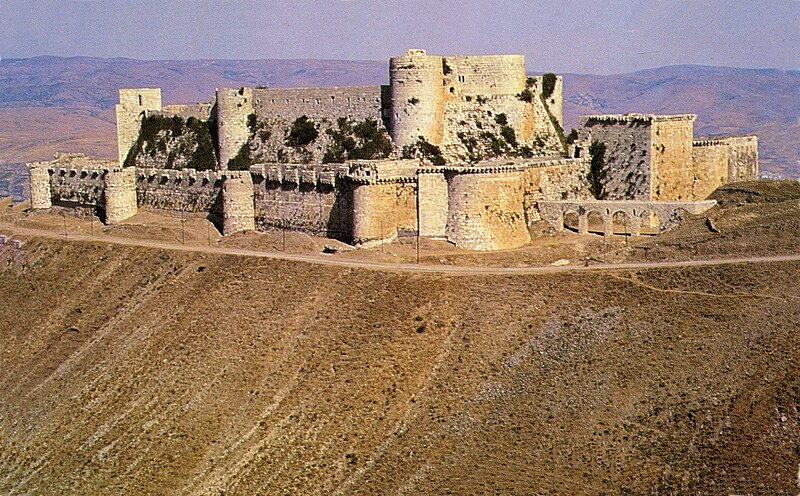
Welcome to Krak des Chevaliers, a monumental stone fortress where Eastern and Western cultures met and where the spirits of medieval knighthood and Islamic dynasties endure. You are standing on the elevated hill near the main entrance, gazing at the sweeping panoramic view of the entire stronghold stretched along the high mountain ridge. The imposing stone walls and tall towers standing before you create an overwhelming landscape that fills every visitor with deep admiration and awe. This site represents the absolute pinnacle of medieval military architecture, formed through a remarkable synthesis of Eastern defense systems and Western fortification techniques. Recognizing its extraordinary architectural value and exceptional state of preservation, this fortress was officially inscribed as a UNESCO World Heritage site in 2006.
Krak des Chevaliers occupied an indispensable strategic position, commanding the crucial north-south trade and military corridor leading from northern Syria directly toward the Holy Land. Below the fortress lies the broad valley of the river Orontes, known locally as Nahr al-Asi. Perched atop a steep rock ridge, this site served as a major stage for historic encounters between East and West over many centuries. During the Crusades, Islamic and Western forces clashed intensely around these grounds, yet they also learned from each other's defensive engineering, exchanging profound influences that helped shape the formidable castle structure seen today.
Surrounded on almost every side by rugged natural bedrock cliffs, the castle could be approached from only one direction. Combined with its concentric wall design, this geographic advantage rendered the fortress virtually impregnable, withstanding numerous sieges without ever succumbing to a direct frontal assault. For both East and West, it remains an ideal archetype of medieval military fortification and a testament to engineering excellence.
Our audio guide tour begins here at the entrance gate and proceeds through the trace of the aqueduct, the concentric outer walls with eight round towers, and the famous two-storey facade once struck upon medieval silver coins. We will then visit the massive square tower added by the Mamluk sultan, before reaching the panoramic overlook offering a sweeping view of the ancient corridor to the Holy Land. As you walk slowly along the pathway, please listen closely to our deep and measured voice. Step forward into this legendary fortress where knighthood, strategy, and history converge.
02 The Impregnable Gate and the Hidden Water Line
Ironically, the sole fatal weakness of this colossal stone fortress, which could never be breached by direct frontal assault or powerful siege engines, was the external water supply channel extending from the distant mountains outside.
Please lift your eyes and look closely at the solid natural bedrock firmly rooted beneath the entrance gate and the outer stone wall soaring above it. …
03 Concentric Walls and the Eight Round Towers
Did you know the remarkable engineering fact that, instead of conventional square towers with right angles, builders constructed round towers with smooth curves specifically to deflect massive catapult stones launched by enemy artillery?
Please look closely to your left at the massive round stone tower soaring with majesty and the towering inner wall wrapped securely behind it. …
04 The Facade Struck upon Silver Coins
Did you know the surprising historical fact that this wall facade was so renowned throughout Europe and the Middle East that the Count of Tripoli had this exact elevation struck upon the silver coins he issued during the thirteenth century?
Please look closely and direct your gaze at the magnificent two-storey stone wall standing directly before you and the three slightly protruding towers aligned along its surface. …
05 The Victory Tower of Sultan Baybars
Did you know the remarkable historical fact that, after the Hospitallers had staunchly defended this stronghold for over a century, it was finally captured in 1271 by the Mamluk army of Egypt, who subsequently added this massive square victory tower?
Please look high up at the large square stone tower standing with great authority in the middle of the courtyard. …
06 Overlooking the Ancient Corridor to the Holy Land
Did you know the remarkable geographic fact that, from this single vantage point atop the fortress, defenders could monitor and control the entire vital north-south trade and military corridor extending from northern Syria to the Holy Land?
Please direct your eyes toward the breathtaking panorama beyond the open walls, where the river Orontes, known locally as Nahr al-Asi, winds gracefully through the lush green valley below. …
07 Closing
Thank you very much for joining our official audio guide tour of Krak des Chevaliers, a monumental stone fortress where the rich histories of East and West endure. From our beginning at the entrance gate through the trace of the outer aqueduct, the eight majestic round towers, the two-storey facade once struck upon silver coins, the victory tower of Sultan Baybars, and the high panoramic overlook of the Orontes valley, we hope this journey has left a profound impression in your heart. …