Contents
History & cultureBY TELLBY7 sections · numbered as on the map01 Orientation
A very warm and heartfelt welcome to Kilwa Kisiwani, an extraordinary island where the grand history of the East African coast echoes across time. As you step onto this peaceful shoreline and feel the gentle ocean breeze, you are entering one of the most prominent hubs of the medieval Swahili civilization. Kilwa Kisiwani has been designated as a UNESCO World Heritage Site in recognition of its extraordinary architectural achievements and its historic role as a thriving center of maritime trade that connected the African continent with the wider world. Together with the nearby ruins of Songo Mnara, this site stands as a testament to indigenous African urbanism and maritime expertise.
Geographically situated nine degrees south of the equator near the mouth of the Mavuji River estuary, this island was ideally positioned to command the trade routes of the Indian Ocean. During the height of the Middle Ages, this island was a bustling maritime metropolis that attracted merchant ships from across the ocean, hosting a flourishing population that once exceeded ten thousand inhabitants. Gold from the inland plateaus, along with ivory and iron, flowed steadily into Kilwa's protected harbor. In exchange, seafaring traders arriving on seasonal monsoon winds brought exotic silk, fine porcelain, beads, and luxury goods from Arabia, Persia, India, and China. This vibrant commercial network transformed Kilwa Kisiwani into one of the wealthiest and most influential city-states along the Swahili Coast.
In contrast to its glorious and opulent past, modern Kilwa Kisiwani offers a serene and traditional sanctuary. Today, the island is home to a resilient community of roughly eleven hundred and fifty residents living in quiet harmony with their surroundings. Because there are no paved roads on the island, the tranquil atmosphere is uninterrupted by automobile traffic, and people travel on foot or by motorcycle. With no natural rivers present, islanders continue to draw fresh water from ancient stone wells that have been utilized for over a millennium, while electricity is provided through small-scale solar power systems.
As we begin our exploration today, we will follow the historical pathways once trodden by medieval sultans, foreign merchants, and local artisans. While walking along the footpaths, please mind your step over uneven coral stone surfaces and coastal terrain, and ensure you stay hydrated under the tropical sun. When you are ready, let us make our way toward our very first stop, the imposing Gereza Fort overlooking the turquoise waters.
02 Gereza Fort
The Gereza Fort, whose name derives from the Swahili word for prison, stands as a formidable monument bearing witness to a turbulent history of foreign invasion, colonial ambition, and military struggle that reshaped the Swahili Coast.
As you stand before this impressive stronghold, take a moment to look closely at the thick coral stone ramparts and the dramatic arched gateway opening directly toward the ocean waters. …
03 Great Mosque of Kilwa
The Great Mosque of Kilwa, recognized as the oldest and largest surviving mosque along the entire East African coast, is an architectural masterpiece whose initial structure was built with a flat roof supported by timber columns cut from single tree trunks, before being expanded with ornate coral domes during later periods of royal prosperity. …
04 Husuni Ndogo
Husuni Ndogo, which translates from Swahili as the Little Palace, presents a captivating architectural enigma: despite its modest name, it features a grand rectangular enclosure wall anchored by corner defense towers that strongly resembles the ancient desert fortresses constructed across the Middle East. …
05 Palace of Husuni Kubwa
The Palace of Husuni Kubwa, standing as the largest single medieval structure in sub-Saharan Africa, is a breathtaking monument of royal power and wealth that once featured over one hundred individual rooms, expansive commercial courtyards, and an extraordinary octagonal swimming pool perched on a coastal cliff. …
06 Swahili Cemetery and Shoreline
Centuries ago, the people of Kilwa demonstrated remarkable maritime engineering skills by constructing massive inter-tidal causeways and raised coral stone platforms nearly one meter high across the shoreline, planting mangrove forests to create natural breakwaters that protected their vital trade harbor.
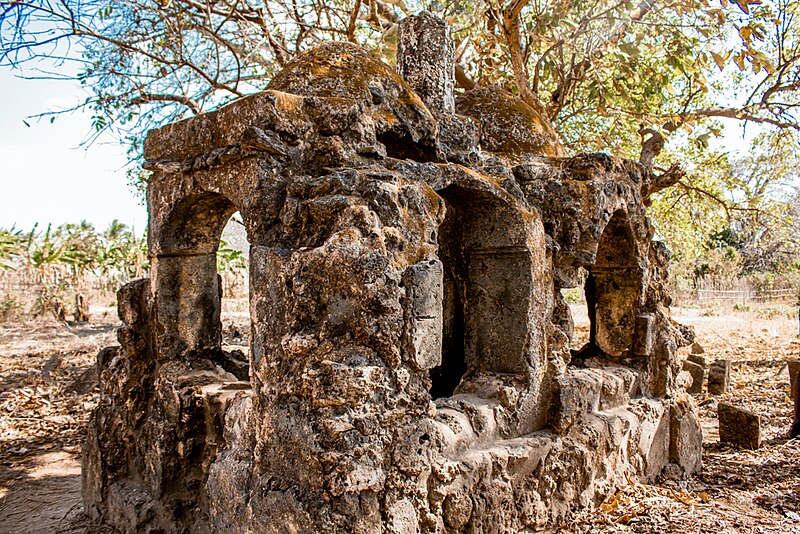
As you walk along the quiet shoreline on the edge of town, look closely at the historic Swahili cemeteries and the ancient coral causeways that emerge from the sea as the tide recedes. …
07 Closing
This concludes our audio guide tour of Kilwa Kisiwani, the glorious medieval trading capital of the Swahili Coast and a magnificent cradle of African maritime civilization. Walking among these ancient ruins today, we have witnessed the physical legacy of an African metropolis that shaped global trade networks. …