Contents
History & cultureBY TELLBY7 sections · numbered as on the map01 Orientation
Welcome to the Pyu Ancient Cities, a monumental UNESCO World Heritage Site where the living history of the earliest and largest urbanized Buddhist civilization in mainland Southeast Asia unfolds before you. Flourishing for over a thousand years between two hundred BCE and nine hundred CE, the Pyu civilization successfully transformed the vast dry zone of the Ayeyarwady River basin into a highly productive agricultural heartland. The Pyu people displayed a remarkable capacity to assimilate Indic cultural influences and adapt them into their own distinct urban planning, architectural mastery, and enduring ritual traditions. The meticulously arranged urban landscapes laid out across these ancient fields preserve the technological innovation and social maturity achieved by Pyu society two millennia ago. The traces of these ancient cities scattered across this vast terrain are not merely silent relics of a bygone era, but precious human heritage that continues to breathe life into the present day.
This extraordinary serial heritage property comprises three major brick-walled and moated ancient cities, known as Halin, Beikthano, and Sri Ksetra. Surrounded by massive red brick walls and protective moats, these urban centers served as the primary gateway for the introduction and spread of Pali-based Theravada Buddhism across the sub-region. The Pyu crafted a unique cultural synthesis by integrating Theravada teachings with Mahayana Buddhism and Hindu iconographic traditions. Through masterly water management engineering, they constructed sophisticated networks of canals and water storage reservoirs in a region marked by seasonal drought, providing an essential lifeline that continues to support local farming communities to this day. Each city developed its own distinct hydrological techniques and architectural styles tailored to its specific environment, and the harmony formed by these three sites completes the rich tapestry of Pyu civilization.
The ancient urban layout before us reflects technological innovation developed two millennia ago. Intricate networks of roads and canals seamlessly linked civic amenities, residential zones, and sacred monastic precincts within and beyond the city walls. As Pyu architects transitioned from perishable timber construction to permanent brick masonry, they erected towering cylindrical stupas and grand ritual structures that still inspire deep devotion and reverence among Buddhist pilgrims from across the globe.
Furthermore, the Pyu practiced a distinctive mortuary custom, placing cremated human remains inside earthenware and stone burial urns interred near sacred stupas and communal funerary terraces. These elaborate funerary rites reflected their profound religious philosophy regarding spiritual rest and the afterlife. These archaeological discoveries, along with finely crafted silver coins, stone casting molds, and metallic artifacts, demonstrate the vibrant trade connections that linked the Pyu realm to China, India, and maritime Southeast Asia. Now, let us step back in time and explore this ancient landscape together as we walk through its majestic brick gates, cosmic citadel sites, irrigation works, and sacred monuments in a warm and welcoming atmosphere. As you stroll through these peaceful grounds where ancient pagodas quietly shine through the passage of time, let us share the sacred vision of peace that the Pyu people dreamed of long ago.
02 Massive Brick Wall and Astronomical City Gates
A monumental red brick wall measuring an astonishing six meters in thickness stands before your eyes, having endured more than two thousand years of history. Please direct your gaze straight ahead to the imposing red brick masonry and the distinctive curved entrance pathway leading into the city gate. …
03 Rectangular Palace Citadel as the Cosmic Hub
This massive rectangular palace citadel site was far more than a mere royal residence; it was a physical replica of cosmic order and astrological chart layout brought down to earth. Please turn your attention toward the eastern direction. The main gateway of the palace complex was meticulously aligned to face the rising sun each morning. …
04 Ancient Irrigation Canals and Water Management
Flowing right beneath your feet is an extraordinary living heritage: an ancient irrigation canal built over two thousand years ago that is still actively used by local farmers for rice cultivation today. Please examine closely the sophisticated water channels and embankment earthworks visible right before your eyes. The central dry zone of the Ayeyarwady River basin where the Pyu lived was an unforgiving environment characterized by low annual rainfall and severe seasonal droughts. …
05 Cylindrical Brick Stupa and Cremation Urn Terraces
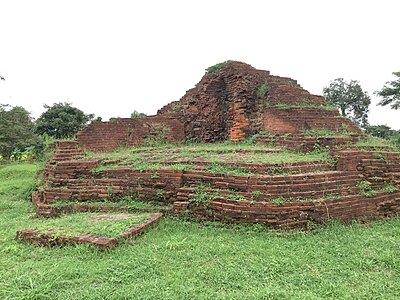
The imposing cylindrical brick stupa towering high before you served as the historic prototype for world-famous Buddhist monuments built centuries later, including the Shwezigon Pagoda in Pagan and the Shwedagon Pagoda in Yangon. Please look up at the soaring red brick masonry of this cylindrical structure. …
06 Silver Coins with Conch and Srivatsa Symbols
The small silver coins displayed in this enclosure served as the pioneering model for all first-millennium coinage across mainland Southeast Asia. This sophisticated silver monetary system represents the oldest and most widely circulated official currency in Southeast Asian history. Please examine closely the small silver coins and stone casting molds displayed inside the exhibit case. …
07 Closing
We have reached the final viewpoint of our audio tour across the Pyu Ancient Cities. Following repeated invasions by the Nanzhao Kingdom, the Pyu city-states gradually weakened, enabling Burman settlers to move into the Ayeyarwady River valley. Yet, the millennium-old Pyu civilization did not meet its end through violent destruction. Instead, the Pyu people and their refined culture were gently absorbed into the expanding Pagan Empire established in the mid-eleventh century. …