Contents
History & cultureBY TELLBY7 sections · numbered as on the map01 Orientation
Welcome to the Lascaux Cave audio tour, situated within the breathtaking landscape of the Vézère Valley in the Périgord Noir region of Dordogne, France. Inscribed on the UNESCO World Heritage list in 1979 under the title Prehistoric Sites and Decorated Caves of the Vézère Valley, this subterranean gallery is universally celebrated as one of the most astonishing artistic treasures created by Upper Paleolithic humans. The renowned prehistorian Henri Breuil famously proclaimed Lascaux to be the Sistine Chapel of Prehistory, the Versailles of Prehistory, and the French Altamira. Geologically, the cavern opened within a Coniacian limestone hill, protected from destructive water infiltration by an impermeable layer of marl. This unique natural seal kept the interior extraordinarily dry for tens of thousands of years, preventing ongoing calcite formation from obscuring the painted walls and preserving the vivid prehistoric mineral pigments in pristine condition. For millennia, this underground sanctuary lay silent beneath the earth. Its rediscovery began in September 1940, when a local teenager named Marcel Ravidat was walking through the woods and noticed his dog, Robòt, chasing a rabbit into a hole created by an uprooted tree. Sensing a vast subterranean chamber beneath the soil, Marcel returned four days later on September 12, 1940, accompanied by his friends Georges Agniel, Simon Coencas, and Jacques Marsal. Armed with a makeshift oil lamp and rudimentary tools, the four young explorers widened the opening, squeezed through the narrow entrance, and stepped into a world untouched for Ice Age generations, where stunning depictions of prehistoric beasts swept across the limestone surfaces. They quickly reported their discovery to their former schoolteacher Léon Laval and the distinguished archaeologist Henri Breuil, initiating an era of worldwide fascination and scientific investigation. A fundamental academic debate regarding Lascaux centers on whether its parietal art represents a single homogeneous composition created within a brief span or a complex accumulation of artwork executed across millennia. Scholars such as André Leroi-Gourhan and Annette Laming-Emperaire argued that the cave functioned as a unified sanctuary designed around 17,000 years ago within just a few centuries. In contrast, researchers like Paul Bahn, Maurice Thaon, and Abbé André Glory pointed to distinct stylistic variations, superimpositions, and radiocarbon data as evidence that the site was decorated over a far longer timeframe, extending across multiple phases from the Solutrean to the Magdalenian periods. As you follow the guided path today, you will encounter the profound technical mastery and enduring mysteries left behind by ancient creators. Step forward into the quiet shadow and listen to the prehistoric stories echoing through the stone.
02 Hall of the Bulls
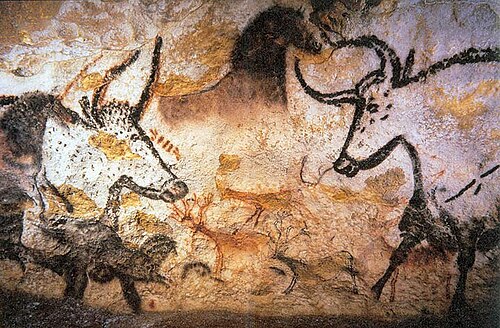
As you step into the magnificent chamber known as the Rotunda or the Hall of the Bulls, you are immediately confronted by an astounding masterpiece of prehistoric art, a giant black bull measuring over five meters in length, which represents the largest single figure ever discovered in Paleolithic cave art. …
03 Axial Gallery
Stepping into the Axial Gallery, you are immediately confronted by an astonishing sight, where a vibrant world of Ice Age animals unfolds across a soaring vaulted ceiling reaching up to four meters in height. To decorate this dizzying height, Paleolithic artists demonstrated remarkable engineering ingenuity by constructing temporary wooden scaffolding and ladders supported by oak timber beams fitted into natural rock ledges. …
04 The Nave
As you step into the soaring corridor of the Nave, you are immediately captivated by one of the most brilliant and visually inventive spatial compositions in all of Paleolithic art, the frieze of the Swimming Stags. Rather than depicting the full bodies of the animals, the prehistoric artist rendered only the heads, slender necks, and magnificent antlers of five stags arranged in a continuous horizontal sequence across the stone face, creating an astounding optical illusion of a herd swimming…
05 The Apse
As you step into the Apse, a compact, circular chamber measuring only a few meters in diameter, you are confronted by a truly mind-boggling artistic concentration, over one thousand fine line engravings etched densely across every available centimeter of the walls and ceiling vault. Out of nearly nineteen hundred recorded figures across the entire Lascaux Cave, more than half of all engravings are squeezed into this single, intimate round room, where countless fine lines overlap in intricate…
06 The Shaft
Standing before the opening of the dark five-meter deep vertical pit known as the Shaft, accessible from the floor of the Apse, you encounter the most secret, isolated, and enigmatic location in all of Lascaux Cave, containing the only depiction of a human figure in the entire subterranean complex. Among hundreds of animal figures painted throughout the main galleries, only inside this secluded, lower pit did prehistoric artists draw a bird-headed man falling backward in an extraordinarily…
07 Closing
Following its discovery in 1940 and subsequent site preparation, Lascaux Cave officially opened to the general public in 1948, captivating visitors from all around the globe. Between 1948 and 1963, more than one million tourists entered the fragile subterranean sanctuary. However, the constant daily influx of over one thousand visitors released 2,500 liters of carbon dioxide and 50 kilograms of water vapor into a confined cave volume of just 1,500 cubic meters, while artificial lighting raised…