 Photo Wikimedia Commons
Contents
History & cultureBY TELLBY7 sections · numbered as on the map01 Orientation
Welcome to Mtskheta, the ancient capital and sacred spiritual heart of Georgia. Situated just twenty kilometers north of Tbilisi, this extraordinary historic town rests peacefully at the scenic confluence of the Mtkvari and Aragvi rivers, nestled in a fertile lowland basin surrounded by the dramatic mountain ranges of the Greater and Lesser Caucasus. Founded in the fifth century BC, Mtskheta holds an unrivaled position in the nation's history and cultural identity. For nearly a millennium, until the fifth century AD when King Dachi transferred the royal seat to Tbilisi, Mtskheta flourished as the heavily fortified capital and thriving political, economic, and cultural core of the ancient Kingdom of Iberia. It was right here in Mtskheta, in the year three hundred thirty-seven AD, that Saint Nino converted King Mirian the Third and Queen Nana to the Christian faith, leading Iberia to officially adopt Christianity as its state religion. This monumental transformation laid the enduring foundation for Georgian art, literature, architecture, and spiritual heritage. Today, Mtskheta remains the revered headquarters of the Georgian Orthodox Church and stands as an eternal symbol of national faith. In recognition of its profound global significance, UNESCO designated the Historical Monuments of Mtskheta as a World Heritage Site in nineteen ninety-four. The UNESCO World Heritage site encompasses three extraordinarily significant architectural masterpieces: the hilltop Jvari Monastery, the majestic Svetitskhoveli Cathedral in the town center, and the tranquil Samtavro Monastery complex. Together, these exceptional monuments illustrate the brilliant evolution of medieval Caucasian ecclesiastical architecture spanning from the fourth to the eighteenth centuries. Positioned at the strategic crossroad of ancient international trade routes connecting the Roman, Persian, Syrian, and Byzantine empires, Mtskheta creatively absorbed diverse artistic traditions while perfecting its own distinct local traditions in stone carving, masonry crafts, metalworking, and pottery. To ensure these irreplaceable cultural treasures are protected against potential armed conflicts, UNESCO placed the Historical Monuments of Mtskheta under Enhanced Protection in twenty sixteen, in accordance with the Second Protocol to the nineteen fifty-four Hague Convention. As you embark on this audio guide journey, you step into a living sanctuary where thousands of years of human civilization, breathtaking stone craftsmanship, and unbroken spiritual devotion exist in complete harmony. Take a moment to admire the peaceful river waters merging below, and prepare to discover the timeless architectural marvels of Georgia's holiest city.
02 Jvari Monastery and the Overlook of Two Rivers
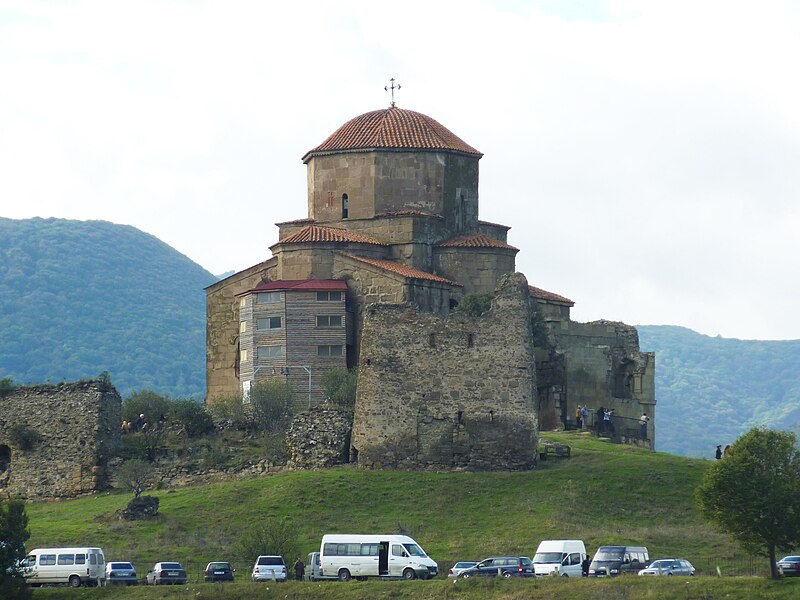
Perched dramatically on the precipitous edge of a bare rocky cliff six hundred fifty-six meters above sea level, Jvari Monastery has stood virtually unchanged since the late sixth century, remaining the foundational masterpiece of Caucasian cross-domed ecclesiastical design. As you walk over to the outer stone terrace wall at the cliff margin, pause for a moment and direct your gaze straight down into the wide valley basin where two historic rivers converge in an unforgettable visual spectacle. …
03 The Gates and Exterior Carvings of Svetitskhoveli
Constructed between the years ten ten and ten twenty-nine under the visionary patronage of Catholicos Patriarch Melchisedek the First, the monumental Svetitskhoveli Cathedral stands as the second largest church building in Georgia and a supreme masterwork of High Middle Age Caucasian architecture. Position yourself in the spacious cobblestone courtyard facing the northern exterior facade, and raise your sight toward the soaring central dome that reaches forty-two meters into the sky, taking in…
04 The Living Pillar and Ciborium Inside Svetitskhoveli
Housed beneath the very foundations of this sacred cathedral lies the Holy Robe of Jesus Christ, brought from Jerusalem to Mtskheta in the first century AD by a local Georgian Jew named Elias who was present at the Crucifixion. Walk along the soaring central nave and stop at the third massive stone pillar on your left from the main entrance, directing your visual attention to the large painted icon mounted directly upon the column face. …
05 Samtavro Monastery Main Church and Royal Tombs
Inside the quiet and deeply reverent main church of Samtavro Monastery lie the original fourth-century tombs of King Mirian the Third and Queen Nana, the historic royal couple who officially proclaimed Christianity as the state religion of Georgia in the year three hundred thirty-seven AD. As you step inside the early eleventh-century cross-domed sanctuary, turn your gaze toward the south-western corner of the nave to observe the modest stone funerary monuments resting peacefully beneath softly…
06 Saint Nino's Tiny Chapel and the Monastery Garden
Standing quietly in the convent garden is Saint Nino's Chapel, a tiny fourth-century stone building erected precisely on the sacred spot where the Enlightener of Georgia lived and prayed beneath a wild blackberry bush. Direct your visual attention to the small domed exterior of this miniature chapel nestled gracefully among the lush green monastery flower beds, noting its humble and intimate scale in striking contrast to the soaring cathedrals you visited earlier in the town center. …
07 Closing
As our audio guide tour of the Historical Monuments of Mtskheta draws to a close, we extend our heartfelt gratitude to you for journeying through Georgia's holiest city with us. From the breathtaking heights of Jvari Monastery where Saint Nino raised her iconic wooden cross overlooking the river confluence, to the monumental walls of Svetitskhoveli Cathedral housing Christ's Holy Robe beneath its Living Pillar, and the tranquil gardens of Samtavro Monastery where Georgia's first Christian…