Contents
History & cultureBY TELLBY7 sections · numbered as on the map01 Orientation
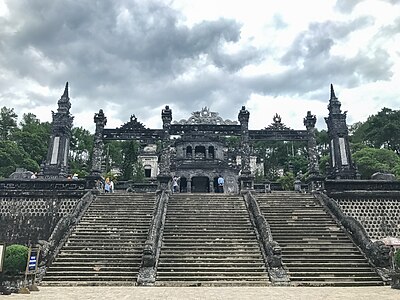
Welcome to the Tomb of Emperor Thieu Tri, a serene and historic jewel nestled within the ancient capital of Hue. Officially known as Xuong Lang, this remarkable imperial mausoleum serves as the final resting place for Emperor Thieu Tri, the third monarch of the Nguyen Dynasty. In 1993, this historic landmark received global acclaim when it was inscribed as a key part of the UNESCO World Heritage listed Complex of Hue Monuments. This prestigious designation recognizes the exceptional architectural value of the complex, where traditional royal design merges effortlessly with the surrounding natural environment. Emperor Thieu Tri ruled Vietnam with great devotion, but facing his final days, he issued a humble decree to his son and successor, Emperor Tu Duc. He requested that his final resting place be constructed with utmost frugality, avoiding lavish decoration or unnecessary burden on the labor force and national treasury. True to his father instructions, Emperor Tu Duc appointed senior official Vu Van Giai in 1848 to direct the construction. Through remarkably efficient organization and dedicated craftsmanship, the primary structures were assembled rapidly, and the entire mausoleum complex was fully completed in less than ten months. Geomantically, Xuong Lang occupies a truly unique position among royal tombs in Hue. Situated at the base of Thuan Dao Mountain, it is the only major imperial mausoleum of the Nguyen Dynasty oriented toward the northwest. Rather than relying on heavy artificial outer walls to enclose the site, the designers cleverly incorporated the surrounding natural terrain. Prominent geographic features, including Thuan Dao Mountain, Ngoc Tran Mountain, Vong Canh Hill, Cham Mountain, and the flowing Perfume River, form a magnificent natural barrier around the sacred grounds. This harmonious arrangement illustrates the classical feng shui concept where mountains halt and waters converge. Spanning spacious grounds in the countryside, the complex is divided into two distinct parallel zones set a short distance apart, separating the temple area for spirit worship from the tomb area where the monarch rests. As you stroll along these quiet paths today, you are invited to explore a timeless landmark where imperial history, royal filial piety, and natural harmony coexist in perfect peace.
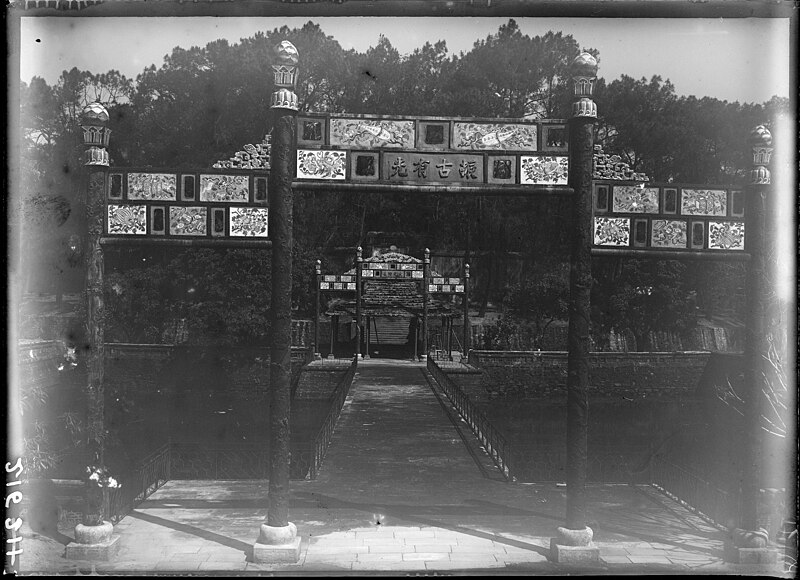
02 Dien Lake and Marble Ceremonial Gate
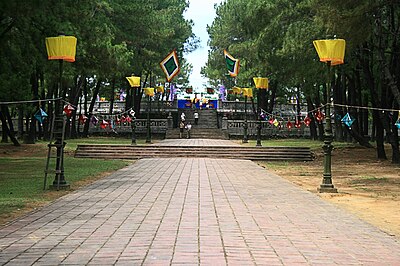
Remarkably, this entire worship sector was constructed in less than ten months while strictly copying the structural regulations established at the tomb of Emperor Gia Long down to the millimeter. At the entrance to the worship area, stand before the tranquil half moon shaped Dien Lake and gaze directly across its calm waters toward the magnificent marble ceremonial gate that welcomes visitors into the sacred domain. …
03 Hong Trach Gate and Bieu Duc Temple
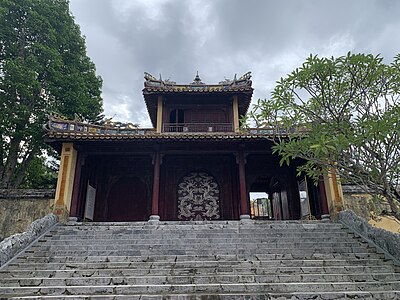
Inside Bieu Duc Temple and upon the wooden panels of Hong Trach Gate, over four hundred and fifty beautifully carved poem panels form an astonishing literary archive preserved in timber. As you step through the watchtower pavilion of Hong Trach Gate, gaze directly toward the impressive double roof of Bieu Duc Temple adorned with dynamic dragon sculptures along its ridges, and observe the sacred altars housed within. …
04 Salutation Courtyard and Stele Pavilion
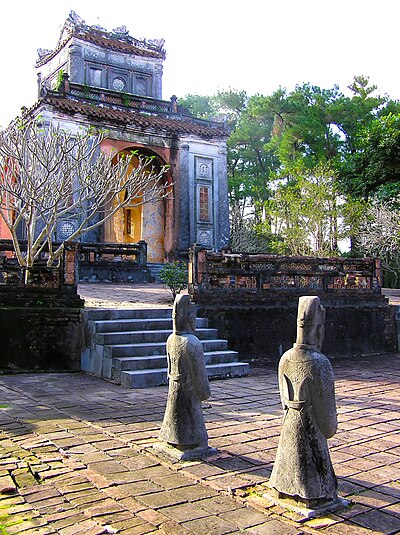
Along the central blue stone pathway bisecting this expansive courtyard, stone statues of civil and military mandarins, horses, and elephants stand in perpetual guard to honor the eternal memory of the emperor. After passing through the cast bronze ceremonial gate decorated with vibrant dragon and cloud motifs beyond the half moon shaped Nhuan Trach Lake, cast your eyes across the brick courtyard toward the stone figures and the square Stele Pavilion elevated upon a platform two point six five…
05 Duc Hinh Pavilion Foundation and Three Stone Bridges
Although the pavilion itself was lost to time, the square foundation resting atop a low hill shaped like a turtle shell and three rainbow stone bridges create a perfectly balanced scene that captivates every visitor. Look toward the eighteen point five meter square brick foundation flanked by two tall brick pillars on the turtle shell hill, and then direct your gaze downward to the crescent shaped Ngung Thuy Lake and its three stone bridges. …
06 Buu Thanh Wall and Underground Burial Tunnel
Inside this circular brick wall measuring two hundred and sixty meters in perimeter, a dense pine forest thrives in silent serenity, gently sheltering the true underground resting place of the emperor. Look directly at the tightly sealed bronze doors, the towering circular brick wall of Buu Thanh, and the lush green pine canopy rising high above the masonry. …
07 Closing
Surrounding the main complex of Thieu Tri Tomb are the quiet resting places of his royal family, forming a touching heritage ensemble in the countryside. Positioned toward the front near the bank of the Perfume River is Hieu Dong Tomb, constructed between 1841 and 1843 for the emperor mother, Empress Ho Thi Hoa. …