 Photo Wikimedia Commons
Contents
History & cultureBY TELLBY7 sections · numbered as on the map01 Orientation
Welcome to the Kazakhstani sector of the Western Tian Shan, an extraordinary mountain domain of majestic landscapes and global ecological significance. As you stand near the historic entry point of the Aksu-Zhabagly State Nature Reserve, you are gazing upon an untouched wilderness that forms a vital component of one of the seven largest mountain systems on Earth. On July seventeenth in the year two thousand sixteen, during the fortieth session of the World Heritage Committee held in Istanbul, UNESCO inscribed the Western Tian Shan onto the World Heritage List as a natural property. This prestigious international recognition celebrates the region for containing superlative natural phenomena, exceptional aesthetic importance, and invaluable natural habitats critical for the in-situ conservation of biological diversity. Spanning across the Turkistan and Zhambyl regions, the Kazakhstani sector encompasses the Karatau Nature Reserve, Sairam-Ugam National Park, and the Aksu-Zhabagly Reserve, which features a core protected property zone of one hundred thirty-one thousand seven hundred four hectares and a buffer zone of twenty-five thousand eight hundred hectares. Elevation across these rugged mountain ranges spans dramatically from seven hundred meters to four thousand five hundred three meters above sea level. This massive vertical range creates a rich tapestry of contrasting ecosystems, where semi-deserts transition into lush foothills, dense mountain woodlands, alpine meadows, and perpetual glaciers. The Western Tian Shan is celebrated worldwide as the ancient evolutionary birthplace of wild fruit and nut species that have sustained humanity for centuries. Ancient merchant caravans traveling along historical Silk Road routes gathered wild sweet apples, apricots, pistachios, and walnuts from these fertile mountain slopes to carry across continents. Today, this living sanctuary preserves an irreplaceable global gene pool, safeguarding natural genetic resistance against agricultural pests and environmental changes. Beyond its botanical riches, this reserve protects endangered wildlife, including the elusive snow leopard, the Karatau wild sheep, and the unique Menzbier marmot. Neighboring communities in Zhabagly and Abaiyl contribute to this conservation landscape, where ancient nomadic ancestors looked up at the towering snow peaks reaching into the clouds and reverently named them Khan Tengri, meaning King of the Sky. Prepare to step through this gateway as the living story of Central Asian biodiversity opens before you.
02 The Entry Gateway: Central Asia's Oldest Nature Reserve
Welcome to the historic entrance gateway of the Aksu-Zhabagly State Nature Reserve, a legendary natural sanctuary that holds the prestigious distinction of being the very first and oldest nature reserve established in Central Asia, officially founded in the year nineteen twenty-six. Look right now at the massive wooden arch gate and the carved stone monument welcoming travelers at the reserve entry point directly in front of you. …
03 Ancestral Orchards and Wild Tulips
Every single time anyone anywhere on Earth bites into a crisp domestic apple, they are tasting a fruit that traces its ultimate genetic ancestry directly back to the ancient wild apple orchards of the Western Tian Shan. Scientific genetic mapping has revealed the mind-blowing reality that approximately forty-six percent of the total genetic makeup of modern cultivated apples originates from Malus sieversii, the ancestral wild apple species endemic to these mountain slopes. …
04 Aksu Canyon: The 500-Meter Chasm
As you step onto the wooden viewing platform at the edge of the precipice, prepare yourself to behold one of the most magnificent geological marvels in Central Asia: Aksu Canyon, a breathtaking chasm that plunges five hundred meters straight down into the earth. Gaze straight down right now over the wooden safety railing, taking in the awe-inspiring spectacle of the turquoise Aksu River carving its relentless course through vertical, sheer limestone walls below. …
05 Petroglyphs: Whispers of Nomadic Prehistory
As you step onto this sunlit rocky outcrop, you are entering an open-air gallery of prehistoric art where ancient nomadic hunters and stone carvers etched thousands of petroglyphs directly into mountain rock surfaces thousands of years ago. Look closely right now at the dark, sun-baked boulder resting at your feet on the right edge of the trail. …
06 High Mountain Juniper Forest and Snow Leopard Realm
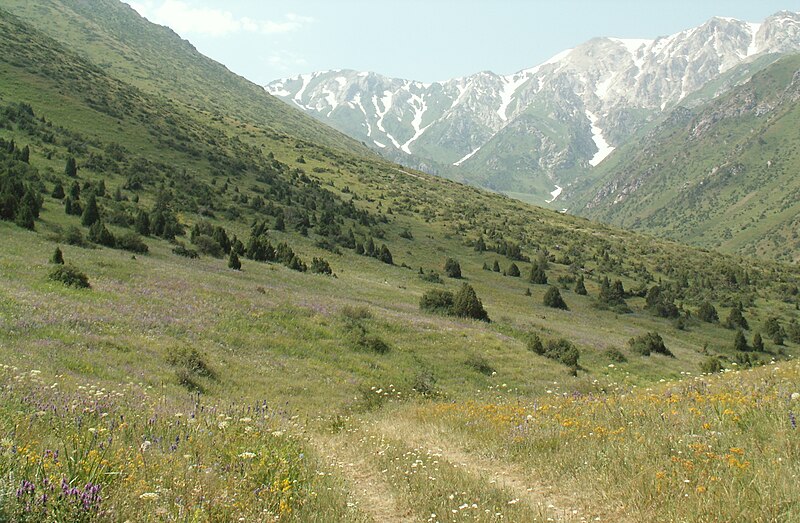
As you arrive at this elevated observation deck surrounded by fragrant juniper woodlands, you have entered the untamed high-altitude realm where rare wildlife, including the elusive snow leopard and the endemic Menzbier marmot, roam the craggy peaks above. Raise your eyes right now toward the soaring, snow-draped mountain ridge stretching dramatically across the horizon ahead of you. …
07 Closing
As our audio walking tour comes to a gentle close, take a moment to pause and gaze once more at the soaring snow-draped peaks of the Western Tian Shan rising majestically into the Central Asian sky. Ancient nomadic ancestors looked up at these colossal mountain ranges with deep reverence, calling them Khan Tengri, the Heavenly Mountains, honoring a landscape where pristine nature and human spirit have lived in harmony for thousands of years. …