Contents
History & cultureBY TELLBY6 sections · numbered as on the map01 Orientation
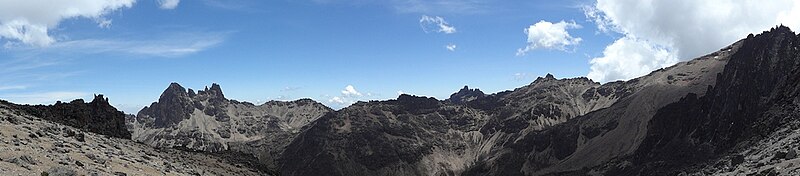
Welcome to Mount Kenya National Park, a world-renowned natural heritage site established to protect the grand mountain landscape and the rich biodiversity surrounding Africa's second highest peak. Mount Kenya is built upon the foundations of an ancient extinct stratovolcano that was active millions of years ago. Geological records indicate that during its peak volcanic period, the mountain reached a staggering elevation of approximately six thousand five hundred meters above sea level. Although immense glacial erosion, relentless weathering, and atmospheric forces over vast spans of time reduced its original height, the massif still presents one of the most visually extraordinary landscapes in East Africa, characterized by steep jagged summits, dramatic rock precipices, and deep U-shaped valleys sculpted by ancient ice flows. Mount Kenya occupies a remarkable ecological transition zone of tremendous scientific importance. The protected area spans from the high-altitude alpine realm, home to bizarre afro-alpine flora and rare endemic botanical species, down through dense cloud forests to the lower scenic foothills. It seamlessly connects with the semi-arid savanna grasslands incorporated within the Lewa Wildlife Conservancy and Ngare Ndare Forest Reserve. First protected as a national park in 1949, this extraordinary sanctuary was inscribed as a UNESCO World Heritage Site in 1997 in recognition of its outstanding universal value, exceptional natural beauty, and irreplaceable ecological processes. Beyond its aesthetic and biological significance, Mount Kenya functions as a vital water catchment tower for the entire surrounding region. The nutrient-rich volcanic sediment in the soil, combined with the continuous discharge of pure freshwater flowing down from the high slopes, feeds major river systems and sustains millions of people, livestock, and agricultural lands in the surrounding plains. However, the delicate tropical glaciers that rest near the summit are currently undergoing alarmingly rapid retreat due to shifting atmospheric conditions and global climate trends. As you begin your journey through this sacred and dynamic mountain landscape, take time to appreciate the immense geological history and the profound ecological changes taking place around you. Enjoy your memorable walk into the extraordinary heart of Mount Kenya National Park.
02 Mount Kenya Forest Reserve and Elephant Migration Route
The vast forest reserve encircling Mount Kenya National Park plays an irreplaceable role as the primary drainage basin and natural reservoir for the region's freshwater supply while hosting an extraordinary concentration of biological diversity. Look toward the dense forest canopy and the electric fencing along the lower border. …
03 The Vanishing Lewis Glacier and Rock Split
Between 2004 and 2016, Lewis Glacier, the largest remaining ice body on Mount Kenya, lost forty-six percent of its surface area and fifty-seven percent of its total ice volume in an alarmingly rapid phase of recession. Look at the exposed central rock ridge rising through the middle of the ice. This dark, jagged rock outcrop rising prominently through the ice sheet provides a striking visual testament to the dramatic structural disintegration of what was once a single, continuous glacier. …
04 Batian Peak and Tropical Glacier Monitoring
Mount Kenya was once a colossal active stratovolcano that reached an estimated height of six thousand five hundred meters above sea level during its main eruptive phase millions of years ago, before unrelenting glacial erosion carved it down to its present central peak structure. Look upward at the steep vertical rock walls of Batian and Nelion rising dramatically into the sky. Before you stand the towering twin summits of Batian and Nelion, the highest points of the mountain massif. …
05 Austrian Hut and Periglacial Ground Transition
Mount Kenya holds the longest continuous record of direct glaciological and meteorological monitoring in the entire global tropics, providing scientists with an invaluable historical baseline for low-latitude climate studies. Look toward the small refuge structure known as Austrian Hut resting at an elevation of 4,790 meters above sea level. …
06 Closing
Thank you for exploring Mount Kenya National Park with us today. The fragile tropical glaciers we observed during this audio journey are declining at an unprecedented pace, and glaciological projections warn that if current retreat rates prevail, all ice bodies on Mount Kenya will be completely extinct before 2030. …