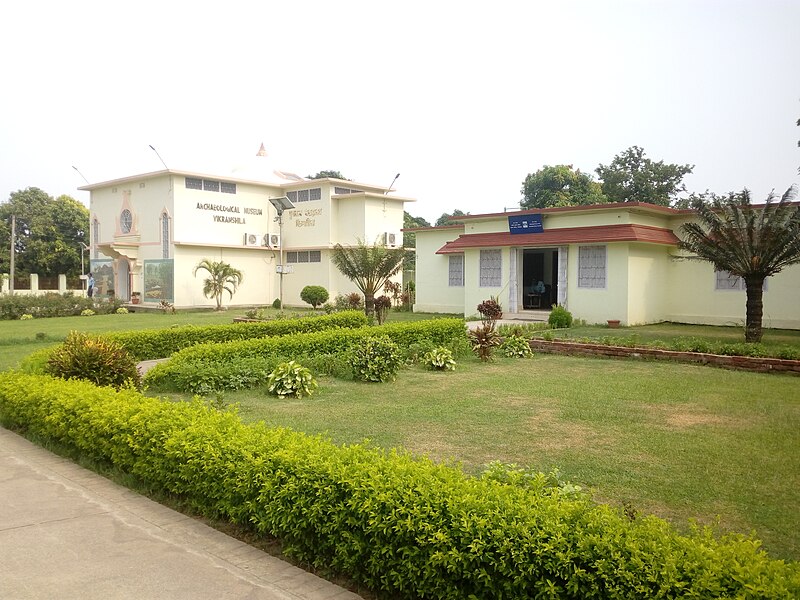
 Photo Wikimedia Commons
Contents
History & cultureBY TELLBY8 sections · numbered as on the map01 Orientation
We extend our warmest welcome to all visitors arriving at Vikramaśīla Mahāvihāra, situated near the southern banks of the River Ganges in Antichak village within the Bhagalpur district of Bihar, India. As you stand here at the orientation point of this expansive historical site, you are gazing upon a monumental sanctuary that once represented the ultimate flowering of Buddhist learning under the Pāla Dynasty. The Pāla Empire ruled Bihar and Bengal from the eighth to the twelfth century CE. While traditional historiography has long attributed the initial founding of this university to King Dharmapāla between the late eighth and early ninth century, modern scholarly analysis demonstrates that it was the third Pāla monarch, King Devapāla, who formally established Vikramaśīla as an official imperial institution known as Vikramaśīladevamahāvihāra during his reign from 812 to 850 CE. The name Vikramaśīla derives from an imperial title, translating to one who possesses prowess as an inborn or acquired character trait.
Look out across the sweeping green lawns surrounding you, where red-brick foundations reveal the immense scale of this ancient university. Vikramaśīla stood alongside the celebrated Nālandā University as one of the twin pillars of Buddhist intellect in Eastern India. During its golden age, Vikramaśīla eclipsed other major regional monastic centers such as Somapura, Trikaṭuka, Uddaṇḍapura, and Jagaddala, eventually assuming direct administrative and academic oversight over Nālandā itself.
What uniquely distinguished Vikramaśīla from all other monastic institutions of its era was its specialization as the sole university dedicated to Tantric and occult studies. During an age when both Mahāyāna Buddhism and Śaiva traditions embraced esoteric rituals, magic, and occult sciences, Vikramaśīla served as the supreme continental center for Tantric scholarship. Alongside esoteric doctrines, rigorous instruction was offered in theology, philosophy, grammar, metaphysics, and logic, drawing thousands of eager monks and scholars from Eastern India, Tibet, and the Kathmandu Valley of Nepal.
Around the year 1200, political turmoil and military raids led by the Afghan commander Muhammad Bakhtiyar brought violent destruction upon the university, leaving its magnificent structures in ruins. Following the loss of royal patronage, this intellectual citadel lay buried for centuries. Today, through extensive conservation by the Archaeological Survey of India and ongoing efforts to establish a Central University at Antichak village, Vikramaśīla is undergoing a majestic rebirth. Step forward along the designated path and prepare to immerse yourself in the enduring legacy of ancient wisdom.
02 The Main Entrance Gateway and Fortified Enclosure
We now guide your attention to the main entrance gateway and the surrounding remains of the monumental fortified enclosure wall. As you stand before this massive entrance, look closely at the thick red-brick foundations beneath your feet and the formidable doorway threshold. Vikramaśīla Mahāvihāra was meticulously planned as an immense square compound, completely enclosed and protected by robust perimeter walls that isolated the academic sanctuary from the outside world. …
03 The Great Central Stupa at the Heart of the Monastery
As you step into the vast central quadrangle of the monastery, the grand brick monument known as the Great Central Stupa rises majestically before you. Cast your eyes upward along the rising terraced levels of this colossal central structure, which stands at the exact geometric center of the entire Vikramaśīla Mahāvihāra layout. This monumental stupa served as the sacred focal point for all religious rituals, ceremonial circumambulations, and academic convocations. …
04 Monastic Cells and the Halls of Great Scholars
As you walk along these rows of small brick cells surrounding the stupa, you enter the vast residential quarters of the ancient monastery. At Vikramaśīla Mahāvihāra, hundreds of compact brick monastic cells were systematically arranged in a grid along the inner perimeter of the outer fortified wall. Each cell provided a private, austere sanctuary where individual monks resided, observed strict monastic discipline, and conducted advanced textual research. …
05 The Ancient Library Building and Manuscripts Preservation
We now guide you to the ancient foundation of a unique separate building identified by archaeologists as the monastery library. Look to your side at the narrow brick pathway connecting the main quadrangle to this secluded structure, and notice the subterranean ventilation shafts along the lower brick walls. …
06 The Scriptorium, Proto-Bengali Script, and Scribes
Step into this historic courtyard of the scriptorium, where manuscript production at Vikramaśīla Mahāvihāra took place. In ancient India, copying sacred scriptures and funding manuscript production were regarded not only as essential academic endeavors but as highly meritorious religious acts known as deyadharma. Within Vikramaśīla's active scriptorium, master scribes and scholar-monks gathered to transform raw palm leaves into exquisite, standardized codices. …
07 Archaeological Discoveries and Artifacts at Antichak
Visitors are now standing at the active archaeological excavation site and artifact display area in Antichak village. Look closely at the active excavation surface and artifact display area, where the material history of this ancient institution is laid bare before you. For centuries, the magnificent remains of Vikramaśīla Mahāvihāra lay buried beneath mounds of earth. …
08 Closing
As we conclude our audio tour of Vikramaśīla Mahāvihāra, look across the vast expanse of red-brick foundations sweeping across the plain before you. Let us reflect upon the four centuries of vibrant intellectual history that once flourished among these sacred ruins. Initiated through the visionary foundation of King Dharmapāla in the late eighth century and formally established as a grand royal institution under King Devapāla in the ninth century, this monumental university shone as the…