 Photo Wikimedia Commons
Contents
History & cultureBY TELLBY7 sections · numbered as on the map01 Orientation
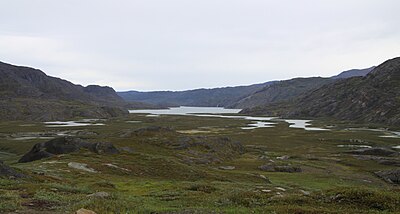
Located inside the Arctic Circle in the central part of West Greenland, the Aasivissuit – Nipisat cultural landscape contains the remarkably well-preserved remains of four thousand two hundred years of human history. This extraordinary territory stretches along a two hundred thirty-five kilometer transect running east to west, extending from Nipisat Island in the Davis Strait to the edge of the vast Greenland Ice Sheet. Over four millennia, successive fisher-hunter-gatherer cultures adapted to the challenging Arctic climate, creating an organically evolved and continuing cultural landscape centered on seasonal migrations and the sustainable hunting of marine and terrestrial animals. The property encompasses a remarkably diverse range of ecosystems including oceans, rocky fjords, coastal islands, inland valleys, and the high ice cap, all of which supported human life across changing historical eras. Throughout this immense expanse, archaeological sites and historical structures bear silent witness to the distinct living traditions of the Saqqaq culture from twenty-five hundred to seven hundred BC, the Dorset culture from eight hundred BC to AD one, the Thule Inuit from the thirteenth century onward, and the colonial period beginning in the eighteenth century. Across seven key localities, from the western coast to the eastern ice margin, the landscape preserves large winter communal houses, seasonal hunting camps, drive systems for caribou, stone meat caches, and ancient graves. Beyond these tangible attributes, the property embodies a rich intangible cultural heritage comprising traditional knowledge of seamanship, weather prediction, food preservation, and Arctic survival strategies. As we begin this journey along the ancient seasonal routes from the sea to the ice, we explore a landscape that demonstrates the incredible resilience of human culture, the deep harmony between people and nature, and an enduring legacy of survival in one of the most extreme environments on Earth. The whistling polar winds and the rhythmic crashing of North Atlantic waves against the rocky archipelago establish an unforgettable acoustic backdrop to this journey. Walking these ancient paths offers a profound moment of reflection on how human societies can thrive in perfect equilibrium with their surrounding environment over thousands of years. Let us step forward together into this ancient Arctic realm, listening closely to the voices of the past echoing across the sweeping tundra and frozen fjords.
02 Nipisat Island: Traces of the Ancient Saqqaq Culture
Four thousand years ago, amid the extreme cold of the Arctic, the people of this island survived by harvesting marine animals using only vessel-shaped stone implements and refined bone tools. Look toward the expansive sea surface stretching out beyond the rocky hill on your left. Nipisat Island, located at the westernmost extremity of the World Heritage site in the Davis Strait, contains exceptionally well-preserved archaeological evidence of the ancient Saqqaq culture. …
03 Innap Nuua: Communal Winter Houses of the Thule
Inside a massive stone house reaching twenty-five meters in length, dozens of family members shared their body heat to endure the brutal nights of the Arctic winter. Raise your eyes and look at the contours of the gently breached stone wall directly in front of you. Innap Nuua is a major winter settlement site established by the Thule Inuit. …
04 Sarfannguit: A Living Village from the Colonial Era
Established in 1843, this small and quiet village remains the sole inhabited settlement within the site where residents continue to hunt and fish across land and sea just as their ancestors did centuries ago. Look at the weathered wooden walls of the colonial-era building standing among the brightly colored houses on your right. …
05 Itinnerup Tupersuai: The Intermediate Summer Camp
This exact location served as a cherished rest stop centuries ago where hunting families paused to catch their breath after trekking tens of kilometers along rugged mountain trails and stream valleys. Look down at the ring of stones arranged in a circle amidst the tundra grass beneath your feet. Itinnerup Tupersuai provides a textbook example of an intermediate summer camp used by Inuit families during the eighteenth and nineteenth centuries. …
06 Aasivissuit: The Great Caribou Hunting Ground
Stretching an astonishing three point nine kilometers in length, this massive stone fence system represents the largest and most sophisticated prehistoric caribou drive system in all of Greenland. Look up at the prominent lines of stone cairns and wall structures running along the ridge toward the distant horizon. …
07 Closing
Our four thousand two hundred year journey across the Aasivissuit – Nipisat cultural landscape, extending two hundred thirty-five kilometers from Nipisat Island in the western ocean to Aasivissuit near the eastern ice cap, now comes to its conclusion. This vast territory stands as an extraordinary testament to the resilience, ingenuity, and sustainable adaptability of human cultures facing the extreme conditions of the Arctic environment. …