 Photo Wikimedia Commons
Contents
History & cultureBY TELLBY7 sections · numbered as on the map01 Orientation
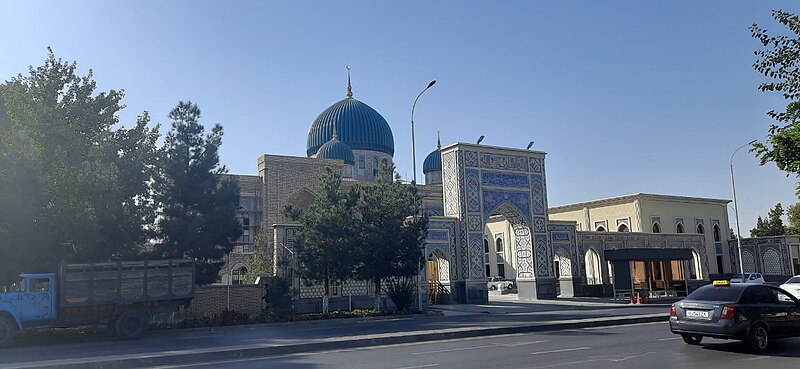
Welcome to the sacred Abdidarun Complex, a serene sanctuary nestled quietly inside the eastern fortress wall of ancient Samarkand. As you step into this tranquil space, you are entering a location of profound historical and spiritual resonance that captures the timeless spirit of Central Asia. Recognized as a core part of the UNESCO World Heritage Site designated under the title Samarkand Crossroads of Cultures in the year two thousand and one, this historic city has served for millennia as a vibrant meeting point where Eastern and Western civilizations, religions, trade routes, and artistic traditions intersected and enriched one another. You do not need to be an expert in medieval architectural history to feel the distinct sense of peace, reverence, and spiritual calm that permeates every corner of this holy ground. To fully appreciate where you are today, let us first explore the fascinating meaning behind the name Abdidarun. In the local language, the word Darun literally translates to inside the city wall. This term stands in direct, intentional contrast to its sister shrine known as Abdiberun, where the word Birun signifies outside the city wall. Thus, Abdidarun denotes the sacred sanctuary located safely within the protective boundary of Samarkand's ancient fortification walls. The origins of this complex trace back to the ninth century, built around the final resting place of the highly esteemed Islamic jurist Abd al-Maziddin, who was revered across the region for his deep wisdom, judicial integrity, and piety. Following his passing around eight hundred and sixty-one, his personal garden transformed into a cherished site of pilgrimage. Over the subsequent centuries, through the Seljuk era in the twelfth century, the glorious Timurid dynasty in the fifteenth century, and into the early twentieth century, successive generations added mausoleums, grand gathering halls, water basins, mosques, and shaded corridors to create the magnificent architectural ensemble you see today. Spread across an expansive area of fifteen hectares, the Abdidarun Complex represents far more than an ancient architectural monument; it is a living symbol of spiritual continuity, environmental harmony, and cultural synthesis. Here, among the shaded courtyards, ancient unglazed baked bricks, vivid blue tilework, and ever-flowing natural spring waters, you can escape the bustling energy of the modern city and connect with the deep, layered history of Samarkand. In this audio tour, we will guide you step by step through the northwestern gate, along the peaceful corridor, around the healing octagonal pond, into the grand Timurid gathering hall, and finally to the innermost shrine where the saint rests. Please take a quiet moment to breathe in the calm atmosphere and prepare your heart to embark on this memorable journey through time.
02 The Northwest Gate and Peaceful Path
Let us begin our exploration with a surprising revelation: this northwest entrance facing Sadriddin Aini Street and the peaceful corridor extending from it were newly constructed in the early twentieth century as a secluded passage cut directly through an ancient public cemetery. Look at the wooden arched gate standing gracefully before you and the long, serene corridor extending beyond it into the inner sanctuary. …
03 The Courtyard and Sacred Spring Pond
Look at the exquisitely crafted octagonal water surface in the center of the courtyard and the gentle shade cast by the surrounding native trees. As you step into the inner courtyard of the Abdidarun Complex, this tranquil pond immediately presents itself as the cooling, central focal point of the entire sanctuary. Behind its serene, reflective surface lies a remarkable hydrological fact that has amazed visitors for generations. …
04 The Timurid Grand Khanqah
Consider a remarkable architectural fact: the towering facade and soaring central dome of this grand hall, the largest structure within the complex, were completed in the first half of the fifteenth century under the direct patronage of Ulugh Beg, the legendary Timurid astronomer-king. Raise your eyes to look up at the grand entry arch, the intricate tile decorations on the facade, and the majestic dome soaring high above it. …
05 Mausoleum and Inner Shrine of Khwaja Abdi
Consider an astonishing historical origin: this sacred inner sanctuary, where the ninth-century jurist Abd al-Maziddin rests, began in the early twelfth century as an exceptionally small octagonal cube structure erected by order of Sultan Sanjar of the Seljuk Empire. Look at the saint's tomb resting in the center of the inner mausoleum and the decorated walls of the Ziyaratkhana prayer room. …
06 The Western Mosque and Master Craftsmen's Legacy
Listen closely to a remarkable hidden detail: concealed within the ornate wall paintings and painted wood carvings of this western mosque are the preserved signatures of the four master craftsmen who created this masterpiece in the early twentieth century. Examine closely the detailed carvings on the wooden columns on your left and the brilliant colorful patterns painted across the ceiling above. …
07 Closing
Today, we have journeyed together through the sacred realm of the Abdidarun Complex, one of Samarkand's most profound, historic, and peaceful cultural treasures. What began in the ninth century as the quiet personal garden of the respected judge Khwaja Abdi, Abd al-Maziddin, has evolved through more than a millennium of continuous history into the magnificent sanctuary you see before you today. …