Contents
History & cultureBY TELLBY7 sections · numbered as on the map01 Orientation
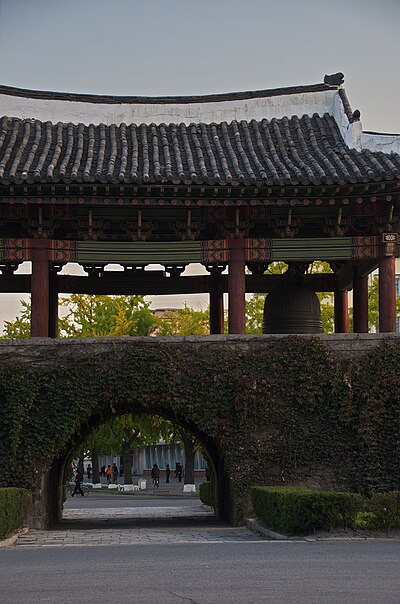
Welcome to the professional audio guide introducing the Bell of Yonbok Temple, located at the heart of the historic city of Kaesong. Kaesong stands as a monumental testament to the magnificent cultural legacy of the Koryo dynasty, an era that achieved extraordinary artistic and technological heights in East Asian history. Preserving numerous historic relics and cultural treasures, this ancient capital offers an unforgettable journey into centuries past. Today, you are standing before Kaesong Namdae Gate, an iconic architectural structure that has silently protected the city for hundreds of years. Resting securely inside the upper storey of this historic gate is the famed Bell of Yonbok Temple, a monumental treasure that embodies the supreme metal casting craftsmanship and dramatic historical vicissitudes of the Koryo era. Beyond serving a practical role as a timekeeper, this bell encapsulates remarkable artistic refinement and profound historical resonance.
The Bell of Yonbok Temple was originally cast in the year 1346 during the Koryo period. It represents a masterwork created through the highly sophisticated metallurgical expertise of contemporary Korean artisans. Initially hung within the precinct of Yonbok Temple, the bell experienced a critical turning point in 1563 when the temple was completely destroyed by a catastrophic fire. Determined to save such an irreplaceable cultural treasure from destruction, the people of the time carefully relocated the undamaged bronze bell to the upper storey of Kaesong Namdae Gate for permanent preservation. Through this historic movement from a Buddhist temple to a prominent city gate, the bell was transformed into a guardian voice for the entire city, surviving unscathed for over eight centuries. Recognized today as National Treasure Number 136 of North Korea, it is celebrated alongside the bells of Sangwon Temple and Pongdok Temple as one of the three most famous historic bells in the Democratic People's Republic of Korea.
Our audio guide tour is structured to provide an insightful exploration of the Bell of Yonbok Temple from your viewing position at Namdae Gate. We will begin by examining the upper storey structure and learning about the dramatic historical journey of the bell's relocation. Next, we will direct our attention upward to observe the apex of the bell, where two intricately tangled dragons form the bell hook with dynamic vitality. We will then examine the middle portion of the bell, where inscriptions rendered in six distinct ancient scripts convey a message of regional peace. Furthermore, we will explore the elegant relief decorations covering the exterior surface, including representations of the Buddha alongside tortoises, crabs, dragons, phoenixes, and deer. Finally, we will contemplate the physical scale of this 14-ton bell, its sound reaching up to four kilometers, and its long legacy as Kaesong's official timekeeper. Please follow our guidance as we begin this memorable exploration.
02 The Bell Relocated to Namdae Gate
The astonishing fact that a national treasure bell, which originally echoed grandly across the spacious precinct of Yonbok Temple, was safely relocated to the upper storey of Kaesong Namdae Gate following a devastating fire in 1563 and has been dramatically preserved to this day presents a truly dynamic plot twist in the history of Korean cultural heritage.
Please raise your eyes and gaze slowly at the upper pavilion resting grandly atop the stone foundation of Kaesong Namdae Gate. …
03 Two Tangled Dragons of the Bell Hook
The bell hook, or Yongnyu, decorating the apex of the Bell of Yonbok Temple stands as a supreme masterpiece of traditional Korean metal craft, brilliantly capturing an intrepid spirit as two massive dragons intertw frantically, wriggling as if they were alive.
Please look closely at the very top of the bell, where the metal hook is twisted in an amazingly dynamic form. …
04 Inscriptions in Six Scripts
The presence of inscriptions written in six entirely distinct ancient scripts—including Chinese, Sanskrit, Mongolian, and Tibetan—engraved together on a single bronze bell stands as a remarkably rare and astounding historical fact among world metal artifacts.
Please move closer and examine the dense rows of text carved precisely around the middle waist portion of the bell. …
05 Elegant Reliefs of Animals and Buddha
The exterior surface of the Bell of Yonbok Temple evokes profound admiration because it is meticulously covered with vivid relief sculptures featuring not only the sacred figure of the Buddha but also a rich variety of natural and mythical creatures including tortoises, crabs, dragons, phoenixes, and deer.
Please focus your eyes on the series of lines engraved along the middle of the bell, dividing the upper from the lower part, and observe the relief figures artfully arranged around them. …
06 The Resonant Sound Over 4 Kilometers
The astounding fact that striking this massive bronze bell—weighing about 14 tons, standing 3.3 meters high, measuring 23 centimeters in thickness, and having a mouth diameter of 1.9 meters—produced a resonant sound that could be heard 4 kilometers away remains truly astonishing.
Please carefully gauge with your eyes the impressive mouth diameter of 1.9 meters and the extraordinary wall thickness of 23 centimeters. …
07 Closing
We express our deepest gratitude to all of you for joining this audio guide exploration of the Bell of Yonbok Temple, recognized as the supreme essence of Koryo metal craft and designated as National Treasure Number 136 of North Korea. Today, through this monumental bronze bell resting in the upper storey of Kaesong Namdae Gate, we have experienced a vivid encounter with eight centuries of brilliant cultural pride and dramatic history. …