Contents
History & cultureBY TELLBY8 sections · numbered as on the map01 Orientation
Welcome to Vijayanagara, the historic City of Victory and the grand capital of one of medieval India's most powerful empires. As you step onto this sacred ground along the banks of the Tungabhadra River in Karnataka, you are entering a landscape where ancient Hindu mythology, royal heritage, and architectural splendor are inextricably linked. Long before it became the seat of an empire, this region was revered as Hampi, a holy pilgrimage site whose name derives from Pampa, an epithet of the goddess Parvati. According to the Sthala Purana, Parvati pursued her intense ascetic penance on Hemakuta Hill to win the devotion of Lord Shiva, who thus came to be worshiped here as Pampapati, while the river itself took the name Pampa. This terrain is also deeply enshrined in the Ramayana as Kishkindha, the mythical monkey kingdom where Lord Rama and Lakshmana met Hanuman and Sugriva to form their legendary alliance during the quest for Sita.
The historical rise of the empire began in 1336 CE during an era of profound political instability. As armies of the northern Delhi Sultanate under the Khalji and Tughlaq dynasties repeatedly invaded the Deccan, plundering established regional realms including the Hoysala, Kakatiya, Seuna Yadava, and Kampili kingdoms, two resilient brothers named Harihara the First, also known as Hakka, and Bukka Raya the First came forward. Guided by the spiritual wisdom of Saint Vidyaranya from the Sringeri Math, they founded a new realm and established the Sangama dynasty. Over the next three centuries, spanning the Sangama, Saluva, Tuluva, and Aravidu dynasties, Vijayanagara expanded into a sprawling metropolis encompassing six hundred and fifty square kilometers.
By 1500 CE, Vijayanagara stood as the second largest city in the medieval world after Beijing and the wealthiest urban hub in India. Home to a population estimated around five hundred thousand people, it was a thriving international trade center where merchants from Persia, Portugal, and distant lands gathered to deal in horses, precious gems, and exotic spices. Visitors left glowing records of its splendor. The Italian traveler Nicolo Conti in 1420 noted its circumference was sixty miles, while the Persian envoy Abdur-Razzak declared that eye has not seen nor ear heard of any place resembling it upon earth. Portuguese trader Domingo Paes, estimating a hundred thousand houses, compared its size and beauty to Renaissance Rome, describing thick forests of mangoes, jack-trees, oranges, and white grapes fed by channels of cut stone.
This golden age ended abruptly in 1565 CE at the Battle of Talikota. A combined alliance of northern Deccan Sultanates defeated the imperial forces, captured and beheaded leader Aliya Rama Raya, and systematically looted and burned the capital for six months. Italian traveler Cesare Federici, visiting two years later, reported empty houses inhabited only by tigers and wild beasts. Brought back to global awareness through nineteenth-century surveys by Colin Mackenzie, 1856 silver iodide photos by Alexander John Greenlaw, and A.H. Longhurst's 1917 guide, Vijayanagara was designated a UNESCO World Heritage Site in 1986.
02 Virupaksha Temple: The Living Heart of Ancient Worship
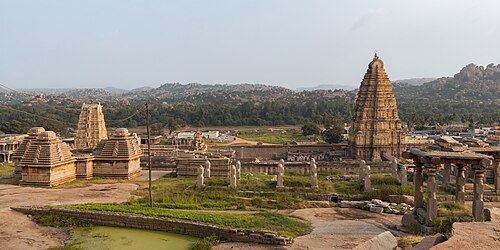
Welcome as you stand before the magnificent Virupaksha Temple, the living spiritual heart of Hampi and the oldest continuously functioning shrine in the entire regional landscape. Unlike the surrounding imperial palaces and civic citadel that fell into silent ruin following the catastrophic defeat of 1565, Virupaksha Temple has maintained an unbroken thread of active daily worship for over a thousand years. …
03 Hemakuta Hill: Sacred Boulders and Panoramic Viewpoints
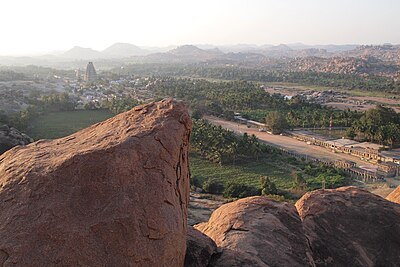
Welcome to Hemakuta Hill, a captivating expanse of gently sloping granite sheet rock situated directly south of the Virupaksha Temple. As you step onto these smooth stone surfaces, you are entering one of the most serene and mythologically rich viewpoints in all of Hampi. Unlike some of the higher and steeper crags in the region, Hemakuta Hill features an accessible, non-strenuous walking surface that allows visitors to explore its monuments with ease. …
04 Achyutaraya Temple and Ancient Market Street
Nestled in a secluded valley between the dramatic boulder ridge of Matanga Hill and the flowing waters of the Tungabhadra River lies the serene Achyutaraya Temple. To reach this breathtaking complex, visitors walk down a broad, colonnaded ancient avenue that once served as a thriving commercial bazaar. Walking along this ruined street offers a vivid window into the daily life of medieval Vijayanagara, where religious devotion and international commerce flourished side by side. …
05 Vittala Temple Complex: Stone Chariot and Musical Pillars
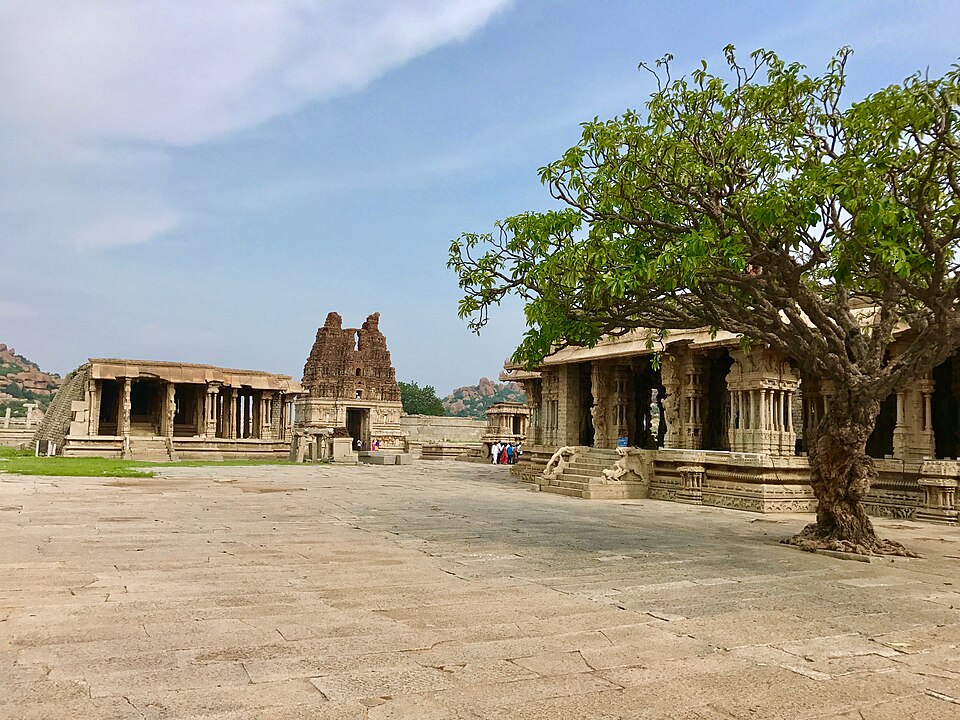
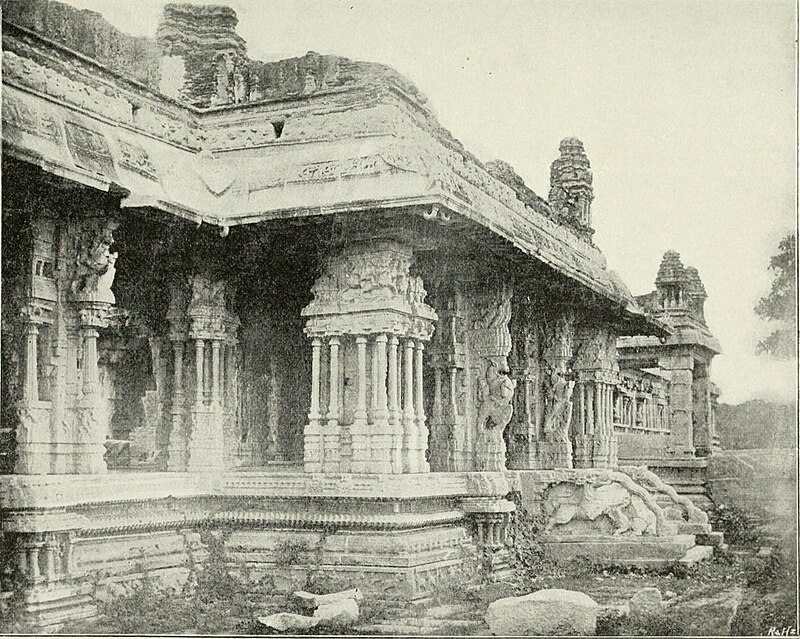
Welcome to the world-renowned Vittala Temple complex, universally celebrated as the ultimate pinnacle of Vijayanagara artistic and architectural achievement. Dedicated to Lord Vishnu, this breathtaking sanctuary showcases the absolute mastery of stone working attained by imperial sculptors during the sixteenth century. …
06 The Royal Enclosure: Citadel of Power and Ceremonies
Welcome to the Royal Enclosure, the sprawling administrative, ceremonial, and military citadel of the Vijayanagara Empire. Surrounded by multi-layered defensive stone walls, this vast precinct served as the exclusive compound from which the emperors ruled their extensive South Indian realm. Although the wooden and plaster superstructures of the royal palaces were burned during the tragedy of 1565, the massive stone basements, ceremonial platforms, and sophisticated water distribution networks…
07 Elephant Stables and Lotus Mahal: Secular Royal Marvels
Welcome to the Zenana Enclosure and the adjoining Royal Stables, home to some of the most extraordinary and remarkably preserved secular structures in Hampi. Unlike the predominantly religious Hindu temple complexes found throughout the region, these royal monuments display a brilliant synthesis of Dravidian Hindu craftsmanship and Indo-Islamic arched architecture. …
08 Closing
As our audio guide journey comes to a close, take a quiet moment to look out across the extraordinary landscape of Vijayanagara. From a booming medieval metropolis of five hundred thousand people to silent, majestic ruins resting among giant granite rocks, the story of this imperial capital is one of the most compelling chapters in world history. …