Contents
History & cultureBY TELLBY4 sections · numbered as on the map01 Orientation
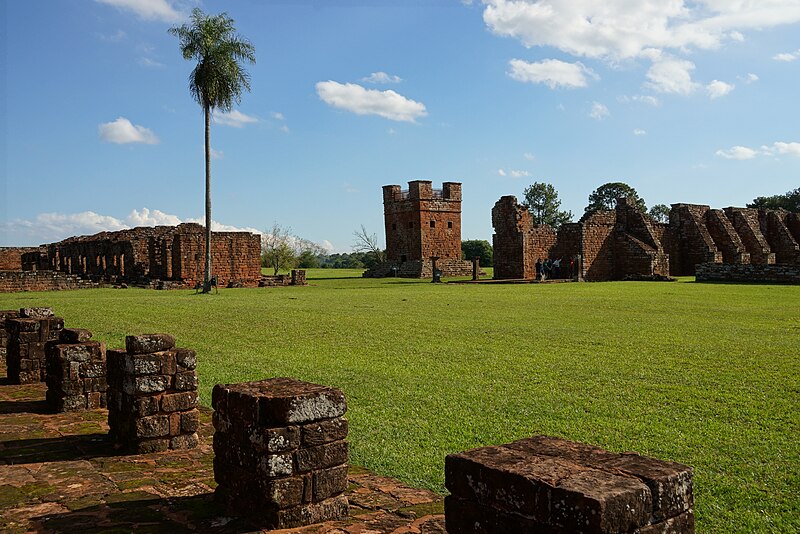
Welcome to the extraordinary UNESCO World Heritage site of the Jesuit Missions of La Santísima Trinidad de Paraná and Jesús de Tavarangue. This historic sanctuary is not defined by dry administrative criteria or complex academic jargon, but rather by the inspiring saga of a unique human community where native Guaraní traditions and European Christian architecture merged into complete harmony. During the seventeenth and eighteenth centuries, the Society of Jesus established an interconnected network of thirty autonomous settlements, known as reductions, across the vast Upper Paraná and Río de la Plata basin. Arriving in the Guayrá region around 1588 with official permission from King Philip II of Spain, the Jesuit missionaries sought to protect the indigenous population from the brutal colonial labor system known as encomienda, which subjected native communities to virtual slavery. Unlike many other colonial missions throughout the Americas, the Jesuits did not force the indigenous residents to erase their cultural identity or undergo aggressive Europeanization. Instead, they preserved and honored the Guaraní language, native leadership structures, and ancestral social organization, creating a peaceful environment for settled agricultural life. The Guaraní retained their traditional way of life, including the cultivation of yerba mate tea, while simultaneously mastering European stone carving, classical music, printmaking, and monumental construction. Together, indigenous master builders and missionaries erected magnificent towns built entirely out of local red sandstone, serving as self-sustaining centers of faith, education, and shared prosperity. Today, although these sandstone structures stand as quiet open-air ruins, their exceptionally preserved urban layouts offer an unmatched glimpse into an unprecedented historical process of peaceful coexistence and acculturation. In this audio guide tour, we will explore both preserved Paraguayan missions in careful sequence. We will first walk through the expansive urban layout of La Santísima Trinidad de Paraná, which represents the largest and most complete reduction ever built, and later journey to the unfinished masterpiece of Jesús de Tavarangue, where time stood still when the Jesuits were expelled. As you stand near the entrance, take a moment to look out over the sweeping green lawns and the weathered red sandstone walls framing the horizon. Listen to the gentle subtropical breeze sweeping through the open stone arcades, and imagine the vibrant daily life that once filled these avenues, where thousands of indigenous families lived, worked, and created extraordinary art. When you are ready, please follow the designated path ahead toward our first stop at the broad main square and the indigenous residential blocks of Trinidad, where our detailed exploration of this historic sanctuary begins.
02 The Mudéjar Trefoil Portals of Jesús de Tavarangue
Remarkably, the stunning trefoil archways framing the three main entrance portals before you represent the only surviving example of Spanish-Arab Mudéjar architectural influence found anywhere among the thirty Jesuit reductions across Latin America. As you approach the entrance, tilt your head upward to admire the three monumental stone portals lined up in imposing symmetry. …
03 The Stone Pulpit and Angel Friezes inside Jesús
Most enchantingly, the angels carved into the high stone friezes lining the interior walls are depicted playing instruments with traditional Guaraní musical expressions, subtly infusing native indigenous artistic soul into Christian iconography. As you stand within the central nave of Jesús, direct your attention toward the elegant stone pulpit attached to the interior wall and look closely at the carved frieze running along the upper wall section above it. …
04 Closing
Today, we have traveled together through two extraordinary UNESCO World Heritage sites: the magnificent completed city of La Santísima Trinidad de Paraná and the unfinished masterpiece of Jesús de Tavarangue. From the expansive central plaza and towering cathedral of Trinidad to the elegant Mudéjar trefoil archways of Jesús, these red sandstone ruins preserve the memory of one of the most remarkable social and cultural experiments in human history. …