 Photo Wikimedia Commons
Contents
History & cultureBY TELLBY7 sections · numbered as on the map01 Orientation
Welcome to this historical audio journey through the Churches and Convents of Goa, a UNESCO World Heritage ensemble universally celebrated as the Rome of the Orient. Sprawled gracefully along the scenic banks of the Mandovi River on the tropical western coast of India, this ancient regional settlement transformed into the political, commercial, and spiritual heart of the Portuguese maritime empire in Asia following its capture in fifteen ten by Afonso de Albuquerque with the crucial alliance of the local Goan leader Timoja. Designated as the supreme capital for all Portuguese territories scattered across the Eastern Hemisphere, Old Goa rapidly evolved into the primary springboard for Catholic missionary endeavors throughout India, Japan, China, and Southeast Asia. During its golden age, the city expanded into a magnificent metropolis of over two hundred thousand residents, punctuated by grand cathedrals, sprawling monastic cloisters, theological seminaries, and palatial civic administration centers. The monumental architecture of Old Goa dramatically reflects the evolving stylistic traditions of Europe, seamlessly incorporating Late Gothic Manueline ornamentation, balanced Mannerist proportions, and theatrical Baroque spatial design. Crucially, however, these holy sanctuaries represent far more than a mere transplantation of Western artistic formulas onto Asian soil. Because European craftsmen were not imported and slave labor was entirely absent from the construction sites, the physical erection and intricate interior embellishment of these grand edifices were entrusted completely to native Goan artisans. Demonstrating extraordinary technical adaptability and deep aesthetic sensitivity, these Indian stonemasons, woodcarvers, and metalworkers integrated traditional Indian floral motifs, indigenous carving methods, and local red laterite stone into European structural plans. This organic synthesis birthed the unique Indo-Portuguese artistic movement, which subsequently served as an architectural prototype for Christian missions throughout Asia. Portuguese rule over this coastal enclave persisted for over four hundred and fifty years until nineteen sixty-one, when Goa was formally reintegrated into the Republic of India. Today, the surviving architectural ensemble stands as an extraordinary testament to centuries of cross-cultural encounter, artistic innovation, and spiritual history. As we walk through this sacred landscape together, you will experience how European architectural framework and Indian artistic mastery fused to create an enduring legacy of human creativity. Please follow the path ahead as we begin our exploration at the oldest surviving church in Old Goa, the fortress-like Church of Our Lady of the Rosary.
02 Church of Our Lady of the Rosary
Welcome to our first designated physical stop, the Church of Our Lady of the Rosary, which holds the prestigious distinction of being the oldest surviving religious monument in Old Goa still standing intact today. Completed in fifteen forty-three, your very first visual impression upon approaching this sacred sanctuary is likely one of rugged, martial defensiveness, for its towering exterior wall profile closely resembles a medieval European fortress rather than a conventional house of prayer. …
03 Ruins of the Church of St. Augustine
As your walking route reaches the elevated summit of Holy Hill, your gaze is instantly captured by an awe-inspiring sight: a giant, solitary forty-six-meter stone bell tower soaring dramatically into the Goan sky. You are standing within the poignant, evocative ruins of the Church and Convent of Saint Augustine. …
04 Basilica of Bom Jesus
We have now arrived before the world-renowned Basilica of Bom Jesus, an extraordinary sanctuary of global Catholic pilgrimage and one of the finest architectural jewels of Asia. Consecrated in sixteen zero five, this magnificent basilica was designed and engineered through the combined genius of the Goan architect Julius Simon and the Portuguese Jesuit Domingos Fernandes. …
05 Church of St. Francis of Assisi
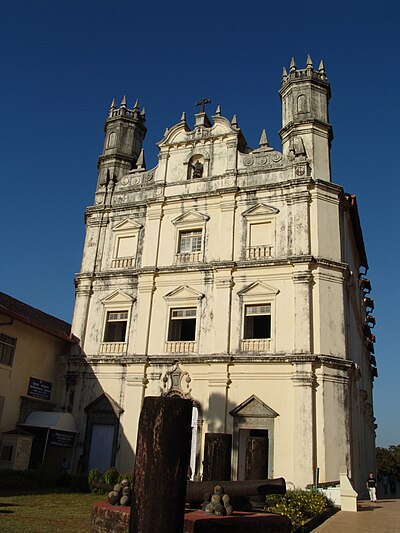
Standing directly across the public square, the Church of Saint Francis of Assisi presents one of the most fascinating architectural puzzles and artistic syntheses in Old Goa. Although the entire church structure was completely rebuilt in sixteen sixty-one in the understated Mannerist style then popular in Europe, the master builders made the extraordinary decision to preserve the original Manueline entrance portal from the earlier sixteenth-century church. …
06 Sé Catedral of Goa
Welcome to the final monumental stop on our walking tour, the magnificent Se Catedral of Goa, officially dedicated as the Cathedral of Saint Catherine of Alexandria. Measuring an extraordinary ninety-one meters in length and fifty-five meters in breadth, this towering sanctuary stands on a massive laterite plinth and is celebrated as one of the largest church buildings in all of Asia. …
07 Closing
As our audio walking tour of the Churches and Convents of Goa comes to its conclusion, we hope you have enjoyed this immersive journey through time, faith, and architectural mastery. Walking among these monumental sanctuaries, you have experienced firsthand how Old Goa earned its historic reputation as the Rome of the Orient. …