 Photo Wikimedia Commons
Contents
History & cultureBY TELLBY8 sections · numbered as on the map01 Orientation
Welcome to Srinagar, the summer capital of Jammu and Kashmir in India, and specifically to the historic and narrow alleyways of the Khanyar quarter located in the heart of the old city downtown area. You are standing today before the entrance to the Roza Bal Shrine, a sacred site that holds some of the most profound mysteries and intense historical debates in human history. The name Roza Bal is deeply rooted in the regional linguistic tradition of the Kashmir Valley. In the local Kashmiri and Urdu etymology, the word Roza signifies a revered tomb or sacred burial place, while the word Bal denotes a specific place, a lake, or a landing shore on a riverbank. Thus, Roza Bal translates directly to the Place of the Sacred Tomb. For centuries, this site served as a quiet and serene sanctuary of prayer for the local community, honoring the medieval Sufi holy men interred within its peaceful grounds. Notably, the shrine observes a very unique local tradition where its doors open for general visitors, devotees, and spiritual seekers strictly only on the thirteenth day of every lunar month. On this particular thirteenth day, people gather to pay their respects and seek spiritual solace. Beginning in the late nineteenth century, a series of extraordinary claims and ancient texts converged upon this modest shrine, drawing the intense focus of global researchers, theologians, and travelers. Most notably, the bold assertion that one of the holy personages buried here, known locally as Yuz Asaf, was actually Jesus of Nazareth who survived the crucifixion, traveled across the ancient Silk Road, and settled in Kashmir transformed this quiet neighborhood shrine into a subject of worldwide fascination. As you stand at the entrance today, leaving behind the bustling noise of the Khanyar street market, this audio guide will accompany you on a contemplative journey through the physical architecture, the ancient courtroom decrees, the Persian manuscripts, and the complex theological perspectives that surround Roza Bal. You are invited to step forward slowly, observe the solemn atmosphere, and immerse your thoughts in the quiet dialogue between faith, local memory, and historical inquiry.
02 Shrine Exterior and Cemetery Courtyard
Let us now closely observe the exterior structure of the Roza Bal Shrine and the serene courtyard that surrounds it. The shrine is constructed as a low, rectangular building set upon a sturdy raised platform, featuring protective railings and a clearly defined entrance pathway arranged along the front facade. Positioned directly in front of the main structure lies a traditional Muslim cemetery, which adds a quiet and somber majesty to the entire compound. …
03 Kashmiri Multi-tiered Roof and Lattice Windows
Now let us direct our attention upward toward the roof structure and the intricate windows set into the shrine walls. The Roza Bal Shrine features a traditional Kashmiri multi tiered sloping roof, crowned at its center by a striking and vibrant green hexagonal dome that provides clear visual prominence. …
04 Inner Chamber and Tomb of Mir Sayyid Naseeruddin
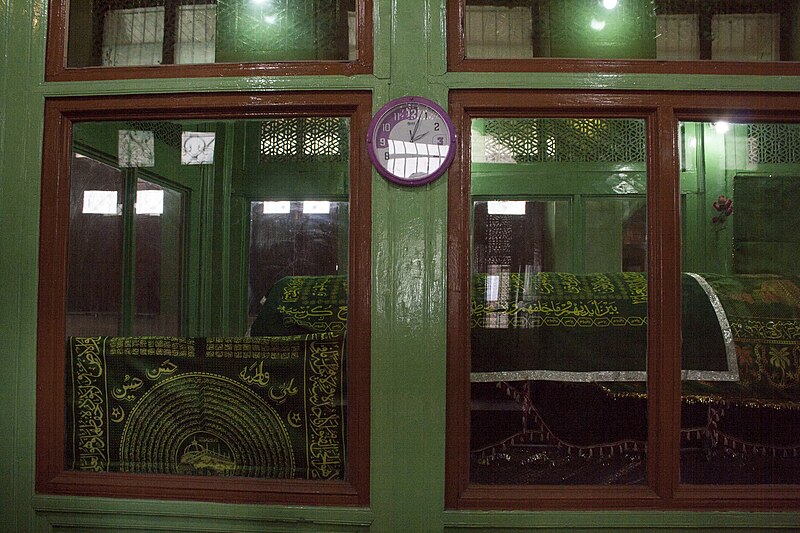
Let us now examine the internal chamber visible through the window and explore the documented history of the saint Mir Sayyid Naseeruddin. Inside the main room stands a wooden sepulcher surrounded by four glass walls that form the central focal point of the inner sanctuary. This wooden tomb structure serves as a decorative, symbolic marker, while the actual physical graves lie beneath in the floor of the shrine chamber. …
05 Tomb of Yuz Asaf and the Carved Footprints
Resting directly beside the tomb of Mir Sayyid Naseeruddin is the grave of another revered figure known locally as Yuz Asaf, or Youza Asouph. The history and identity surrounding Yuz Asaf are steeped in intriguing ancient literature, etymological evolution, and regional folklore. The earliest known written record specifically mentioning Yuz Asaf in Kashmir appears in the seventeen forty seven text Waqiat i Kashmir, also known as Tarikh Azami, authored by the local Srinagar Sufi scholar Khwaja…
06 East-West Burial Alignment and the 1770 Decree
Another fascinating structural secret of the Roza Bal Shrine lies in the physical alignment of the burial tomb itself. In standard Islamic practice, graves are strictly oriented in a north south alignment with the body turned toward the Qibla in Mecca. However, the tomb of Yuz Asaf inside Roza Bal is aligned in an east west direction, with the head turned toward the west and the face facing east. …
07 Ahmadiyya Claims, Modern Controversies, and the Notice Board
Let us now examine the fierce modern controversies surrounding Roza Bal, the Suzanne Olsson DNA incident, and the significance of the notice board installed on its exterior wall. In eighteen ninety nine, Mirza Ghulam Ahmad, the founder of the Ahmadiyya movement, published his work Masih Hindustan mein, or Jesus in India. …
08 Closing
As we bring our audio guide tour of the Roza Bal Shrine to a close, take a moment to reflect upon the rich layers of memory, faith, and tradition gathered within this modest sanctuary in Srinagar's Khanyar quarter. Roza Bal is far more than a simple structure of stone and timber. It is the quiet resting place of the Shia saint Mir Sayyid Naseeruddin and the mysterious Yuz Asaf, a venue where ancient east west burial alignments, the seventeen seventy judicial decree, Persian textual records,…