 Photo Wikimedia Commons
Contents
History & cultureBY TELLBY7 sections · numbered as on the map01 Orientation
Welcome to Naurzum State Nature Reserve, an extraordinarily diverse sanctuary nestled in the Turgay Plateau of the Kostanay Region in northern Kazakhstan. Spanning an expansive total protected area of 3,081 square kilometers, this reserve represents one of the most ecologically significant and historically cherished natural landscapes in Central Asia. The administrative headquarters overseeing the comprehensive management, wildlife monitoring, and scientific research across this vast territory is located in the nearby village of Karamendy, serving as the operational heart for environmental protection in the region. Established in 1931, Naurzum stands as one of the oldest state nature reserves in Kazakhstan, possessing nearly a century of continuous conservation history dedicated to preserving untouched wilderness. In 2008, the outstanding global value of this ecological treasure was formally recognized on the international stage when it was inscribed as a central component of the UNESCO World Heritage Site known as Saryarka Steppe and Lakes of Northern Kazakhstan. The spatial structure of the reserve is organized with meticulous ecological design, comprising 1,910 square kilometers of strictly protected core wilderness zones surrounded by 1,167 square kilometers of protective buffer areas that shield fragile habitats from surrounding human activities. The geography of Naurzum is a rare and captivating tapestry of contrasting environments. Within its boundaries, endless stretches of untouched virgin steppe give way to isolated relict pine forests, shifting golden sand dunes, and shallow steppe lake systems that expand and contract dramatically with the changing seasons. The UNESCO World Heritage recognition acknowledges not only the breathtaking visual harmony of these landscapes but also their critical function as an irreplaceable sanctuary for global biodiversity. The relict pine forests thriving on sandy soils represent a botanical miracle, persisting hundreds of kilometers south of the northern Siberian taiga belt. Simultaneously, the expansive lake networks serve as internationally vital staging grounds where hundreds of thousands of migratory waterbirds gather every spring and autumn along the Central Asian Flyway. The natural harmony found within Naurzum demonstrates the incredible adaptability of living organisms surviving under an extreme continental climate, where winter snowstorms transition into intense summer heat. As you explore this vast sanctuary through our audio guide, you will discover the intricate ecological relationships, geological history, and dedicated wildlife preservation efforts that make Naurzum State Nature Reserve a landscape of worldwide significance.
02 The Relict Pine Forest of Naurzum-Kargay
Discovering a dense and vibrant pine forest thriving in the middle of the arid Central Asian steppe presents a captivating biogeographical paradox. The Scots pine trees standing majestically before you belong to species typical of the cold Siberian taiga, yet here they persist as isolated green islands hundreds of kilometers south of their continuous northern range. Look closely at the sandy ground beneath the tall pine trunks to discern the secret behind this improbable forest. …
03 Lake Aksuat and the Migratory Waterbird Haven
Every spring and autumn, one of Central Asia's most breathtaking wildlife spectacles unfolds as hundreds of thousands of migratory waterbirds converge upon this shallow steppe lake. Globally threatened Dalmatian pelicans, great white pelicans, and elegant flamingos join tens of thousands of Eurasian cranes, greylag geese, shorebirds, and diverse duck species that assemble at Lake Aksuat during their grueling seasonal journeys. …
04 Tersek-Karagay and the Vast Kazakh Steppe
The central Kazakh steppe surrounding Tersek-Karagay endures an extreme continental climate characterized by an extraordinary annual temperature range exceeding eighty degrees Celsius. During the bitter winter months, January temperatures average minus seventeen to minus nineteen degrees Celsius, accompanied by howling snowstorms known locally as buran, whereas summer temperatures in July frequently surge past forty degrees Celsius under a searing sun. …
05 Sypsyn-Aebu Sand Dunes and Desert Flora
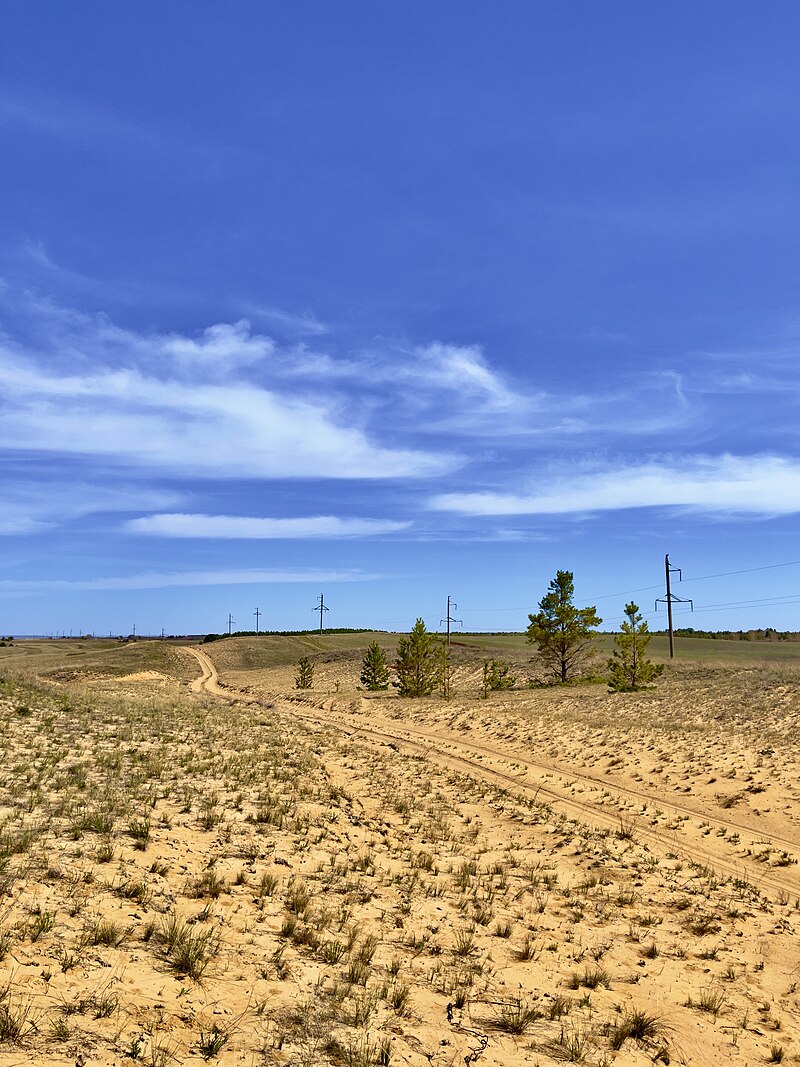
The presence of sprawling sand dunes and semi-desert shrublands directly adjacent to lush pine forests and vast wetland lakes is one of the most astonishing ecological features of Naurzum. Within a distance of just a few kilometers, visitors can witness three radically different biomes—boreal forest, freshwater wetland, and arid sand dune—seamlessly protected within a single reserve. Look down at the pale, loose sand beneath your feet as you walk through this dry landscape. …
06 Lake Zharman and the Protected Eco-Corridor
The seamless integration of three distinct core wilderness clusters through a dedicated 311.59 square kilometer protected ecological corridor and 855.675 square kilometers of buffer zones represents a landmark achievement in modern landscape conservation. Spanning a total protected area of 3,081 square kilometers, this unified spatial network ensures that the component areas of Naurzum do not exist as isolated ecological islands, but rather function as a continuous sanctuary where wildlife can…
07 Closing
As our audio tour comes to a gentle close, we reflect upon our remarkable journey through Naurzum State Nature Reserve. Today, we have explored a landscape of extraordinary contrasts, where ancient Scots pine forests persist as relict islands, untouched virgin steppes stretch to endless horizons, shifting golden sand dunes rise above the plain, and vibrant shallow lakes sustain hundreds of thousands of migratory waterbirds. …