 Photo Wikimedia Commons
Contents
History & cultureBY TELLBY7 sections · numbered as on the map01 Orientation
Lahore Fort is a magnificent historical monument inscribed as a UNESCO World Heritage site in 1981, symbolizing centuries of refined architectural heritage and the ultimate artistic zenith of the Mughal Empire. The strategic land on which the citadel stands holds a deeply rooted history of human habitation spanning thousands of years, serving as a living testament to the history of the region where diverse civilizations intersected and flourished. The earliest recorded structure at this site was a modest mudbrick fortification, which suffered repeated destruction and rebuilding through violent invasions such as those by the Mongol forces, followed by reconstructions under rulers like Sultan Balban and Mubarak Shah. The colossal citadel we see today began to take its definitive shape in 1566 when the Mughal Emperor Akbar completely rebuilt the fort with solid brick masonry to protect the northwestern frontier of his rapidly expanding empire. During the peak of Mughal art and culture, Lahore Fort evolved far beyond a mere military stronghold, becoming the vibrant second capital of the empire and a splendid royal residence. Following Akbar, successive emperors including Jahangir, Shah Jahan, and Aurangzeb continuously added noble structures reflecting their own unique architectural styles and philosophical ideals. Within the imposing ramparts of red sandstone and solid brick, twenty one notable monuments were beautifully established, featuring exquisite palaces decorated with white marble, inlaid gemstones, and reflective glass, alongside serene gardens that provided tranquil retreat. After the decline of Mughal authority, Maharaja Ranjit Singh of the Sikh Empire made the fort his royal residence, adding new pavilions and residential halls, before the site eventually passed through the hands of the East India Company and the British Raj to become a treasured cultural centerpiece of modern Pakistan. Many structures and murals that had deteriorated over centuries have recently regained their original brilliance through extensive scientific research and international cooperation. This grand citadel stands as a true witness to history and preservation efforts, shaped by the rise and fall of dynasties and rich cultural syncretism. As you walk along these ancient ramparts today, prepare to experience the architectural genius of Mughal sovereigns and the magnificent breath of history.
02 Alamgiri Gate
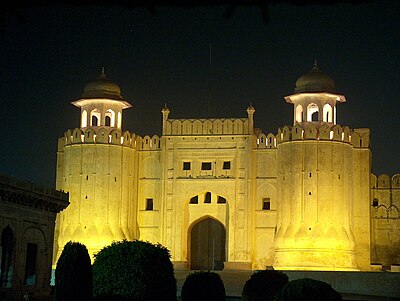
Standing grandly as the majestic western portal to the citadel and the ultimate symbol of historic Lahore, this colossal gate was constructed by Emperor Aurangzeb in 1674 and once proudly graced Pakistani currency as an iconic national treasure. Representing the supreme culmination of late Mughal architecture, the Alamgiri Gate showcases a breathtaking fusion of defensive military strength and royal aesthetic refinement. …
03 Picture Wall
One of the most remarkable facts that immediately captures our admiration is that this monumental wall, stretching across hundreds of meters and adorned with thousands of ornate panels, played the most decisive role in Lahore Fort being inscribed as a UNESCO World Heritage site in 1981. Grandly expanding along the northern and western perimeters of the fort, this monumental Picture Wall stands as the greatest artistic achievement of Mughal court art and one of the world's most extraordinary…
04 Sheesh Mahal & Naulakha Pavilion
The most extraordinary fact that evokes instant awe upon entering this realm is that this white marble pavilion cost an incredible sum of nine hundred thousand rupees at the time of its construction, earning it the very name Naulakha, which signifies nine hundred thousand. Elegantly situated in the Shah Burj block at the northwestern corner of Lahore Fort, this pavilion and the adjoining Palace of Mirrors preserve the ultimate zenith of opulent and refined Mughal court architecture. …
05 Moti Masjid
One of the most poignant historical facts that deeply moves visitors standing in this sacred sanctuary is that following the fall of the Mughal Empire, during Sikh rule, this holy mosque was converted into a state treasury, and when the British annexed the fort in 1849, precious gems wrapped in bits of rags and velvet purses were found scattered across its floor. …
06 Jahangir's Quadrangle & Kala Burj
One of the most intriguing facts that immediately sparks our curiosity upon entering this expansive court is that the ceiling of Kala Burj, the pavilion at the northwestern corner of this quadrangle, features paintings of European influenced angels and symbolism of King Solomon, despite being located within an Islamic emperor palace. …
07 Closing
We express our deepest gratitude to all visitors who have walked together through the majestic history of Lahore Fort today. We sincerely hope that today's journey along the ancient red ramparts and dazzling tile mosaic walls has been a noble experience, allowing you to fully feel the depth of living history and art transcending centuries beyond a mere tour of architectural monuments. …