 Photo Wikimedia Commons
Contents
History & cultureBY TELLBY7 sections · numbered as on the map01 Orientation
Welcome to the formidable Rohtas Fort, an extraordinary historic monument located in the Jhelum district of Punjab, Pakistan. As an outstanding masterpiece of sixteenth-century Islamic military architecture, this grand fortress uniquely blends artistic traditions from Turkey and the Indian subcontinent, serving as the foundational model for the iconic architectural style of the subsequent Mughal Empire.
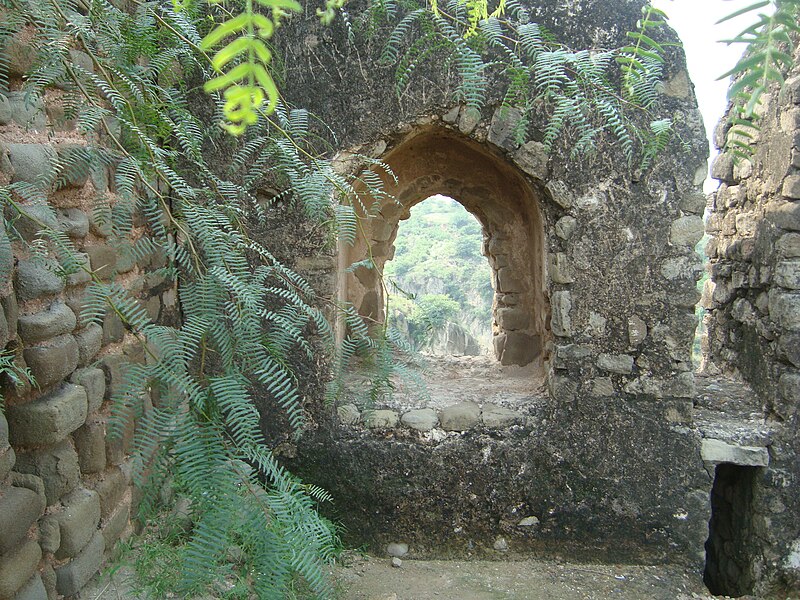
As you look across the surrounding landscape, observe how this magnificent fortress stretches majestically along the rugged ridge positioned strategically between the Pothohar highlands and the vast Punjab plains. Spanning an impressive area of 70 hectares, this massive garrison complex was thoughtfully designed to follow the natural elevation and contours of its hilltop site. The fort is enclosed by imposing stone masonry walls extending more than four kilometers in circumference. These massive ramparts are lined with sixty-eight semicircular bastions and pierced at strategic defensive points by twelve monumental gateways. Surrounded by steep cliffs, rocky hills, and seasonal river streams, the fort seamlessly integrates natural topography with human engineering excellence to create an impregnable barrier.
The compelling historical story of Rohtas Fort began in 1541 under the reign of Sher Shah Suri, the founder of the Sur Empire. After inflicting a decisive defeat upon the Mughal Emperor Humayun and driving him into exile in Persia, Sher Shah Suri sought to consolidate his control over the northern region. However, the fiercely independent local Gakhar tribes of the Salt Range remained loyal to the displaced Mughals and continuously rebelled against Sur authority. To suppress these warring Gakhar tribes and permanently block Humayun from returning to India from Persia, Sher Shah Suri resolved to build a massive military stronghold at this precise strategic position.
Sher Shah Suri entrusted the complex construction of the fortress to his highly capable finance minister, Raja Todar Mal. Despite severe terrain challenges and initial resistance from local populations who refused to assist, Todar Mal successfully guided the project forward with extraordinary administrative skill. Although Sher Shah Suri passed away in 1545 before seeing his vision fully realized, the fortress was completed as an invincible citadel that was never taken by storm throughout its long history.
Inside the ramparts, an interior wall partitions the northwest citadel, known as Andarkot, which was reserved for high officials and royalty. Designed for complete self-sufficiency during lengthy military sieges, the fort incorporates deep stepwells carved directly into limestone bedrock. Today, Rohtas Fort stands as a remarkable testament to early Muslim fortification design. Let us now step inside this legendary stone fortress and explore its majestic portals and enduring structures together.
02 Sohail Gate, The Ceremonial Portal
Did you know that this formidable Sohail Gate, standing over 21 meters high and twenty meters wide with a depth of fifteen meters, served as the primary ceremonial portal and grand main entrance to the entire fortress? As the most elaborate and structurally reinforced entrance among all twelve gates of Rohtas Fort, it showcases the absolute pinnacle of sixteenth-century Sur Empire military architecture. …
03 Shishi Gate, Glazed Tiles and Inscriptions
Did you know that the shimmering blue glazed tiles remaining on the outer arch and facade of this portal represent the earliest known historical example of glazed tile decoration in the region, a technique that was later famously refined in Lahore? The name Shishi Gate itself derives from the Persian word for glass or lustrous tile, reflecting the extraordinary fact that at the time of its sixteenth-century construction, the entire arch was brilliantly decorated with cobalt-blue glazed tiles,…
04 Shahi Masjid and Kabuli Gate
Did you know that the roof of this royal Shahi Mosque is directly connected to the fortification wall patrol path, meaning that fully armed soldiers walked and patrolled directly over the mosque roof? Measuring 19.2 meters in length and 7.3 meters in depth, this small yet elegant mosque demonstrates a brilliant architectural integration where military defensive functions and sacred religious spaces seamlessly become one. …
05 Central Baoli, The Stepped Well
Did you know that this massive underground Central Baoli, featuring 148 deep steps carved directly into solid limestone bedrock, was specifically engineered to ensure complete water self-sufficiency for tens of thousands of garrison troops and war elephants during prolonged military sieges? On the arid Pothohar plateau where water was extremely scarce during dry seasons, the ability of a garrison to survive without external aid relied entirely on this subterranean stepped well. …
06 Haveli Raja Man Singh, The Citadel Palace
Did you know that the Haveli Raja Man Singh stands as the only surviving palace structure inside this strictly functional military fortress, named after the legendary Mughal general Raja Man Singh? Perched on the highest point of the inner citadel, where defensive walls and rugged masonry dominate the landscape, this elegant palatial house offers a striking contrast, illustrating how high-ranking rulers sought royal dignity and residential comfort even within a tense military stronghold. …
07 Closing
One of the most remarkable and captivating aspects of Rohtas Fort is that it represents a rare living fort, continuously inhabited by residents inside Rohtas village within its ramparts since the sixteenth-century era of Islam Shah Suri. For centuries, generation after generation of local inhabitants have lived within the protection of these massive stone walls. …