Contents
History & cultureBY TELLBY7 sections · numbered as on the map01 Orientation
Welcome to the entrance of Gran Piedra and the archaeological landscape of the first coffee plantations in southeastern Cuba. Standing here in the eastern foothills of the Sierra Maestra mountains within the UNESCO Baconao Biosphere Reserve, you are at the threshold of an extraordinary world heritage site where breathtaking natural grandeur meets deep historical memory. Spanning over eighty-one thousand four hundred and seventy-five hectares across the region, this mountain terrain represents an exceptional achievement of human adaptation. Here, during the nineteenth century, mountain pioneers and forced laborers transformed rugged virgin cloud forests into one of the most sophisticated and productive coffee agricultural systems of its time. The remains scattered across these mountains bear unique witness to high-altitude farming engineering and throw dramatic light on the social, economic, and technological history of the Caribbean and Latin America.
As you begin your journey today, you will explore a landscape defined by extraordinary contrasting forces: the massive ancient geological monolith of Gran Piedra soaring high above sea level, and the complex human-engineered network of historical coffee estates hidden within the cloud forests below. Following the Haitian Revolution in the late eighteenth century and early nineteenth century, French planters and tens of thousands of enslaved Africans brought innovative wet-pulping technology, sophisticated hydraulic engineering, and Basque-inspired domestic architecture to these isolated slopes. Together, they forged not only an agricultural empire that supplied luxury European markets, but also a distinct regional culture that deeply influenced Cuban music, dance, cuisine, and social traditions.
Our path today will take you from this mountain orientation site up the historic stone steps through high-altitude cloud forests to the breathtaking summit of Gran Piedra, before descending into the remarkably preserved estate of Cafetal La Isabelica. Along the way, you will discover expansive terraced drying floors, stone arch aqueducts, storage cisterns, and the subtle traces of human labor and engineering that shaped this mountain landscape. Please walk carefully along the mountain trails, breathe in the fresh high-altitude tropical air, and prepare to immerse yourself in a compelling story of natural wonder, technical innovation, and profound historical memory.
02 The Four Hundred and Fifty-Nine Stone Steps
It is truly astonishing to realize that this winding mountain staircase climbing through dense rainforest was carved and laid entirely by human hand over twelve hundred meters above sea level without modern industrial machinery. Building such an incredible stone path along this sheer mountain ridge during the nineteenth century demanded an extraordinary expenditure of physical human effort, engineering determination, and master craftsmanship in an era long before modern construction equipment…
03 The Massive Monolith Overlooking the Caribbean
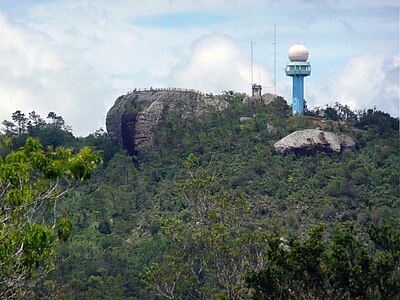
Standing here at the peak of the mountain, it is overwhelming to comprehend that this single colossal block of ancient volcanic rock and limestone weighs more than sixty-three thousand tons, ranking it among the largest monoliths in the entire world. Measuring fifty-one meters in length, twenty-five meters in height, and thirty meters in width, this astonishing geological giant rests naturally atop a mountain peak twelve hundred and twenty-five meters above sea level, commanding the entire…
04 Main House of Cafetal La Isabelica
It is remarkable to realize that this elegantly restored two-story mansion, standing secluded deep within the high mountain rainforest, was established in the seventeen nineties by a French coffee planter who escaped the revolutionary uprising on Hispaniola. Cafetal La Isabelica stands today as one of the finest preserved examples of early nineteenth-century agro-industrial estate architecture anywhere in the Caribbean and Latin America. …
05 Terraced Drying Floors of Secadero
It is extraordinary to learn that these expansive, multi-tiered stone drying terraces carved into the mountain slope processed the high-grade coffee beans that commanded premium prices across European luxury markets during the nineteenth century. Known locally as secaderos, these flat stone-paved platforms represented the central operational hub for drying harvested coffee cherries before export.
Look down right now at the broad paved stone floor beneath your feet. …
06 Hydraulic Aqueducts and Wet Processing Mill
It is deeply impressive that here in these water-scarce high mountains, French engineers constructed stone aqueducts and storage cisterns to operate a wet-pulping mill that laid the technical foundation for modern coffee processing. This innovative hydraulic system, developed in this region, transformed coffee processing methods across the Americas during the nineteenth century.
Look closely at the elegant stone arch aqueduct extending right before your eyes. …
07 Closing
As we conclude our audio guide journey today, take a quiet moment to look back at the grand silhouette of Gran Piedra soaring above the mountain cloud forest and the serene stone ruins of the coffee estates resting below. This extraordinary cultural landscape offers far more than picturesque mountain views or old architectural ruins. It stands as a profound monument to the complex relationship between powerful natural forces and human history. …