 Photo Wikimedia Commons
Contents
History & cultureBY TELLBY7 sections · numbered as on the map01 Orientation
Standing in the vast and sun-baked expanse of the Yazd desert, one can almost hear the echoing footsteps and rhythmic camel bells of ancient merchant caravans that traversed the Silk Road centuries ago. The Zein-o-Din Caravanserai stands resolutely amidst these sweeping sand dunes, appearing like a timeless mirage of safety and comfort. For weary travelers daring to cross this unforgiving wilderness, this fortified sanctuary offered a vital refuge where human warmth, fresh water, and shelter could be found after days of grueling travel. Recognizing its profound universal value and extraordinary architectural heritage, UNESCO officially inscribed this landmark in two thousand twenty-three as an essential component of The Persian Caravanserai World Heritage site. Far more than a mere roadside inn, this desert stronghold served as a vibrant crossroads where goods, ideas, philosophies, and artistic traditions seamlessly flowed between the distant civilizations of East and West.
Positioned roughly sixty kilometers south of the historic city of Yazd along the principal highway leading toward Kerman, and within forty kilometers of the district of Mehriz, this quiet retreat rests five hundred meters off the modern road in the open sands. Its origins date back to the sixteenth century during the brilliant golden age of the Safavid Empire under the reign of King Shah Abbas the First. The construction was commissioned under the direct patronage of Zein-o-Din Ganj Ali Khan, the revered governor of Kerman, who sought to fortify trade routes and guarantee absolute protection for international envoys and royal merchants. Across the vast territories of Persia, the Safavid crown established an ambitious imperial network of nine hundred ninety-nine caravanserais placed at regular intervals of a single day's journey. Masterfully engineered by the visionary architect Sultan Mohammad Yazdi, this specific outpost was crafted to conquer the harsh desert elements while displaying the architectural grandeur of the empire.
What truly elevates this desert sanctuary into a legendary architectural marvel is its unprecedented geometric form. Among all nine hundred ninety-nine caravanserais constructed throughout the historic Persian world, only two were ever built with circular outer walls and round defensive bastions. Remarkably, of those two circular structures, Zein-o-Din is the sole surviving caravanserai along the entire Silk Road that remains completely intact to this day, as its counterpart near Isfahan lies in ruined fragments. Departing from the rigid rectangular layouts standard in traditional Persian design, its circular footprint diffused the force of fierce desert sandstorms while maximizing interior security and thermal insulation. As you stand before this iconic structure, step inside to discover the timeless legends and engineering brilliance preserved within its ancient mudbrick walls.
02 The Fortified Portal Facing the Desert Winds
When you first approach the formidable exterior of this historic site, a dramatic and surprising contrast awaits your senses. Standing in the heart of the desolate Yazd desert, the outer wall initially presents the austere, weathered appearance of a remote military fortress or a derelict ruin battered by centuries of shifting sandstorms. …
03 The Vaulted Passage of Welcome
As you step inside this quiet, shadow-draped entrance vestibule, a compelling historical reality comes to light. This gateway was far more than a simple roadside inn offering selfless hospitality to weary travelers. The head caretaker of this caravanserai was invested with official legal authority by the imperial Safavid court to oversee all commercial transactions and enforce the collection of sales taxes on incoming trade goods. …
04 The Twelve-Sided Courtyard and Central Oasis Pool
As you step out into the sunlit central courtyard, a breathtaking display of geometric architecture unfolds around your senses. Even though the overall external footprint forms a perfect circle with a diameter of forty-six meters, the inner open-air courtyard was ingeniously designed as a perfectly symmetrical twelve-sided polygon. The seamless union of a circular outer defense wall with a twelve-sided inner courtyard is a rare mathematical triumph in Persian architectural history. …
05 Open Iwans and Curtained Guest Quarters
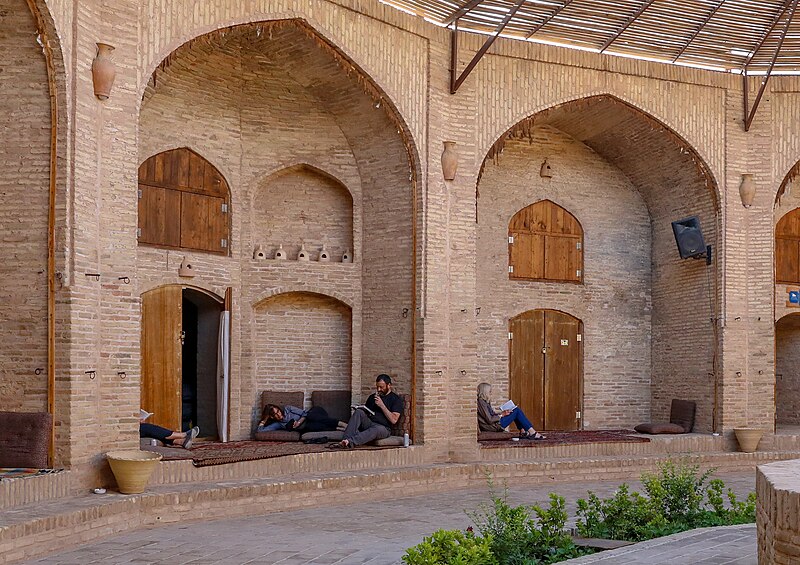
One of the most astonishing facts you will discover as you observe these cozy guest quarters and arched iwans is that not a single room in this historic structure was ever fitted with a heavy wooden door. Instead of wooden doors, privacy was maintained solely by thick woven fabrics and luxurious cashmere curtains suspended over the vaulted entrances. …
06 The Northern Shahneshin and Starlit Roof Platform
Ascending to the rooftop deck, the highest point of this complex, presents you with a wonderfully romantic and mystical surprise. Completely isolated from urban light pollution, the deep desert night sky reveals a breathtaking canopy filled with countless glittering stars and the sweeping arm of the Milky Way. …
07 Closing
Our journey through the historic Zein-o-Din Caravanserai now comes to its natural conclusion. Beginning in the sixteenth century as a fortified Safavid military post and vital Silk Road shelter, this circular fortress has transformed across centuries into an award-winning heritage hotel that welcomes sixty to eighty daily visitors from over seventy nations today. …