 Photo Wikimedia Commons
Contents
History & cultureBY TELLBY7 sections · numbered as on the map01 Orientation
Welcome to the audio guide tour of the Historic Centre of Odesa, a magnificent coastal sanctuary on the Black Sea celebrated for its extraordinary spirit of international exchange and architectural brilliance. This urban masterpiece stands as an exceptional testimony to human collaboration, where diverse ethnic traditions and artistic visions converged to construct a thriving maritime commercial hub. Its inscription on the UNESCO World Heritage List officially recognizes its universal value as an outstanding example of a nineteenth-century Eastern European port city that successfully integrated multi-ethnic influences into a harmonious urban landscape.
The history of Odesa originated in seventeen ninety-four through a strategic decree issued by Empress Catherine the Second following the conclusion of the Russo-Turkish War. Built upon a shallow gulf along the Black Sea plateau approximately thirty kilometers north of the Dniester River estuary, the city was meticulously organized around an elegant grid system. Two deep ravines naturally shaped the orientation of its spacious, tree-lined avenues, dividing the urban layout into rectangular blocks that connected the city center directly with the maritime harbor. The city experienced unprecedented economic growth throughout the nineteenth century, propelled significantly by its status as a free port city from eighteen nineteen to eighteen fifty-nine. For forty remarkable years, this commercial freedom attracted merchants, scholars, sailors, and artists from across Europe and Asia, establishing a vibrant cosmopolitan community.
Architecturally, Odesa is defined by its low-rise structures, mostly spanning two to four storeys, created by master architects and military engineers. In the early decades, distinguished Italian architects introduced classical canons and Mediterranean symmetry, establishing foundational norms that were later enriched by eclectic traditions. Prominent Italian masters like Torricelli and Boffo brought refined proportions that blended seamlessly with local materials. Elegant private palaces, bustling tenement houses, sophisticated stock exchanges, grand theatres, and ornate religious places were constructed side by side, reflecting the diverse beliefs and social structures of its residents. This harmonious blend of eclectic architecture creates a captivating visual identity that tells the story of peaceful cohabitation and international achievement.
Our walking tour today will guide you through the heart of this historic city. We will explore monumental seaside steps, world-renowned cultural institutions, bustling pedestrian avenues, light-filled glass arcades, and resilient sacred landmarks. As you embark on this memorable journey through history, art, and urban design, please remain attentive to your surroundings, walk safely along designated pedestrian paths, and watch for traffic at street crossings. Now, let us begin our exploration of the enduring cosmopolitan heritage of Odesa.
02 Prymorsky Stairs: The Ocean Gateway
The Prymorsky Stairs stand as an extraordinary ocean gateway, connecting the urban plateau directly with the busy Black Sea harbour below. Extending dramatically from the edge of Prymorsky Boulevard down toward the sea, this grand stone structure represents one of the most remarkable architectural and engineering achievements in Odesa. …
03 Odesa Opera and Ballet Theatre: Architectural Eclecticism
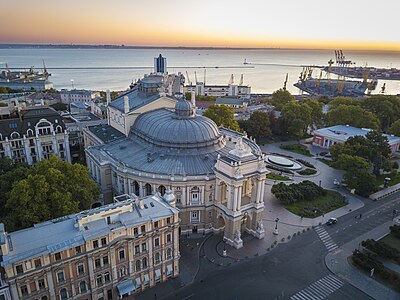
The Odesa National Academic Opera and Ballet Theatre is a world-renowned cultural landmark that serves as the undisputed jewel of Odesa's architectural heritage. Constructed during a golden era of economic expansion in the late nineteenth century, this magnificent theatre reflects the immense wealth, artistic sophistication, and cosmopolitan ambition of the city's golden age. …
04 Deribasivska Street and Palais-Royal: The Heart of Public Life
Deribasivska Street and the adjacent Palais-Royal garden represent the beating heart of public life in Odesa, where civic culture and historical heritage blend seamlessly. Designed within the city's classic grid framework, this famous pedestrian boulevard has served for generations as the primary meeting place for citizens, foreign traders, scholars, and visiting intellects. …
05 Passage and Russov House: The Triumph of Modern Restorations
The Passage arcade and the nearby Russov House stand as triumphant symbols of commercial prosperity and modern preservation, having overcome severe fires and urban decay through dedicated community efforts. Situated at the bustling corner of Preobrazhenska and Sadova streets, these late nineteenth-century landmarks illustrate the opulent eclectic taste that defined Odesa's business center during its economic peak. …
06 Transfiguration Cathedral: Faith and Resilience
The Transfiguration Cathedral, known locally as the Spaso-Preobrazhensky Cathedral, stands in Soborna Square as Odesa's largest Orthodox place of worship and an enduring symbol of spiritual resilience. Having endured tragic ideological destruction and achieved a magnificent modern rebirth, this towering sanctuary embodies the unyielding spirit of a community that fought to restore its deeply rooted cultural identity. …
07 Closing
Thank you for joining us on this audio guide tour through the Historic Centre of Odesa. It has been a true privilege to guide you along these historic avenues, where every stone, arcade, and seaside terrace tells a story of human connection, artistic passion, and cultural synthesis. Odesa stands not merely as a collection of beautiful buildings, but as a living testament to the power of open trade, peaceful cohabitation, and international collaboration that defined Eastern European urbanism in…