 Photo Wikimedia Commons
Contents
History & cultureBY TELLBY8 sections · numbered as on the map01 Orientation
Welcome to the orientation for Gauḍa, the fallen imperial capital of medieval Bengal. You are standing in a historically monumental region that straddles the international border between the Malda district of West Bengal in India and the Chapai Nawabganj district of Bangladesh. Though today it presents a quiet, melancholic landscape of scattered brick ruins submerged beneath dense groves, between the twelfth and sixteenth centuries this city served as the lavish seat of power for Bengal under several influential dynasties. The documented roots of this land trace back to 500 BC during the Mauryan Empire, continuing through the Gupta era until King Shashanka established the Kingdom of Gauda in the early seventh century. His reign marks the inception of the Bengali calendar and firmly established Gauda as the political and cultural heartland of Bengal. Under the Buddhist Pala dynasty, whose emperors proudly adopted the imperial title Lord of Gauda, the region flourished for four centuries, rendering the term Gaudiya synonymous with Bengal and its people. In the late twelfth century, King Lakshmansena of the Hindu Sena dynasty built his royal capital here, naming it Lakshmanavati, also known as Lakhnauti. However, around 1203 AD, the adventurer Bakhtiyar Khilji launched a swift cavalry strike that forced the Sena rulers east and introduced Turkic rule. After periods under the Delhi Sultanate, Sultan Nasiruddin Mahmud Shah restored Gauda as the capital of the independent Bengal Sultanate in 1453. For the next 112 years, the city reached unprecedented heights of wealth and architectural splendor. By 1500, with an estimated population of two hundred thousand inhabitants, Gauda was the fifth most populous metropolis on earth. European observers left glowing descriptions of its paved brick streets, thriving commercial markets, and grand palaces. In 1518, the Portuguese officer Duarte Barbosa observed that the elites of Gauda walked clad in ankle length white cotton smocks with silk scarves and gold mounted daggers, enjoying luxurious lifestyles and frequent bathing in large domestic water tanks. Furthermore, an anonymous Portuguese interpreter who visited the court of Sultan Nasiruddin Nasrat Shah in 1521 described passing through nine heavily guarded gates—escorted past three hundred shield bearing swordsmen and three hundred archers—to reach a vast esplanade where twelve horsemen played polo beneath a carved sandalwood pavilion painted with the sun, moon, and stars. On that occasion, the Sultan distributed one hundred and fifty cartloads of food and six hundred thousand tangas to five thousand impoverished citizens. Yet this golden era collapsed into tragedy. Sacked by Sher Shah Suri in the 1530s and later renamed Jannatabad or Heavenly City by Mughal Emperor Humayun, Gauda met its ultimate downfall in 1575. When the Mughal general Munim Khan reoccupied the city, a deadly outbreak of plague swept through the damp encampments, killing thousands of soldiers along with the general himself. Simultaneously, the main channel of the Ganges River silted up and shifted away, cutting off maritime trade and turning this glorious metropolis into a deserted ghost town reclaimed by the jungle. As we begin our walking tour today, let us explore these silent monuments and experience the immortal legacy of medieval Bengal.
02 Kotwali Darwaza: Border Gateway of the Citadel
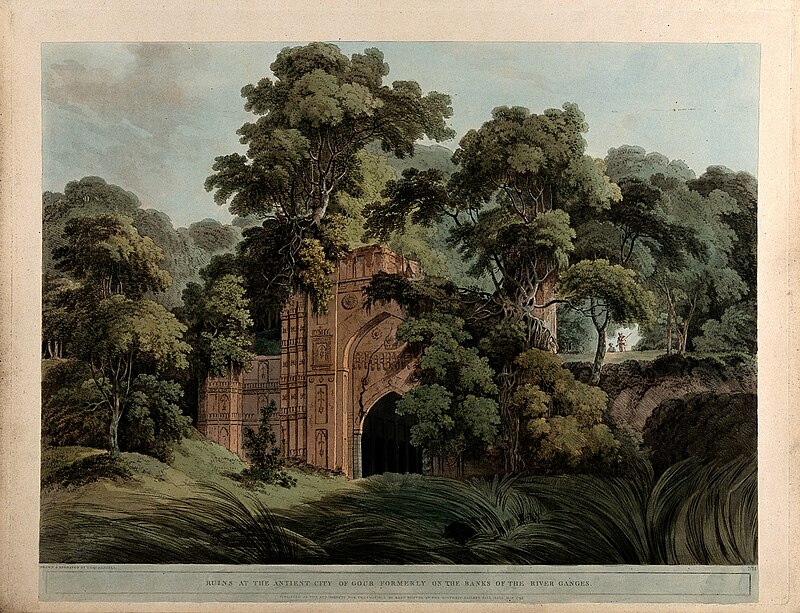
Our first stop on this historic walking tour brings us to the Kotwali Darwaza, the monumental southern gateway that once fortified the ancient citadel of Gauda. Standing before you is a massive red brick structure that originally served as the primary southern portal guarding access to the imperial capital of the Bengal Sultanate. …
03 Lottan Masjid: The Terracotta Masterpiece
Moving further along the historic pathway into the interior of the city, we arrive at the breathtaking Lottan Masjid, situated serenely within a beautifully manicured garden landscape. Believed to have been constructed during the late fifteenth century under the reign of Sultan Shamsuddin Yusuf Shah, this monument is celebrated as one of the most structurally complete and artistic single domed mosques surviving in the Gauda archaeological area. …
04 Tantipara Masjid: Craftsmanship of the Weavers' Quarter
A short walk further north along the heritage route brings us to the impressive ruins of the Tantipara Masjid, a monumental treasure of medieval terracotta relief art. Completed between the 1470s and 1480s during the restoration period of the Ilyas Shahi dynasty, this grand mosque is universally acknowledged by architectural historians as possessing the most refined and intricate brick carved ornamentation in all of Gauda. …
05 Lukachuri Gate and Qadam Rasul Complex
Our route now brings us into the historic core of the citadel, encompassing the monumental Lukachuri Gate and the sacred Qadam Rasul Complex situated just within its precinct. We first confront the Lukachuri Gate, historically designated as the Shahi Darwaza or Imperial Entrance. Erected in 1655 AD by Prince Shah Shuja, the Mughal governor of Bengal and son of Emperor Shah Jahan, this magnificent two story structure served as the grand eastern portal leading into the royal palace grounds. …
06 Firoz Minar: Tower of Victory
Leaving the Qadam Rasul complex and following the shaded northern path, we come face to face with the commanding vertical structure of the Firoz Minar, soaring dramatically into the sky. Standing at an impressive height of 25.6 meters, this monumental brick tower is historically referred to as the Firoza Minar or Blue Tower, representing the most iconic architectural landmark in the entire citadel of Gauda. …
07 Baisgazi Wall and Citadel Ruins
Our walking tour brings us to the monumental heart of the ancient metropolis, the Baisgazi Wall and the surrounding Citadel Ruins. Following a dusty path winding through fragrant mango orchards, you are suddenly confronted by an immense brick fortification rising like a sheer red cliff before you. This is the famous Baisgazi Wall, constructed to encircle and shield the royal palace precinct of Gauda. …
08 Closing
As our journey through the historic site of Gauda comes to an end, we reflect upon the extraordinary historical landscape we have explored together today. From the fortified border gate of Kotwali Darwaza and the brilliant terracotta craftsmanship of Lottan and Tantipara, to the triumphant heights of Firoz Minar and the massive Baisgazi Wall, we have walked through the remnants of a once glorious empire. …