 Photo Wikimedia Commons
Contents
History & cultureBY TELLBY7 sections · numbered as on the map01 Orientation
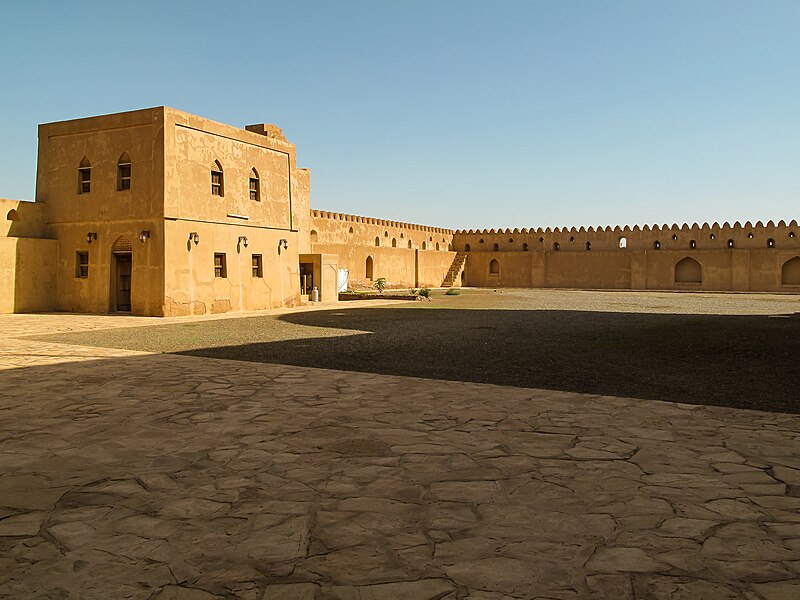
Welcome to Bahla Fort, an extraordinary earthen fortified oasis complex situated at the foot of the Jebel Akhdar highlands within the Hajar Mountains of interior Oman. Constructed primarily from sun-dried mud bricks, straw, and gravelly mortar resting upon sturdy natural stone foundations, this majestic stronghold represents a masterful response to both desert military defense and regional resource management. In recognition of its outstanding historical value as an ancient interior oasis settlement, Bahla Fort was inscribed as Oman's very first UNESCO World Heritage site in 1987. Due to severe rain erosion and structural decay inherent to raw earth architecture, the complex was placed on the List of World Heritage in Danger in 1988. However, through painstaking conservation efforts led by Omani restoration teams adhering strictly to authentic earthen techniques without modern cement, the fort was triumphantly removed from the danger list in 2004. The fortress achieved its expansive layout under the Banu Nebhan dynasty, who established Bahla as their political capital and central stronghold from the twelfth to the late fifteenth century. Controlling the lucrative trade routes connecting the Arabian Sea coast to the interior through the strategic mountain pass of Wadi Samail, the Banu Nebhan accumulated wealth through their command over the frankincense trade and regional agriculture. Encircling this fortified oasis is a monumental perimeter wall known as the sur, stretching roughly twelve kilometers around the historic settlement. Within this outer protective boundary lie historic residential quarters known as harats, including al-Aqr, al-Ghuzeili, and al-Hawulya, alongside traditional audience halls called sablas, bathhouses, and vibrant market lanes. Water critical for survival was drawn from distant mountain springs via the ancient falaj subterranean canal system, seamlessly integrated into the fortress layout. As you begin your physical walk into the heart of this ancient citadel, prepare to experience the remarkable fusion of defensive ingenuity and oasis engineering that sustained this desert civilization across centuries.
02 Section 1
You are standing directly before Sabah, the fortified primary entrance hall and main gatehouse of Bahla Fort. During an armed assault when invading forces attempted to batter down the heavy wooden doors, guards stationed on the upper defense platforms deployed immediate and lethal countermeasures. Through specialized overhead murder holes, sentries poured scalding liquids, including boiling water, burning oil, and intensely heated date honey directly onto the heads of attackers trapped below. …
03 Section 2
You have arrived at Al-Qasabah, the oldest central core and elevated citadel of Bahla Fort. Incredibly, this entire multi-story defensive structure was erected directly upon a massive bare rocky outcrop without any conventional subterranean foundation trenches or modern engineering base. Look down closely at the base where the massive mud-brick walls meet the natural bedrock beneath your feet. …
04 Section 3
You are now entering Bait al-Hadith, or the New House, constructed during the seventeenth-century expansion under the Yaruba dynasty. Remarkable archaeological excavations conducted within this sector during the 1990s revealed that an entire lower complex of residential rooms and subterranean storage vaults had lain completely buried beneath meters of collapsed mud brick for centuries. …
05 Section 4
Standing before you in the elevated southwestern sector of the fortress is Bait al-Jabal, the Mountain House, featuring the prominent watchtower known as Burj al-Riyh, or the Wind Tower. In the intense heat of the desert interior, this remarkable structure achieved internal cooling without any mechanical devices, relying entirely on sophisticated aerodynamic principles and natural air convection. …
06 Section 5
Welcome to the Friday Mosque and the falaj water system precinct, representing the spiritual center and hydrological lifeline of the Bahla oasis. Water sustaining this desert fortress and its surrounding date palm groves was brought from subterranean mountain springs miles away through an ancient system of underground aqueducts known as the falaj. Look closely at the exquisitely carved stucco decorations surrounding the prayer niche, known as the mihrab, located within the Friday Mosque. …
07 Closing
As you complete your exploration of Bahla Fort, reflect upon the extraordinary earthen architectural legacy and desert oasis civilization of interior Oman. Threatened by severe rain erosion and structural decay in the late twentieth century, this monumental fortress was saved through meticulous conservation efforts utilizing strictly traditional mud, straw, and stone, leading to its celebrated removal from the World Heritage in Danger list in 2004. …