Contents
History & cultureBY TELLBY7 sections · numbered as on the map01 Orientation
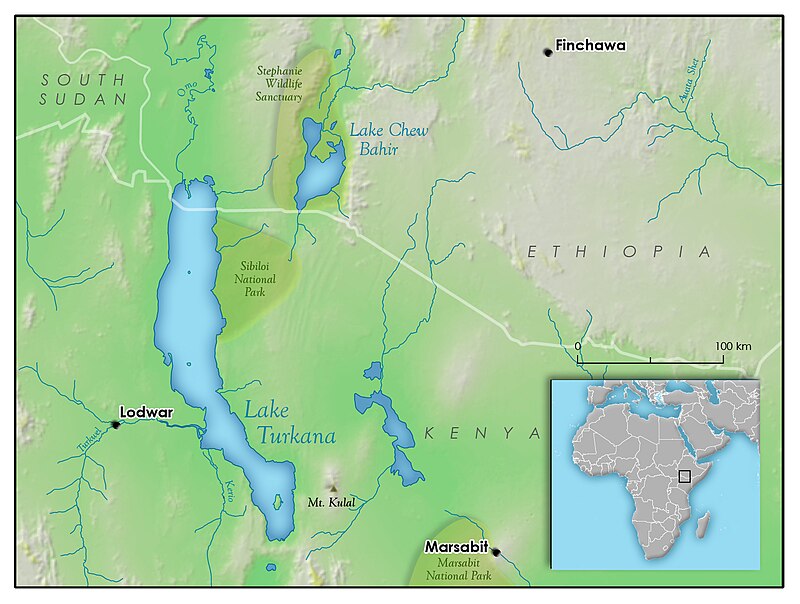
Welcome to Sibiloi National Park, a land of profound depth and timeless silence located on the eastern shore of Lake Turkana in northern Kenya. Surrounded by a harsh and sun-baked desert landscape that borders an endlessly shimmering body of water, this extraordinary place serves as a sanctuary holding the earliest footprints of human history.
Sibiloi National Park is globally recognized as a UNESCO World Heritage site. Its ancient soil layers and deeply eroded sedimentary formations hold vital fossil evidence of our earliest pre-human ancestors and their prehistoric environments. These rich deposits reveal how our species evolved over millions of years, offering direct physical testimony of ancient life without relying on complex academic jargon or legal citations.
Take a moment to look across this dramatic environment. In the middle of an intense desert heat where dry winds sweep across the terrain, a massive green-tinted lake spreads out to the horizon. Travelers and researchers have long affectionately called these waters the Jade Sea due to their mesmerizing color. Stretching down the Great Rift Valley, this body of water is the largest alkaline desert lake on Earth, creating a remote landscape so stark and breathtaking that it feels almost extraterrestrial.
Decades ago, early scientific expeditions led by bold young researchers set out into this distant wilderness to uncover the roots of humanity. In the late nineteen sixties, young scholars including a twenty-three-year-old Richard Leakey and a twenty-two-year-old Kay Behrensmeyer embarked on an arduous overland journey from Nairobi. Driving a single sturdy Land Rover north past Mount Kenya, they navigated the dusty washboard tracks through Isiolo and Marsabit, crossed the scorched expanse of the Chalbi Desert, and passed the remote palm oasis of North Horr. Upon reaching Ferguson's Gulf, they boarded a wooden boat captained by a skilled sailor named Hassan and crossed the turbulent, green-tinted waters to land on the uncharted eastern shore. Arriving in a wild territory completely devoid of modern roads or detailed maps, they established a shoreline camp made of simple reed huts. Because local conflicts had kept modern human settlements away, the area remained a pristine natural sanctuary where lions, topis, zebras, and hippos roamed freely in a setting that felt like an untouched Garden of Eden.
During our walking tour ahead, we will follow the very tracks where those early pioneers walked under the blistering sun. As we walk past red clay ridges and ancient volcanic ash beds, you will hear the human stories behind the historic fossil discoveries and learn how scientists pieced together the story of our ancient climate. We invite you to step forward with a sense of reverence, adventure, and quiet reflection as we begin our journey into the cradle of humankind.
02 Shoreline Camp and the Emerald Waters of Turkana
Did you know that despite being surrounded by the scorchingly relentless heat of the desert during the day, the winds blowing across this vast alkaline lake create powerful, howling wind tunnels inside the simple reed huts at night? This extreme climate, where scorching midday temperatures abruptly give way to punishing nocturnal gales, was a daily reality that the early research team had to endure while living on the edge of the wilderness. …
03 Area 101: The Testing Grounds of Earth and Heat
Did you know that when a young female geologist first arrived at this uncharted wilderness, she was sent out into the scorchingly hot, exposed sediment beds without taking a single drop of water as an informal endurance test? This silent trial was orchestrated by expedition leader Richard Leakey to see whether the new researcher had the mental fortitude and physical stamina required to withstand the punishing desert heat of the Turkana Basin. …
04 Camel Safari Ridge and the Discovery of Skull 406
Did you know that because no roads or motorized vehicles could traverse this rugged wilderness, the expedition's pack camels were officially registered with the government as police vehicles? Since standard vehicles could not navigate the deeply eroded gulleys, officials formally classified these working camels as government utility transport, though they certainly lacked metal license plates attached to their tails. …
05 Area 105 and the KBS Tuff Discovery
Did you know that a few dark basalt stone flakes scattered on a tiny, quiet hill sparked one of the greatest scientific dating debates in modern anthropology? These unassuming stone pieces, crafted by early human hands and buried under volcanic ash, ultimately reshaped our understanding of prehistoric human technology and ancient chronology.
Look down at the pale white outcrop embedded in the reddish earth directly in front of you. …
06 The Petrified Forest: Memories of an Ancient Ecosystem
Did you know that this sun-baked desert, where shade is almost impossible to find today, was once a lush, humid tropical forest filled with giant trees, ancient hippos, and massive prehistoric crocodiles? What appears today as a barren wilderness of rock and sand was millions of years ago a thriving, water-rich ecosystem teeming with diverse animal and plant life.
Notice the heavy, stone-like tree trunks lying half-buried in the gravel right before you. …
07 Closing
You are standing at the Overlook of Eternity, positioned high upon a sweeping ridge that offers a breathtaking panoramic vista across the timeless expanse of Lake Turkana. As you look out over the vibrant green waters of the Jade Sea merging with the vast desert horizon, a sense of profound stillness and wonder fills the air, bringing our audio guide journey to a gentle, contemplative conclusion.
The red soil and rocky paths we traveled today represent far more than a remote desert park. …