Contents
History & cultureBY TELLBY7 sections · numbered as on the map01 Orientation
Welcome to the historic site of La Santísima Trinidad de Paraná, located in the Itapúa Department of southeastern Paraguay. Situated on a tranquil hill approximately twenty-eight kilometers northeast of the modern city of Encarnación, this extraordinary complex was originally established in 1706 and completed in 1712 as a Jesuit Guaraní reduction. This archaeological site represents the most complete and ambitious self-sufficient community co-created by European Jesuit missionaries and the indigenous Guaraní people during the Spanish colonial era. Recognizing its outstanding historical and architectural significance, UNESCO designated it as a World Heritage site in 1993 alongside the nearby ruins of Jesús de Tavarangüe.
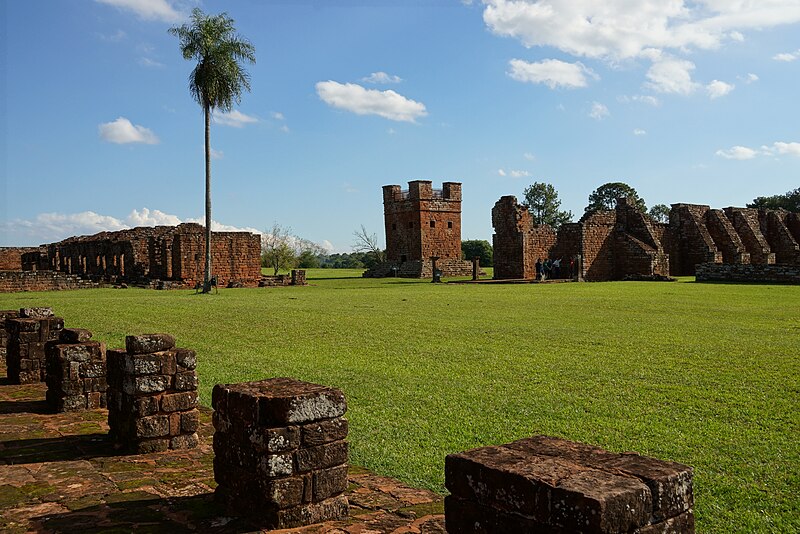
As the very last of the thirty Jesuit missions constructed across the Paraná River basin encompassing present-day Paraguay, Brazil, and Argentina, Trinidad stands out as the best preserved and most extensive reduction in the region. It functioned not only as a sacred religious refuge to introduce indigenous inhabitants to the Christian faith, but also as an entirely self-contained society operating outside regular Spanish colonial life. Within its carefully planned urban grid, the mission housed a vast central meeting square, a grand main church, a smaller secondary church, an impressive belfry and watchtower, a college with a cloister, family living quarters, agricultural gardens, and specialized artisan workshops.
Our guided walking route today will systematically uncover the rich daily life, artistic brilliance, and dramatic historical narrative embedded within these massive stone ruins. We will begin our journey at the vast central plaza, surrounded by continuous stone housing arcades built for Guaraní families. From there, we will approach the breathtaking main church nave, which once stood as the largest religious temple across all Jesuit missions in South America. Next, we will inspect the intricate stone pulpit assembled from over a thousand pieces, the legendary frieze of musical angels playing Baroque instruments, the ornate sacristy portals leading to a subterranean stone crypt, and the majestic freestanding square tower. Finally, we will conclude our tour at the site museum housed within the ancient sacristy.
As you walk through these ancient grounds, take time to appreciate the remarkable organic architecture and the master craftsmanship of the Guaraní stonecutters carved into the local red sandstone. Standing here at the threshold of this magnificent historical monument, let us now begin our exploration by stepping forward toward our first stop, the Main Plaza and Housing Arcades.
02 Spot 1: Main Plaza & Housing Arcades
Standing here at the Main Plaza, you are witnessing one of the most remarkable architectural turning points in the history of South American missions. The Italian Jesuit architect Giovanni Battista Primoli made the bold decision to completely abandon the traditional timber post and wooden framing constructions commonly used across the thirty regional missions. Instead, he designed and constructed the entire reduction using massive, meticulously hand-carved stone ashlars. …
03 Spot 2: Main Church Nave & Stone Walls
Stepping into the main church nave, visitors are immediately confronted by the extraordinary demographic and structural scale of this sacred space. Established in 1706, this reduction experienced remarkable growth, and by 1728 over three thousand Guaraní residents lived within the community. To accommodate this massive congregation, the Jesuits and Guaraní constructed what was the single largest church temple built across all thirty Jesuit missions in South America. …
04 Spot 3: Stone Pulpit & Musical Angels Frieze
As you reach the intricate stone sculptures surrounding the sanctuary, you encounter one of the most astonishing discoveries in South American art and music history. The relief frieze of musical angels carved along the altar wall was, prior to the discovery of written manuscript scores in Moxos, Bolivia, the single visual proof of the extraordinary sophistication of Baroque church music performed within the Jesuit reductions. …
05 Spot 4: Sacristy Portals & Stone Crypt
Reaching the center floor area near the altar, visitors encounter one of the most solemn, hidden secrets of the entire temple. Hidden right near the center of the church floor lies a subterranean stone crypt built specifically for burying primary Spanish religious leaders and Jesuit superiors who governed the reduction. Built directly beneath the sacred heart of the church nave, this underground chamber served as an exclusive, deeply reverent burial place. …
06 Spot 5: Belfry & Watchtower
Stepping into the outdoor grounds, visitors encounter one of the most distinctive freestanding structures in mission architecture. Rising in complete isolation at a deliberate distance from the main church, this massive square stone tower functioned not only as a traditional belfry but also as an elevated watchtower or atalaya protecting the entire reduction. …
07 Closing
Welcome to the site museum, housed within the remarkably preserved ancient sacristy and galleries of the main church. This museum contains the invaluable artistic and archaeological treasures recovered from La Santísima Trinidad de Paraná. Exhibited inside are indigenous ornamental stone carvings, sculpted fragments of saints, and elaborate architectural reliefs depicting local flora and fruits carved into sandstone by Guaraní stonemasons. …