 Photo Wikimedia Commons
Contents
History & cultureBY TELLBY8 sections · numbered as on the map01 Orientation
Welcome to the National Museum of India, located on the vibrant avenue of Janpath in New Delhi. I am honored to serve as your senior curator for this tour, guiding you through five thousand years of extraordinary artistic heritage. As you stand here in our magnificent central entrance lobby, take a moment to look around the lofty hall. You are positioned at the threshold of India's largest and most comprehensive cultural repository, home to more than two hundred thousand treasures spanning from the prehistoric Indus Valley civilization down to the modern era.
The visionary origins of this institution trace back to nineteen forty six, when the Gwyer Committee, led by Sir Maurice Gwyer, former Chief Justice of India and Vice Chancellor of Delhi University, first proposed the establishment of a national museum. Sir Mortimer Wheeler, then head of the Archaeological Survey of India, played an indispensable role by advocating for the unification of scattered site museums under a single national umbrella. The pivotal catalyst occurred during the winter months of nineteen forty seven and nineteen forty eight, when the Royal Academy of Arts hosted a landmark exhibition of Indian and Pakistani art at Burlington House in London. This British government sponsored exhibition elevated Indian artifacts to the status of high art on the global stage. Inspired by this triumph, Prime Minister Jawaharlal Nehru and key leaders resolved that upon their return, these irreplaceable masterpieces should be permanently retained for the enlightenment of the Indian public.
On August fifteen, nineteen forty nine, the museum was temporarily inaugurated inside the opulent state rooms of Rashtrapati Bhavan, then known as Government House, by Governor General C. Rajagopalachari. In nineteen fifty five, Prime Minister Jawaharlal Nehru laid the foundation stone at our present Janpath site, a premier plot originally reserved in Edwin Lutyens' urban master plan for an Imperial Museum. Designed by architect Ganesh Bikaji Deolalikar, the building was conceived as a multi phased octagonal structure radiating around a tranquil central garden court. Vice President Dr. Sarvepalli Radhakrishnan officially inaugurated this permanent building on December eighteen, nineteen sixty.
Dr. Grace Morley, our distinguished first director who previously founded the San Francisco Museum of Art, assumed leadership in August nineteen sixty and revolutionized our curatorial philosophy. Championing cultural democracy, she introduced modern display techniques including visual storage, sleek teakwood pedestals, directional track lighting, climate control, and staggered glass display cases. Her inclusion of comfortable couches and leafy plants created visual pauses, fostering an egalitarian environment where every visitor could engage intimately with art. Now, please follow my guidance as we step to the right of the lobby into our first destination, the Harappan Gallery.
02 Harappan Gallery
As you step through the entrance on the right into the Harappan Gallery, you arrive at the heart of an exhibition showcasing the Indus Valley civilization, which flourished between twenty seven hundred BC and twenty one hundred BC. Housing more than three thousand five hundred antiquities on permanent loan from the Archaeological Survey of India, this hall presents the world's most comprehensive collection of Harappan urban heritage. …
03 Maurya, Shunga and Satvahana Arts Gallery
As you step out of the Harappan Gallery and enter the Maurya, Shunga, and Satvahana Arts Gallery, you are welcomed into a space dedicated to ancient Indian stone sculpture from the fourth century BC to the first century BC. This gallery highlights masterworks produced during three monumental dynasties that shaped the foundational vocabulary of early Indian art. Stand near the center of the hall to take in the impressive array of carved sandstone monuments surrounding you. …
04 Kushana and Gupta Gallery
Step forward into the Kushana and Gupta Gallery, a transformative hall celebrating an evolutionary golden era in Indian art spanning from the first to the sixth century CE. This gallery highlights the dramatic visual shift when Indian artists began depicting deities in fully realized human forms, ultimately achieving the ultimate refinement of classical sculpture. Take a moment as you enter to admire how the surrounding figures balance physical grace with serene spiritual introspection. …
05 Bronze Gallery
Welcome to the Bronze Gallery, an extraordinary space showcasing the dynamic evolution and technical brilliance of Indian metal casting. Curated by Deputy Curator of Archaeology Shri Tejpal Singh, designed by Ms. Matrika of Mumbai, and executed by the Central Public Works Department, this gallery presents world renowned metal sculptures accompanied by detailed contextual displays explaining ancient lost wax production processes. …
06 Buddhist Artifacts Gallery
Welcome to the Buddhist Artifacts Gallery, a revered sanctuary housing the holy relics of Lord Buddha alongside an extraordinary collection of sacred art gathered from across Asia. As you step into this tranquil space, the dimmed reverent lighting and masterfully crafted icons evoke a profound atmosphere of spiritual devotion, inner peace, and universal compassion.
Please approach the enclosed central relic chamber situated in the middle of the hall. …
07 Miniature Paintings and Decorative Arts Gallery
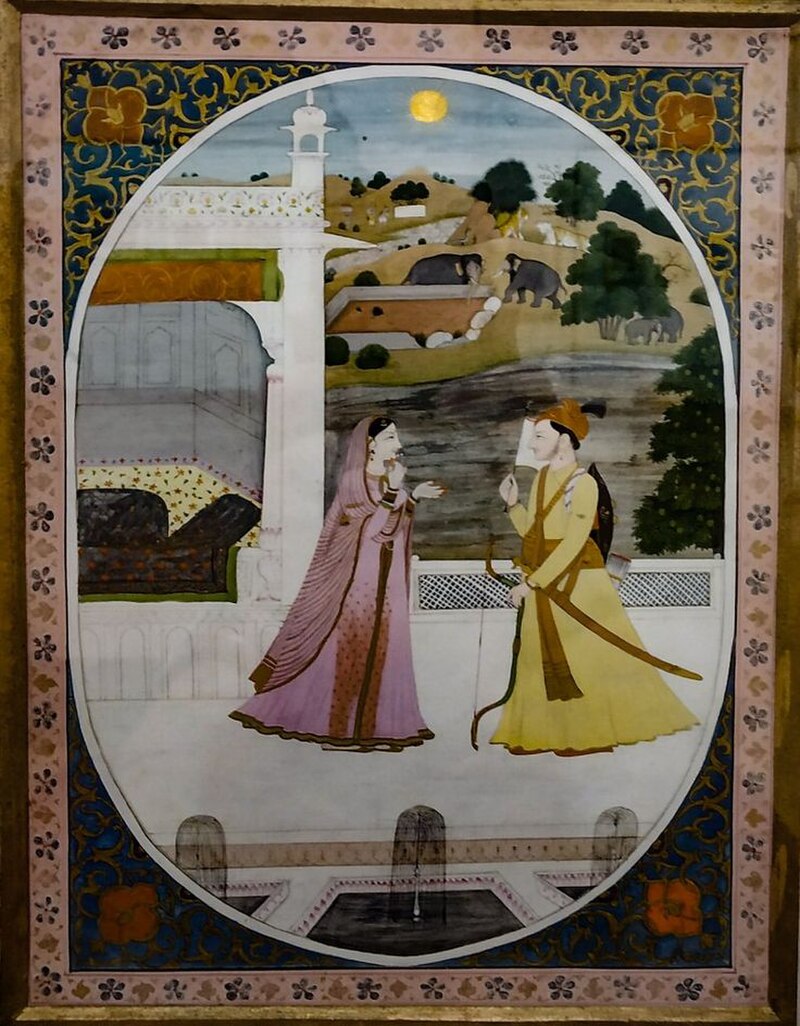
Welcome to the Miniature Paintings and Decorative Arts Gallery, a mesmerizing wing housing the world's largest collection of miniature paintings alongside exquisite luxury artifacts reflecting Indian royal and aristocratic lifestyle from the sixteenth to the twentieth centuries. As you step into this visually stunning hall, take a moment to admire how the luminous mineral pigments, carved ivory, and polished jade objects illuminate the rich courtly traditions of India. …
08 Closing
Stepping out from the exhibition galleries, welcome to the Central Garden Court, the peaceful heart of the National Museum in New Delhi. Enclosed by the radiating wings of the magnificent octagonal building designed by architect Ganesh Bikaji Deolalikar, this lush green courtyard offers a serene atmosphere to quietly reflect upon your journey through five thousand years of Indian cultural heritage. …