 Photo Wikimedia Commons
Contents
History & cultureBY TELLBY7 sections · numbered as on the map01 Orientation
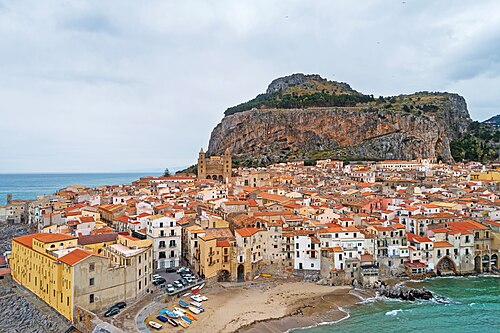
Welcome to Cefalù Cathedral, a magnificent architectural masterpiece standing proudly between the dramatic limestone cliff of La Rocca and the crystal-clear waters of the Mediterranean Sea on the northern coast of Sicily. I am your audio guide, and it is my absolute pleasure to accompany you through this extraordinary monument of medieval Mediterranean civilization. In twenty fifteen, Cefalù Cathedral was officially inscribed as a UNESCO World Heritage Site as an integral component of Arab-Norman Palermo and the Cathedral Churches of Cefalù and Monreale. Built during the golden era of the Norman Kingdom of Sicily in the twelfth century, this cathedral represents a brilliant synthesis of Western Latin, Islamic, and Byzantine traditions. During this remarkable period, Sicily was home to a vibrant, diverse population comprising Muslims, Byzantines, Latins, Jews, Lombards, and French immigrants. Under the visionary leadership of King Roger the Second, these varied cultural groups coexisted fruitfully, contributing their unique artistic techniques, structural engineering, and decorative concepts. The result was an entirely new spatial and aesthetic language that spread widely across the Mediterranean basin. The cathedral before you stands as a timeless testament to human harmony and creative cross-cultural collaboration. The lively public square where you are standing right now has long served as the heart of the community, a historic crossroads where merchants, pilgrims, and seafarers from distant lands gathered to exchange ideas and goods. As you look up at the soaring facade framed by the rugged cliff face behind it, you can feel the profound sense of majesty, spiritual peace, and artistic innovation that has endured for nearly nine centuries. The harmonious integration of diverse traditions visible here demonstrates how different cultures came together to build a shared sanctuary of monumental beauty. Cefalù was historically a vital maritime center, and the construction of this grand cathedral underscored both royal authority and divine protection over the realm. Every stone and archway reflects the collaborative devotion of medieval craftsmen who transcended cultural boundaries. Before we step closer to explore the detailed exterior features, take a moment to absorb the tranquil atmosphere of this historic square and admire the impressive outline of the cathedral against the Sicilian sky. When you are ready, let us shift our attention toward the imposing twin towers framing the entrance.
02 Spot 1 - Exterior Facade & Twin Towers
While a famous medieval legend tells us that King Roger the Second built this grand cathedral in fulfillment of a sacred vow after miraculously surviving a violent storm at sea and washing ashore at Cefalù, the historical reality reveals a far more calculated political motive: to display the absolute authority of the Norman kingdom, reinforce royal legitimacy, and establish a magnificent dynastic burial church on a Carolingian-Norman westwerk model. …
03 Spot 2 - Portico & Porta Regum
As you stand directly before the entrance, your eyes are immediately drawn to an elegant covered gallery spanning the space between the two massive towers, anchored by a magnificent marble doorway. This exquisite main entrance is not merely a simple passage into the cathedral, but rather a remarkably sophisticated architectural addition joined to the medieval facade in the fifteenth century by the master builder Ambrogio da Como from Lombardy. …
04 Spot 3 - Nave & Ancient Spolia Columns
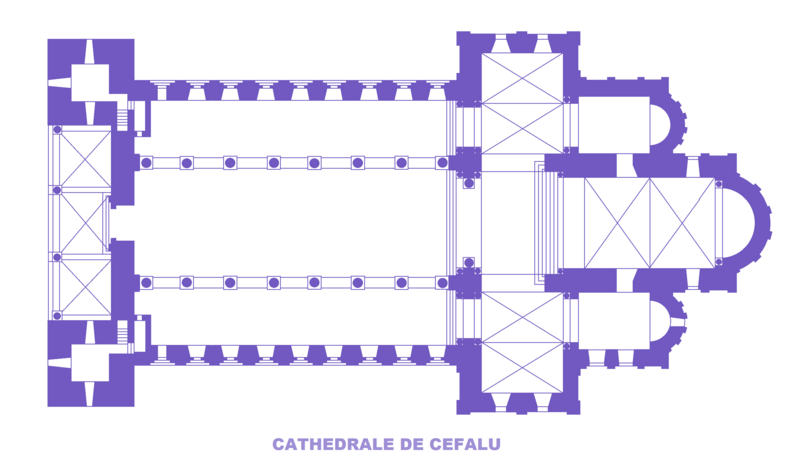
As you step inside the cathedral and look down the soaring central aisle, the rows of ancient stone columns supporting the nave tell an extraordinary story of historical reinvention. The sixteen monumental stone columns lining the central aisle were not newly quarried for this church, but are authentic spolia re-used directly from second-century AD Roman ruins. …
05 Spot 4 - Choir & Apse Mosaics
Fix your eyes upon the monumental bust of Christ that dominates the high apse dome, radiating a divine golden light through the sacred space. Covering an incredible total surface area of six hundred and thirty square meters, this mosaic masterpiece was brought to completion in eleven forty-eight by supreme Byzantine masters. The mosaicists executed this vast decorative program from the top of the apse vault downward, systematically lowering temporary wooden scaffolding step by step. …
06 Spot 5 - The Cloister
Stepping into the tranquil outdoor quadrangle attached to the cathedral's northern flank, you are immediately surrounded by rows of sculpted double columns topped with extraordinary capitals. The sculpted capitals resting atop the paired columns in this monastic cloister are ranked among the most refined and artistically significant achievements in all of medieval European Romanesque art. …
07 Closing
Thank you very much for joining us on this comprehensive audio guide tour of Cefalù Cathedral. As you step outside into the sunlit square and gaze up at the breathtaking relationship between the rugged cliff of La Rocca and the deep blue waters of the Mediterranean Sea, you can feel the profound weight of history and holy time that this monumental sanctuary has preserved for nearly nine hundred years. …