Contents
History & cultureBY TELLBY8 sections · numbered as on the map01 Orientation
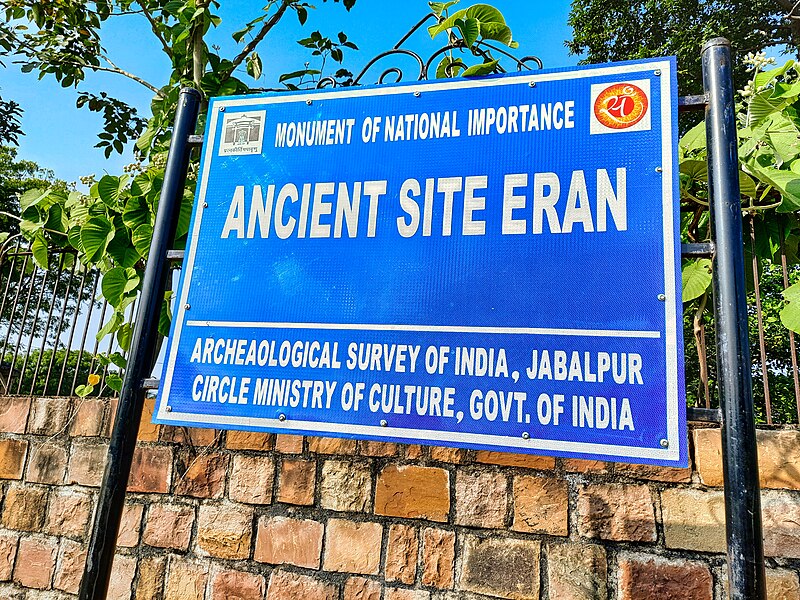
Welcome to the Eran Archaeological Complex, a magnificent ancient heritage site situated along the sweeping bends of the Bina River in the Sagar District of Madhya Pradesh. As you stand upon this historical peninsula, observe how the river forms a dramatic inverted U-shaped loop, enclosing the ancient town on three sides with its protective waters. In ancient India, such geographical formations were highly favored by settlement planners because the surrounding river and the elevated forested terrain to the south provided unbeatable natural fortification against invading forces.
The name Eran itself traces its etymological roots back to Eraka, a species of tall, lush grass known as Elephant cattail that flourishes abundantly along the banks of the Bina River. Alternative historical interpretations suggest that the name may also derive from Eraka meaning serpent, as reflected in the prominent snake imagery appearing on the ancient coins minted at this very site. Throughout history and across various epigraphs and coins, this grand settlement was recorded under several names including Erakaina, Erakanya, Airikina, Erikina, and Erakina. During the golden age of the Gupta Empire, the renowned emperor Samudragupta designated Eran as the administrative capital of Airkina Vishaya and affectionately bestowed upon it the romantic epithet Swabhoga-Nagar, meaning the Pleasure-Town, where the monarch himself frequently retreated to enjoy its serene natural beauty and strategic comfort.
Eran represents far more than a single moment frozen in time. It is a continuous tapestry of human civilization spanning several millennia. Archaeological excavations have unearthed a rich succession of cultural layers, beginning with the Neolithic tools dated around 2100 BCE and the vibrant Chalcolithic culture from 2000 BCE to 700 BCE, characterized by delicate microlith blades, painted pottery, and copper celts. Following these early eras, Eran flourished through the Early Historic period, growing under the governance of mighty regional and imperial dynasties including the Mauryas, Sungas, Satavahanas, Shakas, Nagas, Guptas, and Hunas, as well as the later Kalachuris, Chandelas, Parmaras, Mughals, Marathas, and Dangi rulers. In the third century BCE, the local inhabitants of Eran made celebrated contributions toward the construction of the Great Stupa at Sanchi. During the Gupta era, Eran reached its apex as a paramount military cantonment, a thriving mint city, and a vibrant center of artistic innovation. Let us now embark on a memorable journey through time across the sacred grounds of Eran.
02 The Buddhagupta Garuda Pillar: Monument of Devotion and Victory
Standing proudly exactly seventy-five feet in front of the primary temple line is one of the most celebrated structural marvels of ancient India: the Buddhagupta Garuda Pillar. Carved entirely out of a single monolithic block of red sandstone, this astounding column rises to a height of nearly forty-nine feet and rests upon a robust square stone platform measuring thirteen feet on each side. …
03 The Colossal Varaha Temple: The Cosmic Boar Narrative in Stone
Stepping directly behind the Buddhagupta Pillar, you come face-to-face with one of the most astonishing iconographic achievements in world art history: the Colossal Varaha Boar Statue. Rendered in glowing red sandstone, this massive sculpture measures approximately thirteen point eight feet in length, eleven point two feet in height, and five point one feet in width. …
04 The Vishnu Temple Ruins: Majestic Iconography and Classical Art
Located directly north of the Varaha shrine, the Vishnu Temple Ruins present the most complete structural layout and beautifully preserved entrance doorway in the entire Gupta complex at Eran. As you walk toward this shrine and observe its ground plan, notice how it was designed on a rectangular layout measuring thirty-two point five feet in length and thirteen point five feet in width, where the inner sanctum was fronted by a sturdy pillared portico. …
05 The Narasimha Temple Ruins: Sanctuary of the Man-Lion Avatar
Occupying the northernmost position within the main temple cluster at Eran are the evocative ruins of the Narasimha Temple. This sacred sanctuary was dedicated to Lord Vishnu's fourth incarnation, Narasimha—the fearsome half-man, half-lion avatar who manifested to defeat the tyrannical demon king Hiranyakashipu and protect his devout young follower, Prahlada. …
06 Inscription Pillars and Ancient Mint: Chronicles in Stone and Coin
The archaeological legacy of Eran is extraordinarily enriched by its foundational epigraphic records and its history as one of ancient India's paramount royal mints. Positioned near the site's eastern precinct is a small sandstone pillar originally erected around 350 CE during the reign of the Indo-Scythian Saka ruler King Sridharavarman, together with his Naga military commander. …
07 Dangi Fort Gate and River Ghats: Medieval Walls and Sacred Waters
As you walk away from the ancient temple complex and head toward the riverbank and village boundary, you transition into a fascinating later layer of Eran's multi-millennial history. Here stand the impressive stone remains of the Dangi Fort, constructed between 1700 and 1800 CE by the local Dangi rulers. …
08 Closing
As our journey through the Eran Archaeological Complex comes to a close, we stand in quiet reflection at the edge of the Bina River, enveloped by thousands of years of layered human civilization. From the prehistoric microlith blades and Neolithic stone axes recovered along Reta Ghat to the sophisticated die-struck coins of the ancient mint, and onto the sublime Gupta sculptures of Varaha, Vishnu, and Narasimha, Eran endures as an incomparable living museum of Indian history, spirituality, and…